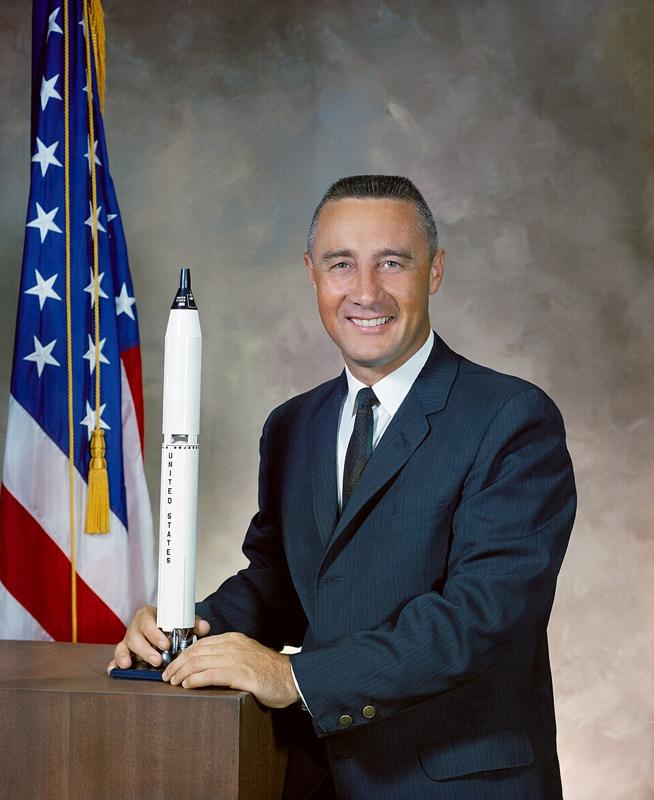
Gus Grissom
Born April 3, 1926, Mitchell, Indiana · Died January 27, 1967, Cape Kennedy (Launch Complex 34), Florida · Mitchell Lodge No. 228, Mitchell, IN
Gus Grissom, one of NASA’s original Mercury Seven, was the second American in space and lost his life in the Apollo 1 fire in 1967.
A Mitchell Boy Who Would Not Spend His Life Hanging Bus Doors
Virgil Ivan “Gus” Grissom was born on April 3, 1926, in Mitchell, Indiana, the eldest of four children of Dennis and Cecile Grissom. His father kept a job at the Baltimore and Ohio Railroad through the Depression, at twenty-four dollars a week. Gus was too short for high-school sports, led the Honor Guard in the local Boy Scout troop, delivered newspapers twice a day and picked peaches and cherries in the summer. He later wrote that he first met Betty Moore when she entered Mitchell High School as a freshman, “and that was it, period, exclamation point.” They married in July 1945.
He enlisted as an aviation cadet in his senior year, reported for duty in August 1944, and hoped to fly in combat, but Japan surrendered before he received flight training. After a series of desk jobs he was discharged in November 1945 and went to work at Carpenter’s Bus Body Works, installing doors on school buses. He did not intend to stay. With Betty working as a long-distance telephone operator and Gus flipping burgers about thirty hours a week, plus a grant under the G.I. Bill, he earned a bachelor’s degree in mechanical engineering from Purdue University in 1950. “She had made my degree possible,” he said of his wife.
A Hundred Missions in Korea, and a Secret Summons to Washington
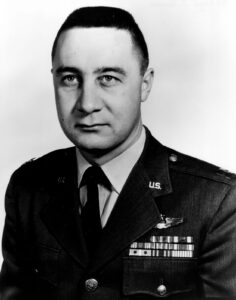
He re-enlisted, won his Air Force wings in March 1951 and, less than a year later, was sent to Korea with the 334th Fighter Interceptor Squadron. He flew a hundred combat missions in an F-86 Sabre that he named “Scotty,” after his first son, usually as a wingman, and later said that neither he nor the leaders he flew with were ever hit. He came home in 1952 with the Distinguished Flying Cross and the Air Medal with cluster and became a jet instructor at Bryan, Texas, work he found could be more dangerous than combat: “At least you know what a MiG is going to do.” A second son, Mark, was born in 1953. He studied aeronautical engineering at the Air Force Institute of Technology in 1955, went to test-pilot school at Edwards Air Force Base in 1956, and in May 1957 returned to Wright-Patterson as a fighter test pilot, “as happy,” he said, “as any pilot in the Air Force.” He logged about 4,600 flying hours, 3,500 of them in jets.
Then a classified teletype ordered him to an address in Washington, in civilian clothes. He was one of 110 military test pilots invited to learn about Project Mercury. Doctors nearly disqualified him for hay fever; he told them it would not matter, because “there won’t be any ragweed pollen in space.” In April 1959 the National Aeronautics and Space Administration selected him as one of the Mercury Seven. He moved the family to Langley Air Force Base in Virginia and, in the first year, spent 305 days away from home. On July 21, 1961, after Alan Shepard’s flight in May, Grissom piloted the second American crewed spaceflight.
Liberty Bell 7 and a Hatch That Blew Too Soon
He named the capsule Liberty Bell 7 because it looked like a bell. It had a larger window than Shepard’s spacecraft and a new explosive hatch, designed to blow clear when the pilot struck a plunger. After two weather postponements he lifted off on July 21. The flight lasted fifteen minutes and thirty-seven seconds, reached 118 miles and traveled 302 miles downrange. The attitude controls felt “sticky and sluggish,” but reentry was successful and the capsule landed in the Atlantic.
After splashdown he armed the hatch and waited for the recovery helicopter to lift the capsule slightly, so that water would not pour in when the hatch came off. “Suddenly,” he later wrote, “the hatch blew off with a dull thud.” Water flooded the cabin. He pulled himself out, became tangled in dye-marker lines, freed himself, and watched the helicopter try and fail to hold the waterlogged spacecraft, which was cut loose and sank. Air was leaking from an open inlet in his suit, and souvenirs stored in a leg pocket were dragging him down. He was pulled from the water and taken to the recovery ship USS Randolph.
Molly Brown, a Corned Beef Sandwich, and Three Orbits
Named to command the first crewed Gemini flight, and with Liberty Bell’s loss still on his mind, Grissom named the spacecraft Molly Brown, after the Broadway musical The Unsinkable Molly Brown. He had first considered Wapasha, after a Native American people of his home state, then dropped it when someone noted it would be nicknamed the Wabash Cannon Ball. When officials asked for a more formal name, he suggested the Titanic, and they let Molly Brown stand.
On March 23, 1965, he and John Young lifted off for a five-hour, three-orbit flight, the first time an American had flown in space twice. They changed the spacecraft’s path and made the first lifting reentry of a crewed capsule, maneuvers Grissom later said they carried out “almost exactly as planned.” Midway through, Young offered him a corned beef sandwich smuggled aboard; crumbs of rye floated in the cabin, and NASA later forbade such items on future flights. The capsule splashed down after about eighty thousand miles. President Lyndon Johnson presented both men with NASA’s Distinguished Service Medal. Grissom later served as backup command pilot for Gemini 6.
The First Apollo Crew, and a Price He Had Already Named
In 1966 NASA named Grissom, Edward White and Roger Chaffee as the crew of the first crewed Apollo mission, then designated AS-204 and planned for February 1967. A NASA history of the crew later recorded that Grissom had been told privately that if all went well he would be the first American to walk on the Moon. Just weeks before the scheduled flight he wrote, “There will be risks, as there are in any experimental program, and sooner or later, we’re going to run head-on into the law of averages and lose somebody. I hope this never happens, and… perhaps it never will, but if it does, I hope the American people won’t think it’s too high a price to pay for our space program.”
On January 27, 1967, at 5:31 p.m. Central Standard Time, during a simulated launch test at Cape Kennedy, fire swept the command module. Grissom, White and Chaffee died in a matter of seconds. He was later awarded the Congressional Space Medal of Honor and buried at Arlington National Cemetery, survived by Betty and their two sons.
Mitchell Lodge No. 228, and the Degrees He Took in Florida
Grissom was initiated in Mitchell Lodge No. 228, in his Indiana hometown, on February 10, 1949, passed on April 14 and raised a Master Mason on May 19, while he was still a Purdue student. On September 14, 1963, at a festival in Orlando, Florida, he received the York Rite degrees, and on September 25 he received the thirty-second degree in the Scottish Rite’s Valley of Orlando, Southern Jurisdiction. He also belonged to Brevard Commandery in Cocoa, Florida; to the Shrine, first at Bahia Temple and later at Arabia Temple in Houston; and to the Cape Canaveral Chapter of National Sojourners, a Masonic organization for current and former military officers, at Patrick Air Force Base. He was a life sponsor of the Knights Templar Eye Foundation.
How did Grissom’s work on Gemini III advance the pilot’s ability to control a spacecraft in orbit?
Sources
- National Aeronautics and Space Administration — Former Astronaut Virgil I. Grissom
- National Aeronautics and Space Administration — Virgil I. Grissom Biographical Data (PDF)
- National Aeronautics and Space Administration — Detailed Biographies of the Apollo 1 Crew
- National Aeronautics and Space Administration — Virgil I. “Gus” Grissom
- Gray Masonic Lodge No. 329 — Honoring a Brother (Gus Grissom)
- State of Indiana — Virgil I. “Gus” Grissom
Life & Masonic Timeline
NASA, via Wikimedia Commons · Public domain · Source