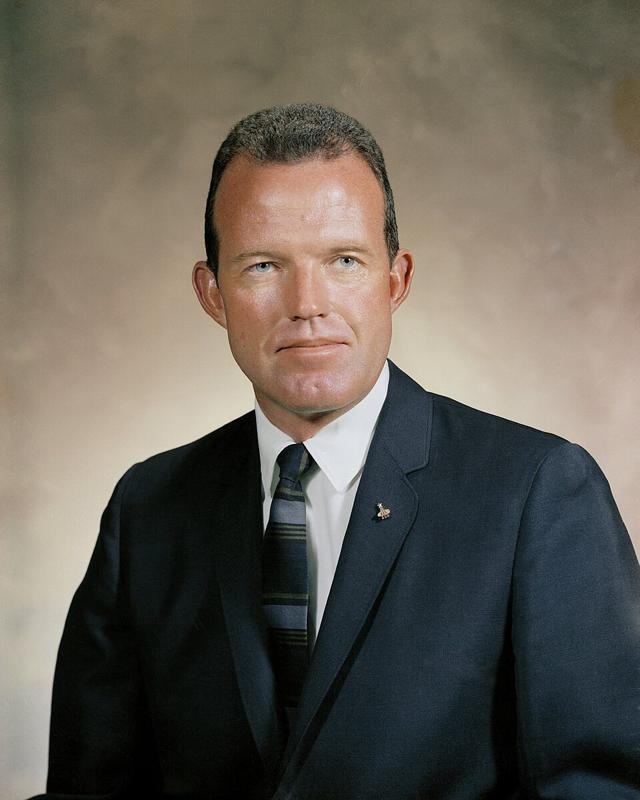
L. Gordon Cooper
Born March 6, 1927, Shawnee, Oklahoma · Died October 4, 2004, Ventura, California · Carbondale Lodge No. 82, Carbondale, Colorado
Gordon Cooper flew the final Mercury mission and commanded Gemini 5, helping establish that astronauts could live and work in orbit for days.
I had a lot of faith in all my hardware and my spacecraft, and I had a lot of faith in the launch team, I had faith in myself, and I had faith in God.
A Shawnee Test Pilot Among the Mercury Seven
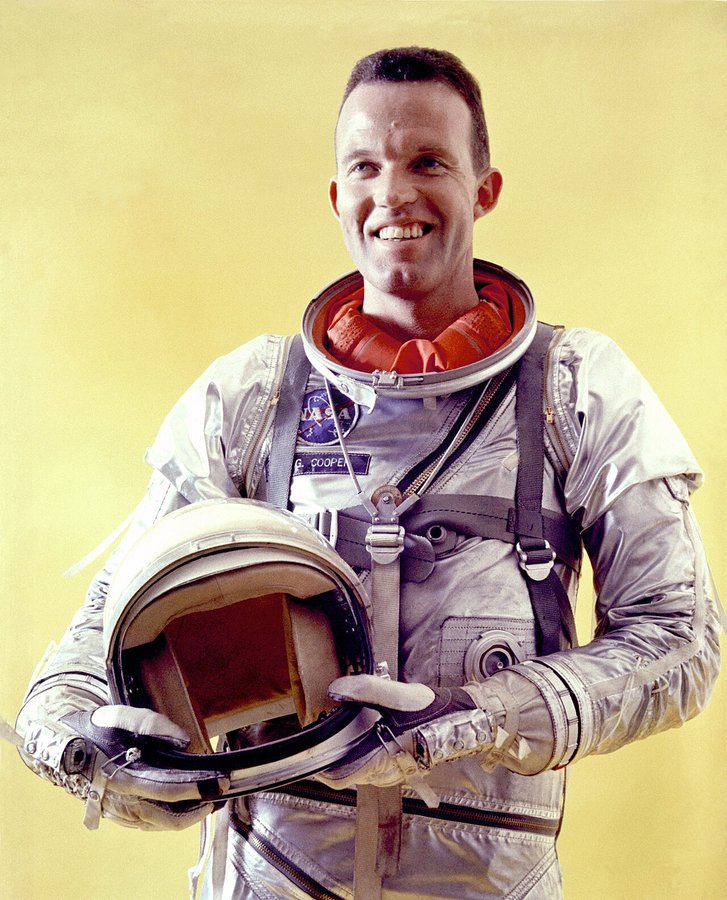
Leroy Gordon Cooper Jr. was born in Shawnee, Oklahoma, on March 6, 1927. He attended schools in Shawnee and in Murray, Kentucky, then completed three years of study at the University of Hawaii, after which he received an Army commission. He transferred that commission to the Air Force, went on active duty in 1949, and was given flight training. His next assignment was with the 86th Fighter Bomber Group in Munich, Germany, where he flew F-84s and F-86s for four years and also attended night classes of the University of Maryland’s European Extension. He returned to the United States, spent two years at the Air Force Institute of Technology, and in 1956 received a Bachelor of Science degree in aeronautical engineering. He then went to the Air Force Experimental Flight Test School at Edwards Air Force Base, California. After graduating in 1957 he was assigned as an aeronautical engineer and test pilot in the Flight Test Division there, flying experimental fighter aircraft. He later logged more than 7,000 hours of flying time, 4,000 of them in jets.
In 1959, while he was managing a number of test programs at Edwards, he was ordered to Washington, D.C., with no explanation. He later recalled that he did not even know a space program was coming. After a day of briefings on the new project, those who wished could sign up; those who did not could go home, no questions asked. He signed up, and in April 1959 he was selected as one of the original Mercury astronauts of the National Aeronautics and Space Administration.
Faith 7, Flown by Hand, and Eight Days on Gemini 5
On May 15–16, 1963, he piloted the spacecraft Faith 7 on a 22-orbit mission that concluded the operational phase of Project Mercury. The flight lasted 34 hours and 20 minutes, reached an altitude of 166 miles, a speed of 17,546 miles per hour, and traveled 546,167 miles. Asked how he chose the name, he said: “I had a lot of faith in all my hardware and my spacecraft, and I had a lot of faith in the launch team, I had faith in myself, and I had faith in God.”
The flight had been stretched from eighteen orbits to twenty-two after Walter Schirra’s success on Sigma 7, and the capsule was loaded with cameras; at a press conference that February Cooper called it “practically a flying camera.” The first launch attempt, on May 14, was scrubbed after he had spent six hours strapped in. Once in orbit he photographed the Ganges delta and the Himalayas, worked through eleven experiments, and on his seventeenth orbit sent down the first television pictures from an American crewed spacecraft. He also reported seeing vehicles on dirt roads, smoke from trains and the tops of houses, which many vision experts thought impossible from a hundred miles up.
The trouble began while he was out of radio contact. When he came back into range he realized, he later said, that he was “slowly but surely, having an electrical fire from my relays.” The inverters shorted, and he lost the spacecraft’s entire electrical system. As carbon dioxide rose in the cabin and in his suit, he reported in his usual understated way: “Things are beginning to stack up a little.” What remained were manual push-and-pull rods for the attitude jets, a view out the window for pitch, roll and yaw, and a wristwatch for timing. He had to fire the retrorockets by hand, fly the spacecraft through reentry, and deploy the drogue, the main parachute and the landing bag manually. He came down near the carrier U.S.S. Kearsarge, drifted about two miles, and was hoisted aboard; he stepped out of the capsule on the carrier’s deck. “That’s really what we’d been wanting to do all along,” he said of flying the ship by hand. “So, it just gave me the opportunity to do what we’d been wanting to do.”
In that single flight he logged more time in space than the other five Mercury flights combined. Within a week he had received the Distinguished Service Medal from President John F. Kennedy at the White House, addressed a joint session of Congress, and ridden through a New York ticker-tape parade that drew an estimated four and a half million people. On June 28 he and his wife, Trudy, flew their own plane home to Shawnee for the town’s welcome.
On August 21, 1965, he launched as command pilot of Gemini 5, with Charles Conrad as pilot. Their eight-day, 120-revolution mission set a new space-endurance record, traveling 3,312,993 miles in 190 hours and 56 minutes. Cooper became the first person to make a second orbital flight and, with that mission, gave the United States the lead in accumulated hours in space. He and Conrad also tried to read giant white rectangles laid out on tilled soil near Laredo, Texas, a ground-based eye chart; the tests showed that astronauts could indeed pick out roads, and ships with their wakes, from orbit. Gemini, he later explained, was in essence an enlarged Mercury: a two-pilot crew, systems moved into an adapter section to reduce noise and free room for fuel cells and a propulsion system, and a chance to test the maneuvers needed for later rendezvous on the way to the Moon. He later served as backup command pilot for Gemini 12 and backup commander for Apollo 10, and retired from the Air Force and from the space agency in 1970, as a colonel. His decorations included the Air Force Distinguished Flying Cross, the NASA Distinguished Service Medal, the Collier Trophy and the Harmon Trophy.
Engines, a Consulting Firm, and Carbondale Lodge No. 82
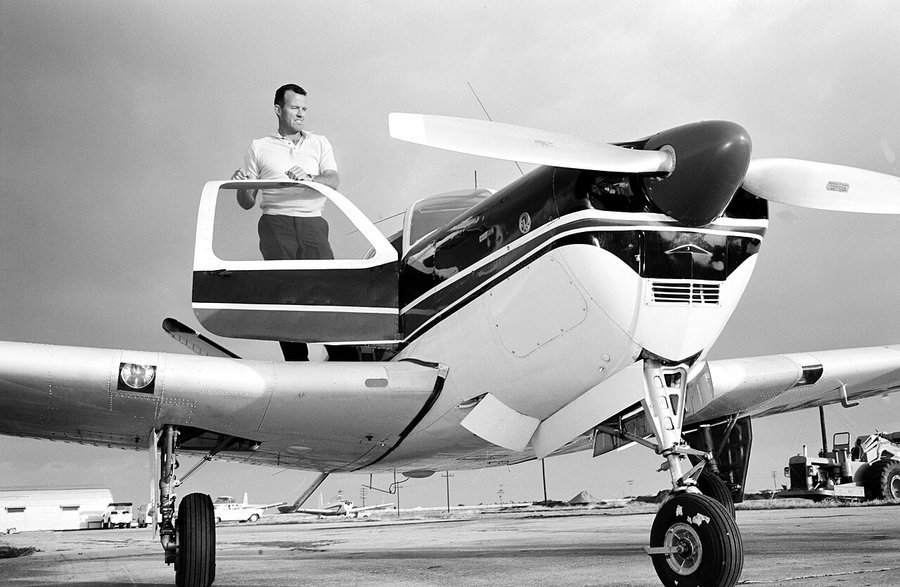
Alongside the spaceflights he ran companies that built race and marine engines, designed and raced championship cars at Indianapolis, conducted tire tests for Firestone, and worked on telemetry and on turbine engines in cars. After leaving government service he headed the consulting firm Gordon Cooper & Associates, whose projects ranged from aviation and aerospace to land and hotel development. From January 1973 to 1975 he was vice president for research and development, including work related to EPCOT, at Walter E. Disney Enterprises, the research subsidiary of Walt Disney Productions. He died at his home in Ventura, California, on October 4, 2004, at the age of seventy-seven.
Cooper was a member of Carbondale Lodge No. 82, in Carbondale, Colorado. He was active in the Blue Lodge, the York Rite and the Scottish Rite, and his honors included the Scottish Rite’s thirty-third degree, the York Rite Knight of the Purple Cross, and the DeMolay Legion of Honor.
What does Cooper’s manual return from orbit reveal about the pilot’s role in early spaceflight?
Sources
- National Aeronautics and Space Administration — Leroy Gordon Cooper, Jr.
- National Aeronautics and Space Administration — L. Gordon Cooper Jr. Oral History, May 21, 1998
- Grand Lodge of British Columbia and Yukon — Freemasons in Space
- National Aeronautics and Space Administration — Cooper’s Faith 7 Mission Closes Out Project Mercury
- National Aeronautics and Space Administration — The View from Above: The Gemini Visual Acuity Experiments
Life & Masonic Timeline
NASA, via Wikimedia Commons · Public domain · Source