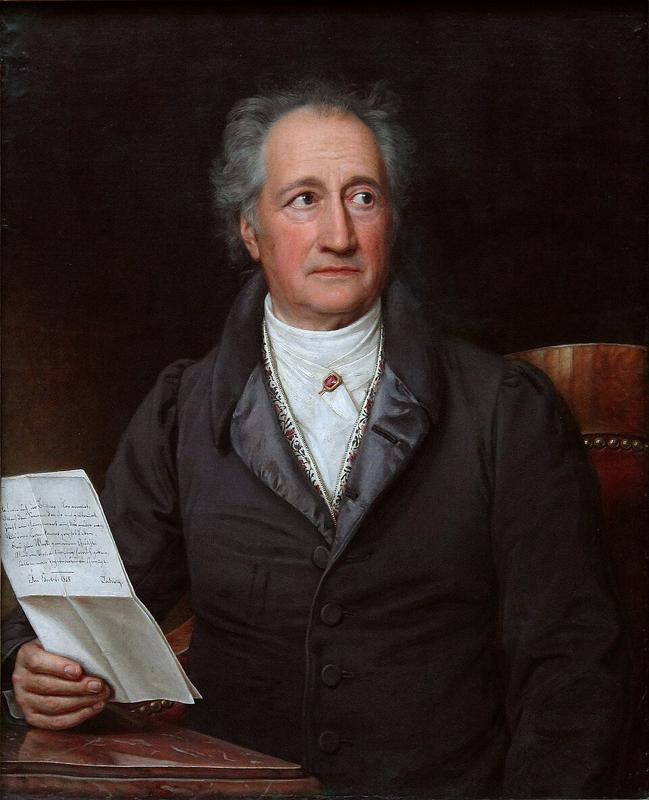
Johann Wolfgang Von Goethe
Born August 28, 1749, Frankfurt am Main · Died March 22, 1832, Weimar · Lodge Amalia, Weimar
Johann Wolfgang von Goethe wrote Faust and The Sorrows of Young Werther while pursuing a long career in science, theater and government in Weimar.
The Mason's ways are / A type of Existence
A Frankfurt Boyhood Shaped by His Father’s Plan
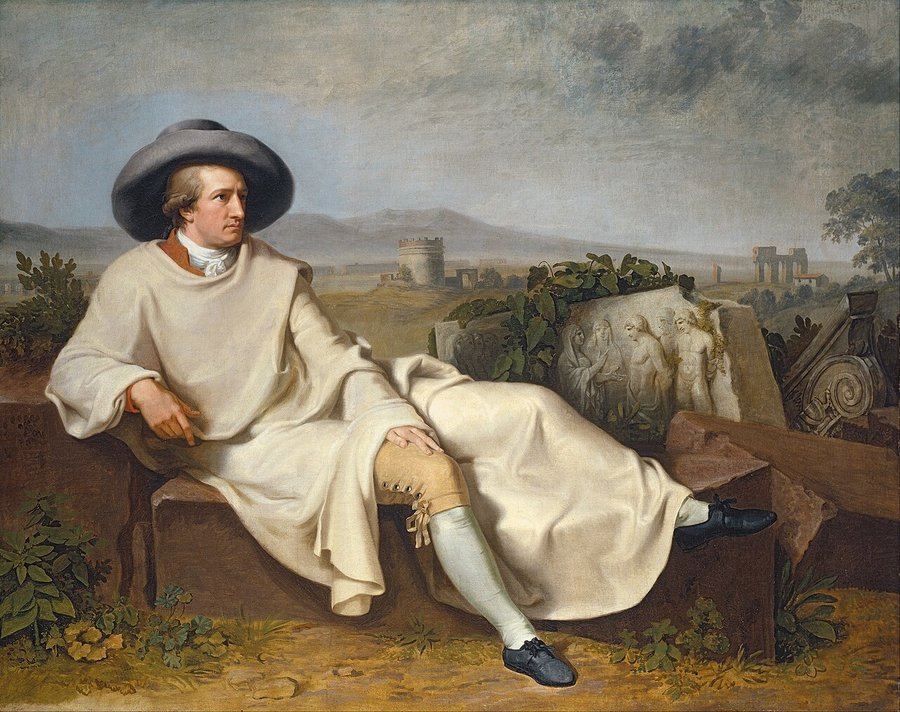
Goethe was born in Frankfurt in 1749, the eldest of seven children, of whom only he and his sister Cornelia survived into adulthood. His father, Johann Caspar Goethe, held the title of imperial councilor but lived on an inherited fortune, collecting books and paintings and directing his children’s education himself. His mother, Catharina Elisabeth Textor, was the daughter of Frankfurt’s most senior official. Goethe and his sister were taught at home by tutors until he was sixteen.
His father intended him to follow his own path: law at Leipzig, practice at the imperial supreme court in Wetzlar, then a grand tour of Italy. Goethe entered Leipzig University in 1765 and, alongside law, studied drawing with Adam Friedrich Oeser and wrote poetry, including the collection Annette. A serious illness in 1768 sent him home without a degree and kept him convalescing for many months, during which he wrote the Leipzig Songbook, a series of ten poems set to melodies, studied alchemy, and may already have conceived a play about Faust. After further legal study in Strasbourg, he became famous across Europe with The Sorrows of Young Werther in 1774.
Goethe moved to Weimar in 1775 at the invitation of the young Duke Carl August and spent decades in the duchy’s service, with responsibilities that came to include its mines and its court theater. He also pursued serious scientific work and in 1786 left for Italy, a journey that renewed his poetry and produced the Roman Elegies.
The House on the Frauenplan and the Long Labor of Faust
In 1782 Goethe moved into the house on the Frauenplan where he lived and worked for almost fifty years. He redesigned rooms according to classical ideals and assembled collections of art and scientific specimens. He also conducted botanical experiments in its garden. His son August was born in 1789 to Christiane Vulpius, whom Goethe formally married in October 1806, after Napoleon’s army had sacked Weimar.
Goethe published the narrative poem Hermann and Dorothea in 1797. The first part of Faust followed in 1808. Its scholar, dissatisfied with the limits of learning and experience, enters a bargain with the devil. Goethe drew on Christian, medieval and classical traditions in reworking the older legend.
He completed the second part of Faust late in life but withheld it from immediate publication. His daughter-in-law Ottilie discussed the work with him, and he read it to her in January 1832. The manuscript involved several scribes, with Goethe making revisions. He arranged with Johann Peter Eckermann for publication after his death.
Goethe died in Weimar on March 22, 1832. Eckermann and Friedrich Wilhelm Riemer prepared the first printed edition of Faust’s second part that year. Its surviving manuscript comprises 188 leaves.
A Privy Councilor Asks to Become a Brother
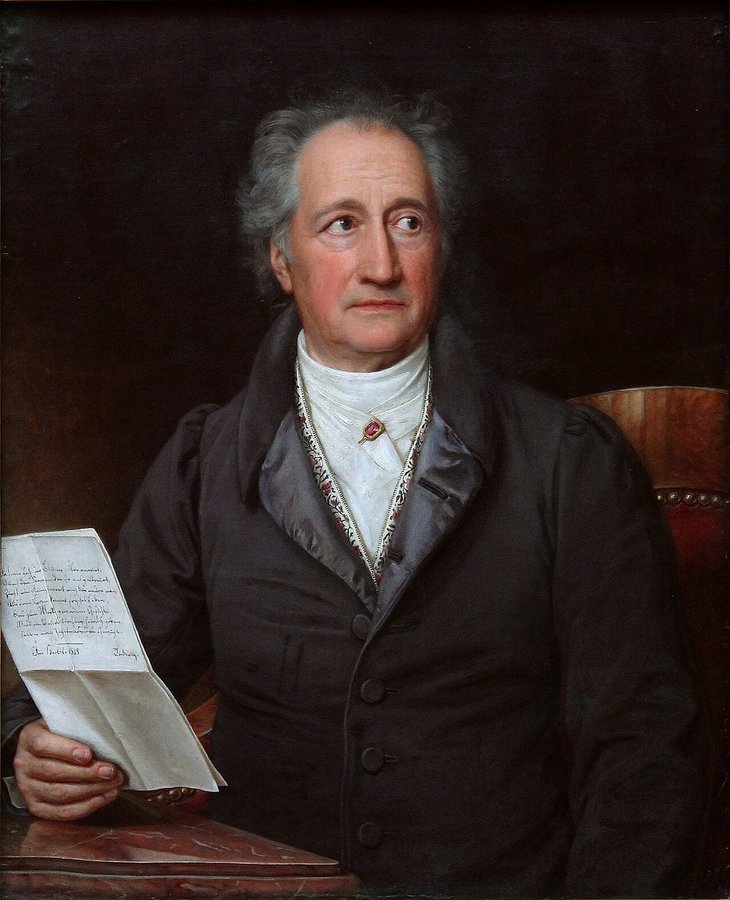
Weimar’s lodge, Amalia, had been founded on October 24, 1764, the birthday of the Duchess Anna Amalia for whom it was named. Goethe’s interest grew during his Swiss journey of 1779 with the duke, and early in 1780 he wrote to the lodge’s Master, Baron Jakob Friedrich von Fritsch, who was also his senior colleague in government. He had long wished to belong to the Freemasons, he explained; the only thing he had lacked was the title that would let him come closer to men he had learned to respect, and that sociable feeling alone was what moved him to ask.
No brother objected, and Goethe was initiated on June 23, 1780, the eve of the lodge’s Saint John’s Day festival, with Johann Joachim Christoph Bode presiding. In the minutes the candidate appears simply as “Joh. Wolfgang Goethe, 30 years old, of the Lutheran religion, born in Frankfurt am Main,” serving the ducal house as privy councilor. In March 1781 he wrote asking whether he might in time be advanced to the Master’s degree, so that his brothers would no longer have to treat him as a stranger. He was passed to Fellowcraft on June 23, 1781, exactly a year after his initiation.
On February 5, 1782, Duke Carl August himself was initiated in the lodge. On March 2 the duke received the second and third degrees, and in the same meeting Goethe and the anatomist Justus Christian Loder were raised Master Masons. Later that year disputes over the direction of German Freemasonry led the lodge to suspend its meetings, and it stayed dark for a quarter of a century.
Reviving Lodge Amalia and Mourning Wieland
In 1808 Carl August entrusted Goethe and the publisher Friedrich Justin Bertuch with bringing the lodge back to life. Goethe cast his vote for Bertuch as Master, and the lodge reopened on October 24, 1808, its forty-fourth anniversary, in the Wittumspalais, the late duchess’s palace. Goethe sent apologies that evening, writing that he would not want to seem indifferent for a moment “to so dear and significant a connection.” In April 1809 the poet Christoph Martin Wieland, then seventy-six, joined the lodge with Goethe present.
By 1812 the burden of office kept Goethe from regular attendance, and he asked the Master to treat him as an absent member rather than set a bad example. He stayed close to the lodge all the same, and its more important speeches and songs were often shown to him first. When Wieland died in January 1813, Goethe wrote and delivered the memorial address at the lodge’s funeral observance on February 18, 1813, published that year as Wieland’s Andenken in der Loge Amalia.
In November 1814 Goethe returned to the lodge to see the raising of Colonel Caspar von Geismar, a Russian officer who had protected Weimar during the fighting of October 1813. That evening is thought to have inspired his poem Symbolum, which compares the Mason’s path to the course of a life. Thomas Carlyle later translated it into English, opening with the line “The Mason’s ways are a type of Existence.” On December 5, 1815, Goethe’s son August was initiated on his father’s recommendation, and August long served as the link between his father and the lodge.
On June 23, 1830, the fiftieth anniversary of his initiation, the lodge sent a deputation and presented Goethe with a diploma of honorary membership. Too unwell to receive the brothers in person, he accepted it with evident joy and sent a poem of thanks, “Dem würdigen Bruderfeste,” which begins “Fifty years are now gone by” and was read aloud the next day at the lodge’s Saint John’s Day banquet.
Goethe asked to join so that he could come closer to men he respected, and fifty years later he was still writing poems for them. What first drew you to your own lodge, and what has kept you there?
Sources
- Hugo Wernekke, Goethe und die königliche Kunst (Leipzig, 1905), via the Warburg Institute
- Anna Amalia zu den drei Rosen, Weimar, “Geschichte” and “Logenbrüder”
- Encyclopaedia Britannica — Johann Wolfgang von Goethe
- Poetry Foundation — Johann Wolfgang von Goethe
- Klassik Stiftung Weimar — “Faust II” im Pappelholzschrank
- Klassik Stiftung Weimar — Goethe Residence
- Thomas Carlyle, Past and Present (1843), Project Gutenberg
- Grand Lodge of British Columbia and Yukon — Goethe
Life & Masonic Timeline
Joseph Karl Stieler, via Wikimedia Commons · Public domain · Source