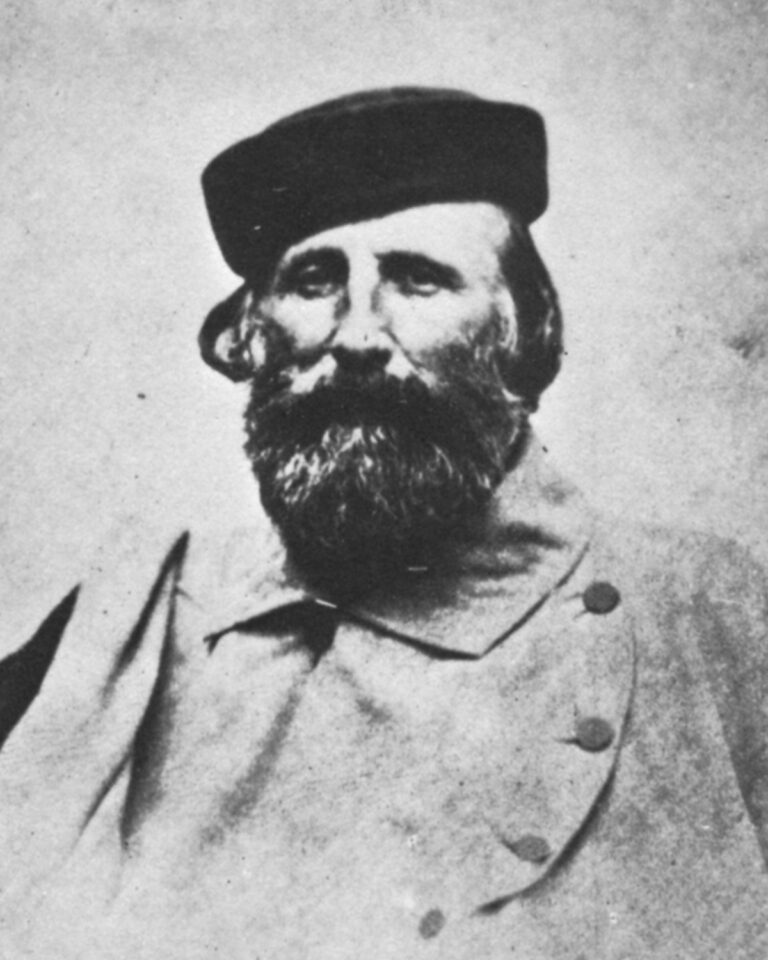
Giuseppe Garibaldi
Born July 4, 1807, Nice · Died June 2, 1882, Caprera, Italy · Loge Les Amis de la Patrie, Uruguay (regularized 1844); earlier Asilo de la Virtud, Montevideo
Giuseppe Garibaldi led volunteer armies in the struggle for Italian unification and became one of the founders of the modern Italian state.
From a Merchant Captain of Nice to the Red Shirts of Montevideo
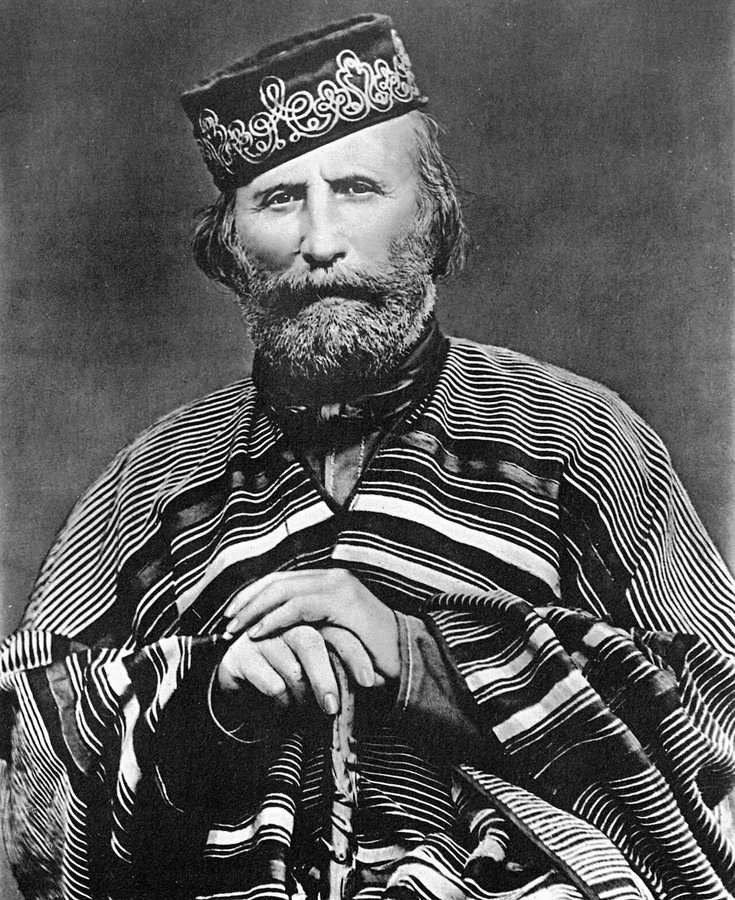
Giuseppe Garibaldi was born in Nice on July 4, 1807, the second son of Domenico Garibaldi and Rosa Raimondi. Drawn to the sea, he started as a cabin boy on the brigantine Costanza, then sailed with his father and other shipowners to the eastern Mediterranean and the Black Sea, and in 1832 he earned certification as a merchant captain. He was in command of his own ship in 1833 when, in an inn at Taganrog on the Black Sea, G. B. Cuneo of Oneglia told him about Giuseppe Mazzini’s movement. Garibaldi later said he had been “initiated” into the “sublime mysteries of the fatherland,” and he joined Mazzini’s Young Italy.
Under the assumed name Cleombroto he signed on as a common sailor aboard the frigate Des Geneys, to help a rising meant to support a Mazzinian expedition into Savoy. The plot failed in February 1834. He fled to Marseilles, where he learned that he had been sentenced to death on June 3. After a voyage to the Black Sea and service in the flotilla of the Bey of Tunis, he left Marseilles in 1835 as second in command of a brigantine bound for Rio de Janeiro, arriving around the turn of the year. In Rio he joined other Italian exiles at meetings of Young Italy, and with his friend Rossetti he took up privateering for the breakaway state of Rio Grande do Sul against Brazil, later commanding its fleet.
In South America he met Anna Maria Ribeiro da Silva, known as Anita, who became his wife and fought beside him. Early in 1842 the two withdrew to Montevideo, where he fought for Fructuoso Rivera against Manuel Oribe, who was backed by the Argentine dictator Juan Manuel de Rosas. On August 15, 1842, the Argentine fleet forced his flotilla ashore near Nueva Cava. Given a new flotilla, in 1843 he called on the Italians of Montevideo and formed the Italian Legion. Its black flag represented Italy in mourning, with a volcano at the center for the dormant power of the homeland, and it was there that the legion first wore the red shirts later associated with his volunteers. Victories at Cerro and at San Antonio del Salto in 1846 helped secure Uruguay’s liberty and made him a hero in Italy and Europe.
Rome, the Expedition of the Thousand, and a Meeting at Teano
News of revolution in Palermo persuaded him to sail for home on April 12, 1848, with part of the legion. At Gibraltar he learned that the King of Sardinia was preparing to fight Austria, and he decided to land at Nice, where, to the surprise of his Mazzinian comrades, he declared that he was “not a republican, but an Italian.” The Piedmontese government received him coldly. Leading a band of volunteers, he fought at Luino on August 15, took Varese, held out at Morazzone on August 26, and then, pressed by much larger Austrian forces, withdrew into Switzerland. Late that year he offered his sword to the Roman Republic. Kept at a distance at first, and elected by Macerata to its Constituent Assembly, he was finally called to Rome for its last defense against a French force sent by Louis Napoleon. The city fell on June 30, 1849.
Garibaldi slipped the encirclement, reached San Marino on July 31, and set out for Venice, which was still holding out. Austrian ships forced him ashore at Magnavacca, and in the pursuit that followed Anita, pregnant with their fifth child, died on August 4. He accepted expulsion from Piedmont and began a second exile, first as the guest of the Piedmontese consul at Tangier, where he began his memoirs, then in New York, living on Staten Island with Antonio Meucci in the house that is now the Garibaldi-Meucci Museum and working in a candle factory. He went back to sea in Central America and sailed between Peru, China and Australia. In the mid-1850s he returned to Italy and bought part of the island of Caprera, north of Sardinia, where he built a home.
Won over by the realism of the Sardinian government, he met Camillo di Cavour, its prime minister, in secret on August 13, 1856, and then declared publicly that Italian unity should rest on the monarchy. On March 2, 1859, on the eve of war with Austria, he met Cavour again to agree on the organization of volunteers, and on that occasion met King Victor Emmanuel II. Made a general, he led the Cacciatori delle Alpi (Hunters of the Alps), defeated the Austrian general Urban near Varese on May 26 and at San Fermo the next day, and entered Brescia in triumph on June 13. He was angered when Nice, his birthplace, was ceded to France in return for military assistance, and in April 1860 he publicly attacked Cavour for the cession.
That same month news of a revolt in Palermo gave him an opening. With at least the tacit consent of the government, he led about a thousand volunteers, later known as I Mille (the Thousand) or the Red Shirts, out of Quarto on the night of May 5, 1860. They landed at Marsala on May 11, and local rebels joined them. After a victory at Calatafimi in mid-May he took Palermo on May 27, won at Milazzo on July 20, crossed the Strait of Messina on August 19 and entered Naples on September 7, declaring himself dictator of the Two Sicilies. After the decisive battle of the Volturno on October 1–2, he met Victor Emmanuel at Teano on October 26. On November 7 he rode into Naples beside the king; the next day he handed him the results of the plebiscite, and on November 9 he left for Caprera, refusing promotion and every reward.
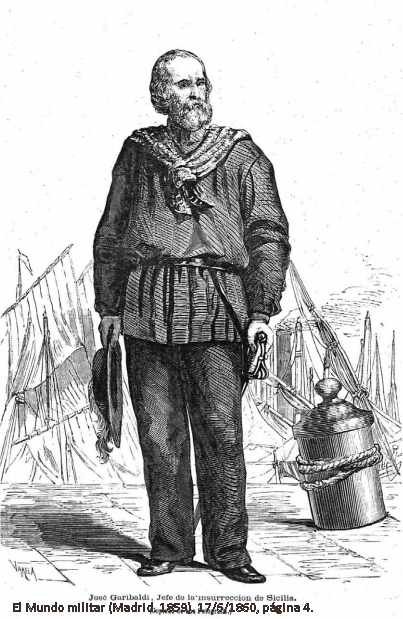
Abraham Lincoln offered him a command in the Union Army during the American Civil War, but nothing came of it. After Cavour’s death in 1861, revolutionaries looked to Garibaldi again. Following a failed attempt to invade the Trentino in May 1862, he went to Palermo, issued a proclamation against France, and under the slogan “Roma o Morte” (“Rome or Death”) marched on Rome against the Italian government’s wishes. In late August, at Aspromonte, he forbade his men to fire on fellow subjects of the kingdom, and he was shot in the foot and taken prisoner by Italian soldiers. He was held in honorable imprisonment at Varignano and underwent an operation. After an amnesty, in March 1864 he left Caprera for London, where he met Mazzini, the Russian exile Alexander Herzen and the prime minister, Lord Palmerston, and saw for himself how extraordinary his popularity had become.
Obbedisco, Mentana, and the Last Years on Caprera
In 1866, in the war against Austria, he again commanded the volunteers, led them into the Trentino, won at Monte Suello on July 3 and at Bezzecca on July 21, and, when ordered to halt his advance on Trento, answered with a telegram: “Obbedisco” (“I obey”). Venetia passed to Italy, and Rome seemed to him more urgent than ever. On September 24, 1867, Italian soldiers stopped him at Sinalunga as he organized an expedition against the city and returned him to Caprera. He slipped past the watching fleet, crossed the papal border with volunteers on October 23, and at Mentana on November 3 was driven back by French and papal troops. Arrested, he was shipped back to Caprera on November 25, virtually a prisoner.
He left the island only to fight for France in 1870–1871, winning at Dijon in January 1871. In 1874 he was elected a deputy for Rome. In his last years he leaned toward a humanitarian socialism and joined the International. He revised the memoirs he had begun at Tangier, adding a version in blank verse, wrote three novels between 1869 and 1874, Clelia, Cantoni il volontario and I Mille, and wrote poetry in Italian and French. He died at Caprera on June 2, 1882.
Montevideo Lodges and the Title “First Freemason of Italy”
Garibaldi was initiated in 1844 in Logia Asilo de la Virtud in Montevideo, a lodge regarded as irregular, and his membership was regularized on August 8 of that year in Loge Les Amis de la Patrie in Uruguay. In December 1861 the Grand Orient of Italy voted him the title “First Freemason of Italy.” On March 11, 1862, its Supreme Council named him Sovereign Grand Commander and Grand Master, an office he resigned on July 7, 1868. He never joined a lodge in Italy and took no direct interest in the work of the Craft. He saw Freemasonry as a network that could unite progressive men as brothers, and above all as a political force, and he was frustrated that he could not use it as one.
Why did Garibaldi surrender his command at Teano rather than keep power in the south?
Sources
- Garibaldi-Meucci Museum — Giuseppe Garibaldi
- Encyclopedia.com — Giuseppe Garibaldi
- Treccani — Garibaldi, Giuseppe
- Grand Lodge of British Columbia and Yukon — Giuseppe Garibaldi (Ars Quatuor Coronatorum, volume 102)
Life & Masonic Timeline
Giuseppe Garibaldi, 1870. Nadar. via Wikimedia Commons, cropped · Public domain · Source