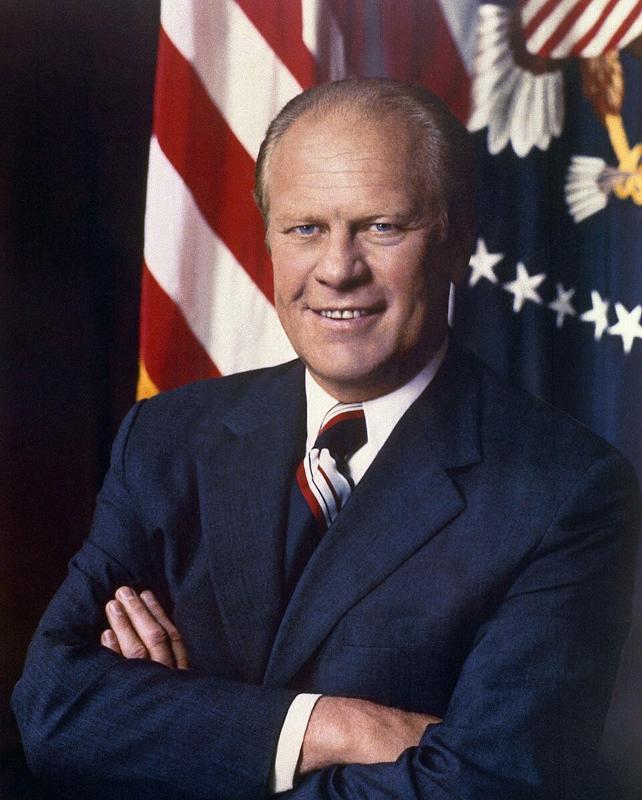
Gerald R. Ford
Born July 14, 1913, Omaha, Nebraska · Died December 26, 2006, Rancho Mirage, California · Malta Lodge No. 465, Grand Rapids, MI (passed and raised by courtesy in Columbia Lodge No. 3, Washington, D.C.)
Gerald R. Ford steadied the presidency after Watergate and remains the only president never elected to either the presidency or the vice presidency.
I believe that truth is the glue that holds government together, not only our Government but civilization itself.
From Leslie King to Grand Rapids and the House
Gerald Rudolph Ford Jr. was born Leslie Lynch King Jr. in Omaha, Nebraska, on July 14, 1913. His parents separated two weeks after his birth. His mother, Dorothy Ayer Gardner, later married Gerald R. Ford, a Grand Rapids paint salesman. The family called the boy Gerald Ford Jr.; the name was legally changed on December 3, 1935. He grew up with three younger half-brothers — Thomas, Richard and James — became an Eagle Scout in 1927, and graduated from South High School in Grand Rapids in 1931.
At the University of Michigan he majored in economics, played center on the Wolverines’ national-championship football teams of 1932 and 1933, and was named the team’s most valuable player in 1934. After graduating in 1935 he declined offers from the Detroit Lions and the Green Bay Packers and went to Yale as boxing coach and assistant football coach, earning a law degree in 1941. In 1934, when Georgia Tech refused to play if Willis Ward, a Black teammate and close friend, took the field, Ford threatened to quit; at Ward’s urging he agreed to play. After Pearl Harbor he joined the Naval Reserve in April 1942 and served on the light carrier U.S.S. Monterey in the Pacific, including at the Battle of the Philippine Sea, and was discharged as a lieutenant commander in February 1946.
Back in Grand Rapids he practiced law and, with encouragement from his stepfather and Senator Arthur Vandenberg, won a 1948 Republican primary against an isolationist incumbent, then the House seat, with 61 percent of the vote. On October 15 of that year he married Elizabeth (Betty) Ann Bloomer; they had four children, Michael, John (Jack), Steven and Susan. He represented Michigan’s Fifth District from January 3, 1949, to December 6, 1973, sat on the Appropriations Committee, and in 1963 was appointed to the Warren Commission investigating President Kennedy’s assassination. In January 1965 he became House Minority Leader. He later described himself as “a moderate in domestic affairs, a conservative in fiscal affairs, and a dyed-in-the-wool internationalist in foreign affairs.”
A Vice President by Amendment, and a Pardon
After Vice President Spiro Agnew resigned in 1973, President Nixon nominated Ford under the Twenty-fifth Amendment, which provides for filling a vacancy in the vice presidency. Ford became the first vice president confirmed under that amendment, taking the oath on December 6, 1973. When Nixon resigned on August 8, 1974, Ford took the presidential oath the next day — the only person to hold the office without having been elected president or vice president. “Our long national nightmare is over,” he said.
On September 8, 1974, exactly one month later, he granted Nixon a “full, free, and absolute pardon” for offenses Nixon had committed, or might have committed, as president. He believed that prolonged proceedings would keep the country mired in Watergate. Public reaction was largely negative, and his first press secretary resigned in protest. On October 17 he appeared before a House subcommittee — the first sitting president to testify before a congressional committee of inquiry since Abraham Lincoln — and said, “There was no deal, period, under no circumstances.” In December 1974 Congress confirmed his vice-presidential nominee, former New York governor Nelson Rockefeller.
Helsinki, Saigon, and a Narrow Defeat
Ford continued negotiations with the Soviet Union and in August 1975 signed the Helsinki Accords with Leonid Brezhnev and the leaders of more than thirty other nations. His administration used American aid to help Israel and Egypt accept an interim agreement. At home, fearing inflation, he vetoed thirty-nine measures in his first fourteen months, most of which Congress did not overturn. In late April 1975, as South Vietnam collapsed, he ordered the evacuation of Americans and of South Vietnamese with ties to the United States; his administration oversaw the admission of tens of thousands of Vietnamese refugees. On May 14 he ordered forces to retake the merchant ship S.S. Mayaguez, seized by Cambodian gunboats; the ship and all 39 crewmen were recovered, though 41 Americans died in the operation. On two trips to California in September 1975 he was the target of assassination attempts, by Lynette “Squeaky” Fromme and by Sara Jane Moore.
After a primary challenge from Ronald Reagan, Ford won the Republican nomination and lost a close election to Jimmy Carter. He left office in January 1977. At the inaugural, Carter said, “For myself and for our nation, I want to thank my predecessor for all he has done to heal our land.” The Fords retired to Rancho Mirage, California. Betty Ford later obtained treatment for drug and alcohol problems and, after her recovery, opened the Betty Ford Center. Ford died at home on December 26, 2006, at the age of 93, and was interred at the Gerald R. Ford Presidential Museum in Grand Rapids.
Malta Lodge No. 465 — Four Brothers on One Night
On September 30, 1949, Ford was initiated in Malta Lodge No. 465 at the Grand Rapids Masonic Center on Fulton Street, together with his half-brothers Thomas Gardner Ford, Richard Addison Ford and James Francis Ford. Columbia Lodge No. 3 in Washington, D.C., conferred the Fellowcraft and Master Mason degrees as a courtesy on April 20 and May 18, 1951. Malta later merged into Doric Lodge No. 342. He joined the Scottish Rite, Valley of Grand Rapids, in 1957 and received the Thirty-third Degree of the Northern Masonic Jurisdiction on September 26, 1962, at the Academy of Music in Philadelphia, serving as exemplar for his class. He was also a Shriner of Saladin Temple. From the sources we do have, it is believed that he received DeMolay’s Legion of Honor in 1968. As president he was unanimously elected an Active Member of the International Supreme Council of the Order of DeMolay, and its Honorary Grand Master, at its annual session in Orlando, Florida, in April 1975. He held that post until January 1977 and received his collar and jewel as a Past Honorary Grand Master on October 24, 1978, in Topeka, Kansas. On January 11, 1977, near the end of his term, York Rite chapter and council degrees were conferred in a special Oval Office ceremony.
“When I took my obligation as a master mason — incidentally, with my three younger brothers — I recalled the value my own father attached to that order,” he said in 1975. “But I had no idea that I would ever be added to the company of the Father of our Country and 12 other members of the order who also served as Presidents of the United States.” He remains the most recent President known to have been a Freemason.
How did Ford’s pardon of Nixon shape the public’s trust in his effort to move beyond Watergate?
Sources
- White House Historical Association — Gerald R. Ford
- Gerald R. Ford Presidential Library and Museum — Biography of Gerald R. Ford
- Miller Center — Gerald Ford: Life in Brief, by John Robert Greene
- Miller Center — Gerald Ford: Life Before the Presidency
- Miller Center — Gerald Ford: Foreign Affairs
- Grand Rapids Masonic Center — Gerald R. Ford Masonic record
- Scottish Rite, Northern Masonic Jurisdiction — Gerald Ford, Freemason
Life & Masonic Timeline
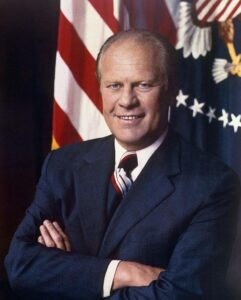
David Hume Kennerly, via Wikimedia Commons · Public domain · Source