
George Washington
Born February 22, 1732 · Died December 14, 1799 · Fredericksburg Lodge No. 4
So far as I am acquainted with the principles & Doctrines of Free Masonry, I conceive it to be founded in benevolence and to be exercised only for the good of mankind.
A surveyor who learned from defeat
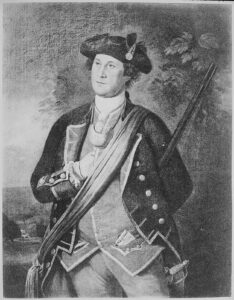
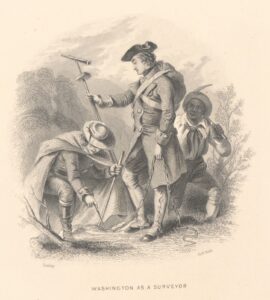
George Washington was born on February 22, 1732, on his family’s plantation at Popes Creek in Westmoreland County, Virginia. His father, Augustine, was a leading local planter and a justice of the county court. George’s schooling was practical rather than classical. Along with reading, writing and basic legal forms, he studied geometry and trigonometry to prepare for his first career as a surveyor. He also studied manners, which Mount Vernon’s historians say shaped his character and conduct for the rest of his life. In 1749 he was commissioned as surveyor for the newly formed Culpeper County, and the work taught him to live on the frontier.
His first military command ended in humiliation. In 1754 the French surrounded his small fort in the Ohio Country, and the campaign helped ignite the French and Indian War. He resigned his commission, but he went back to the frontier in 1755 as a volunteer aide to General Edward Braddock and was there when Braddock’s army was routed near the Monongahela. He learned from defeat early, and he learned it in public.
Two decades later he took command of the Continental Army and held it together for eight years of war, until the victory at Yorktown in 1781. Then he did something without precedent. On December 23, 1783, he appeared before Congress at Annapolis and resigned his commission. Mount Vernon’s biography compares him to Cincinnatus, the Roman hero whose conduct he most admired: Washington “had the wisdom to give up power when he could have been crowned a king.” He went home intending never to serve in public life again.
He did serve again. He presided over the Constitutional Convention in 1787 and became the first President in 1789. During a general European war in 1793, he judged that the young republic’s interest lay in neutrality, because war would wreck its commerce and finances. Keeping the country out of that war is counted among his most important achievements. His Farewell Address set out what he believed the nation would need in order to last. After two terms he retired to Mount Vernon, where he died on December 14, 1799.
Power held in trust
Washington’s greatest gift may be the habit he modeled: power held in trust and handed back. A republic depends on leaders who are willing to step down, and he showed it twice, in 1783 and again in 1797.
An honest account also has to include slavery. Slavery was part of Washington’s life from an early age, and Virginia’s economy depended on the forced labor of enslaved Africans and their descendants. Mount Vernon’s historians write that his views changed over time. Economic and moral concerns led him to question slavery after the Revolution, though he never lobbied publicly for abolition. “Unable to extricate himself from slavery during his lifetime,” he freed the 123 enslaved people he owned outright in his will. The 153 “dower” slaves held through Martha Washington’s first husband’s estate were not his to free. That record does not cancel his greatness, and his greatness does not excuse it. Both belong in the story.
A Brother from Fredericksburg
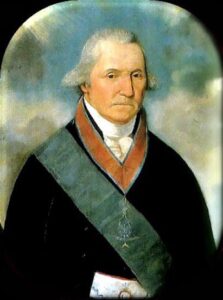
Washington joined the Lodge at Fredericksburg, Virginia, at age 20. He received the first degree on November 4, 1752, paying the lodge two pounds and three shillings. He was passed to the second degree on March 3, 1753, ten days after turning 21, and raised a Master Mason on August 4, 1753. The surviving minute book records him at only two more meetings, on September 1, 1753, and January 4, 1755, before his duties took him away. His mother lodge became Fredericksburg Lodge No. 4 under the Grand Lodge of Virginia, and it still meets today. The lodge’s own history says he remained a member until his death.
From 1778 until the end of his life, Washington often took part in Masonic gatherings. In 1779 he attended American Union Lodge, made up of soldiers from the Connecticut regiments, for its Feast of St. John the Baptist. In 1784 his neighbors at Alexandria Lodge No. 39 elected him an honorary member. Four years later he agreed to serve as charter master when the lodge moved under the Grand Lodge of Virginia. After his death it was renamed Alexandria-Washington Lodge No. 22. His most public Masonic act came on September 18, 1793, when he presided over the ceremonial laying of the United States Capitol cornerstone, acting as grand master pro tem. At his funeral in 1799, his brothers of Alexandria Lodge performed Masonic rites.
Mount Vernon’s historians add an important caution. Individual Freemasons took part in the Revolution, but the fraternity as an institution, and its lodges, stayed politically neutral. Washington’s story is not proof that the Craft made a nation. It is the story of a man who valued what the Craft valued: self-command, duty and a lifelong effort to improve his own conduct. Those are working tools any of us can pick up.
Brothers in the winter camps
You will often hear that nearly all of Washington’s generals were Freemasons. The record is more modest, and more interesting. The careful count comes from Ronald E. Heaton’s study for the Masonic Service Association. As Mount Vernon’s research files summarize it, Heaton found 33 generals of the Continental Army, and eight of Washington’s military aides, who were Masons. That is a substantial share, but it is not “all,” and larger claims go beyond what the records show.
Some of those brothers came from Washington’s own mother lodge. Mount Vernon notes that men from the Lodge at Fredericksburg, including Hugh Mercer and George Weedon, later served in the Continental Army. Mercer and Weedon both rose to general. Lafayette was a Mason too. The Grand Lodge of British Columbia and Yukon notes that his name appears among visiting brethren at a Paris lodge in December 1775, before he ever sailed for America. The old stories of his being made a Mason at Valley Forge or Morristown rest on tradition, not records.
Did Washington pick officers because they were brothers? Nothing in the record says so. He chose men for ability, experience and the needs of the army, and Mount Vernon’s historians stress that the fraternity as an institution stayed out of politics. What the Craft offered was common ground among men from different colonies.
They did sit in lodge together. In December 1778 Washington joined the Grand Lodge of Pennsylvania’s St. John’s Day celebration in Philadelphia. On June 24, 1779, he attended American Union Lodge, a lodge of Connecticut soldiers, for the Feast of St. John the Baptist. On December 27, 1779, in the hard winter at Morristown, he sat with the same lodge, listed first among the visitors. General Mordecai Gist and Colonel Otho Holland Williams were also present. That evening the lodge took up a petition asking for one Grand Master over all thirteen states. Washington was not formally nominated, and the idea came to nothing, but it shows officers who had learned to work together in the field now hoping to bring the same harmony to the Craft.
Washington’s most admired act may have been walking away from power. When have you seen someone in your lodge or community earn more respect by stepping aside than by holding on?
Sources
- George Washington’s Mount Vernon, Biography of George Washington
- George Washington’s Mount Vernon, Digital Encyclopedia: Freemasonry
- Fredericksburg Masonic Lodge No. 4, History
- George Washington’s Mount Vernon, George Washington & Freemasonry (Mary Thompson research file, citing Ronald E. Heaton)
- George Washington Masonic National Memorial, Washington Attends a St. John the Evangelist’s Day Celebration, 1779
- Grand Lodge of British Columbia and Yukon, Gilbert Lafayette
- George Washington’s Mount Vernon, Digital Encyclopedia: Hugh Mercer
- George Washington’s Mount Vernon, Digital Encyclopedia: George Weedon
Life & Masonic Timeline
