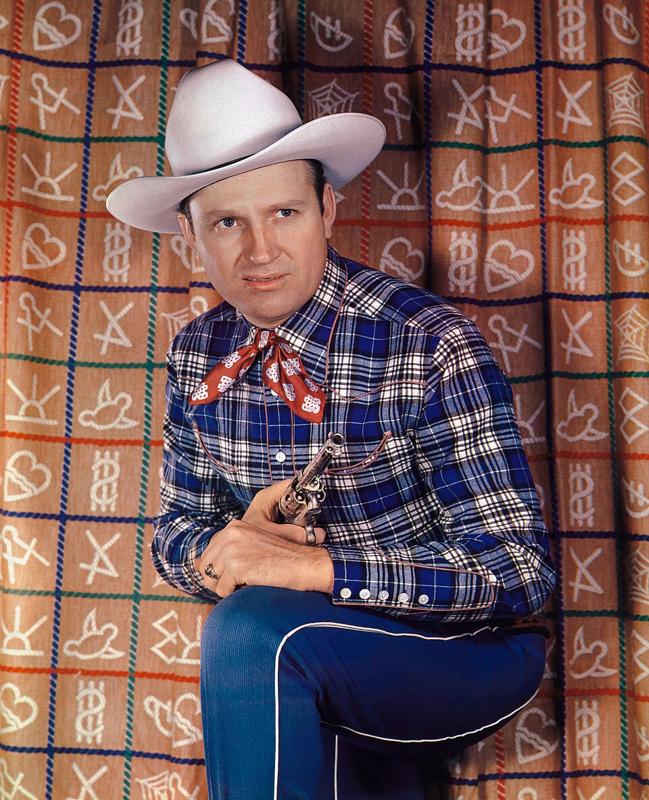
Gene Autry
Born September 29, 1907, Tioga, Texas · Died October 2, 1998, Studio City, Los Angeles, California · Catoosa Lodge No. 185, Catoosa, Oklahoma
Gene Autry defined the singing cowboy on film, radio and television, gave children his Cowboy Code, and recorded Christmas songs heard every December.
From a Tioga Telegraph Office to “Oklahoma’s Yodeling Cowboy”
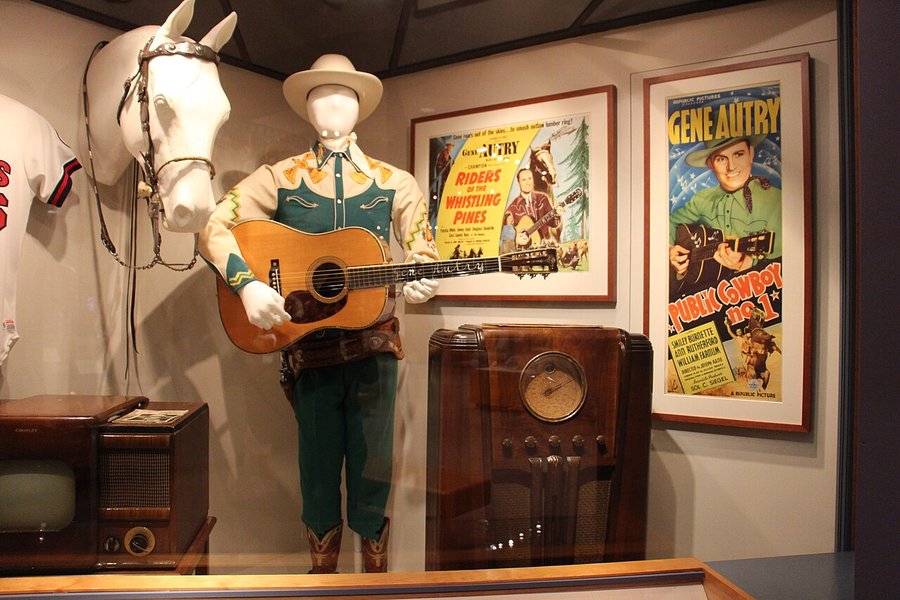
Orvon Gene Autry was born in Tioga, Texas, on September 29, 1907, the first child of the cattle rancher Delbert Autry, and was raised in Texas and Oklahoma. The family later moved to Ravia, Oklahoma. At five he sang in the church choir where his grandfather was a minister; at twelve he took guitar lessons from his mother on an instrument ordered from a Sears catalog. As a young man he worked as a telegraph operator for the Frisco Railroad in Chelsea, Oklahoma. One evening in 1927, Will Rogers overheard him singing and playing guitar during his shift and suggested he try radio work in New York. Autry went, did not yet establish a career there, and returned to Oklahoma, where Tulsa station KVOO billed him as “Oklahoma’s Yodeling Cowboy.”
He signed with Columbia Records in 1929 and soon appeared on the National Barn Dance for station WLS in Chicago. Two years later he recorded “That Silver-Haired Daddy of Mine,” which the Texas State Historical Association records as a million-selling hit and part of the first album to be certified gold. In 1932 he married Ina Spivey, a schoolteacher from Oklahoma. He first appeared on screen in 1934, in the Western In Old Santa Fe, starring Ken Maynard, and the next year played the lead in Tumbling Tumbleweeds. He went on to star in 93 feature films, popularizing the musical Western through 1953. In 1940, theater exhibitors voted him the fourth biggest box-office attraction, behind Mickey Rooney, Clark Gable, and Spencer Tracy.
Melody Ranch, a Flight Officer’s Wings, and the Cowboy Code
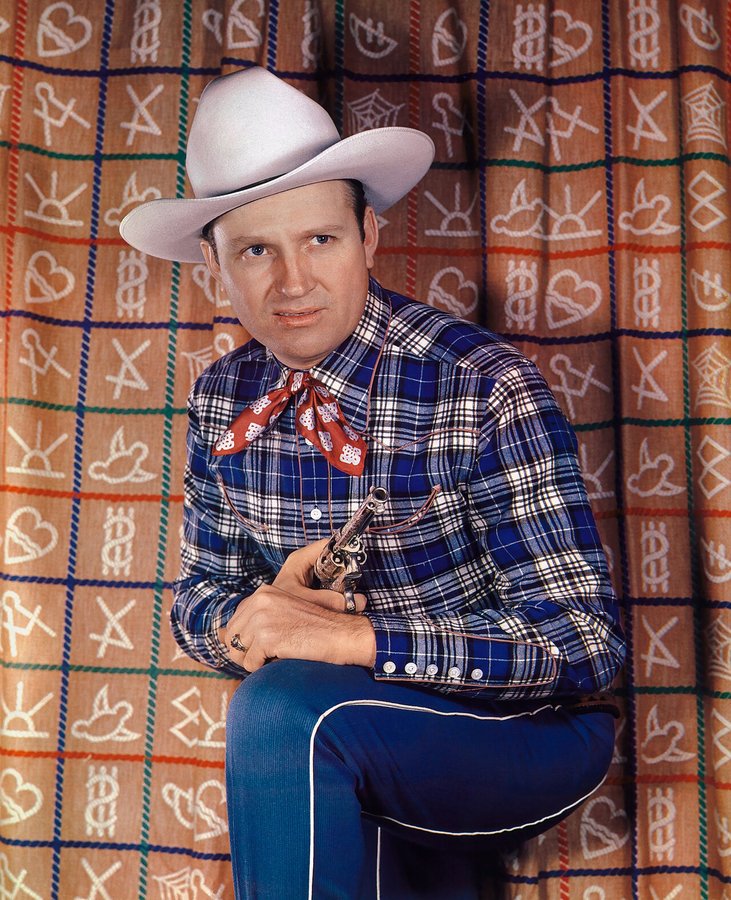
From 1940 to 1956, audiences heard him weekly on Gene Autry’s Melody Ranch over the CBS Radio Network, with “Back in the Saddle Again” as its theme. He made 640 recordings, including more than 300 songs he wrote or co-wrote; his records sold more than 100 million copies. He was the first performer to sell out Madison Square Garden, and on tour he often did two shows a day, seven days a week, for 65 to 85 days at a stretch. His Christmas recordings included “Here Comes Santa Claus (Right Down Santa Claus Lane)” and “Peter Cottontail,” both among his platinum records, and “Rudolph the Red-Nosed Reindeer,” which his official biography calls the second-best-selling Christmas single of all time, with more than 30 million copies sold. “Frosty the Snow Man” followed in 1950.
On July 26, 1942, at the Pentagon’s request, he was sworn into the Army Air Forces as a technical sergeant during a live broadcast of Melody Ranch, and within a week the program became the Sgt. Gene Autry show, often broadcast before audiences of soldiers at Luke Field in Arizona. He already held a private pilot’s license, and he set out to earn his wings. On June 21, 1944, at Love Field in Dallas, he received his service pilot wings and was made a flight officer with the 91st Ferrying Squadron of the Air Transport Command. He flew cargo aircraft, among them the C-109, a converted Liberator bomber that hauled fuel over the Himalayan route known as the Hump into the China–Burma–India theater. On his trip there, the plane he was co-piloting turned back from a typhoon and landed at Gander, Newfoundland, with one engine out and little fuel left; the crew waited out two weeks of fog and then finished the mission. After the war he was reassigned to Special Services and toured with a United Service Organizations troupe in the South Pacific before resuming films in 1946.
His pictures and radio dramas always had him doing the right thing, and in the late 1940s that habit hardened into a creed. As early as August 1947 he was voicing cowboy rules on Melody Ranch, and his publicists turned them into ten “Cowboy Commandments” that fan magazines printed as they evolved. The cowboy must never shoot first, hit a smaller man, or take unfair advantage. He must never go back on his word. He must be gentle with children, the elderly, and animals, must not hold racially or religiously intolerant ideas, must help people in distress, and must respect women, parents, and his nation’s laws. The last commandment was the shortest: “The Cowboy is a patriot.”
Flying a, the Angels, and a Museum of the West
In 1950 he became the first major motion-picture star to use television as a principal medium. Through Flying A Pictures he produced and starred in 91 half-hour episodes of The Gene Autry Show for CBS, and went on to produce Annie Oakley, The Range Rider, Buffalo Bill Jr., The Adventures of Champion, and the first 39 episodes of Death Valley Days. Under the Golden West Broadcasters banner he owned stations including KMPC radio and KTLA television in Los Angeles. His love of baseball led him in 1960 to acquire the American League’s new Los Angeles Angels franchise, which began play in 1961 and later became the California Angels; he served as vice president of the American League until his death.
The Gene Autry Western Heritage Museum opened in November 1988. After later mergers, including a 2004 affiliation that created the Autry National Center, the institution became, in 2015, the Autry Museum of the American West. After Ina’s death, Autry married Jackie Ellam in 1981; together they helped support the museum. He is the only entertainer with stars in all five Hollywood Walk of Fame categories—radio, recording, motion pictures, television, and live performance. He was inducted into the Country Music Hall of Fame, the Nashville Songwriters Hall of Fame, the National Cowboy Hall of Fame, and the National Association of Broadcasters Hall of Fame, and received a lifetime achievement award from the American Society of Composers, Authors and Publishers. In 1978 he published his autobiography, also titled Back in the Saddle Again. In 1995 he sold 25 percent of the baseball franchise to the Disney Corporation. He died at his home in Studio City, California, on October 2, 1998, at the age of 91.
Raised in Catoosa Lodge No. 185 Before the Fame Arrived
Autry was raised a Master Mason in 1927 in Catoosa Lodge No. 185, in Catoosa, Oklahoma, the same year Will Rogers heard him singing in a railroad telegraph office, and years before the films that made him nationally known. He went on in the Scottish Rite to the 33rd degree as an Honorary Inspector General, and he received the Grand Cross of the Court of Honor. His gravestone records that he was a 33rd degree Mason.
How did Autry’s museum work broaden the story of the West beyond the cowboy he played?
Sources
- Gene Autry Official Website — Gene’s Biography
- Texas State Historical Association — Autry, Orvon Gene
- Grand Lodge of British Columbia and Yukon — Gene Autry
- Gene Autry Official Website — Flight Officer Gene Autry
- Gene Autry Official Website — Gene Autry’s Cowboy Code History
Life & Masonic Timeline
Harry Warnecke / Robert F. Cranston, via Wikimedia Commons · Public domain · Source