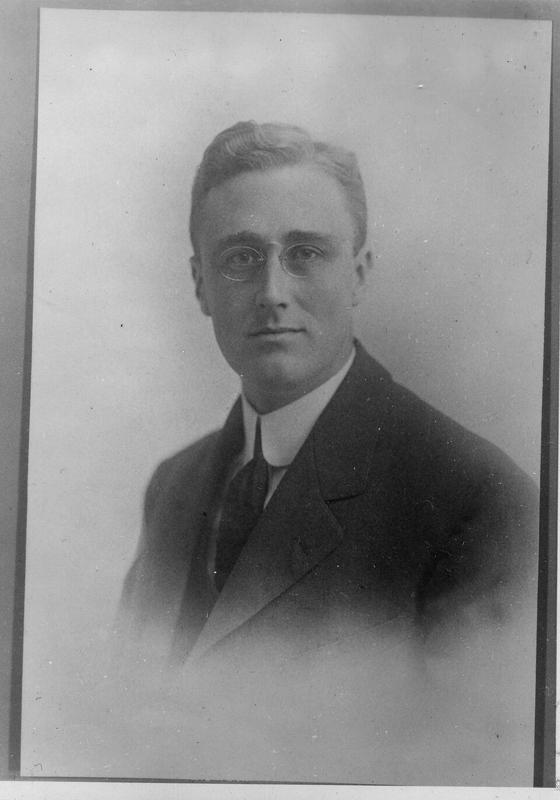
Franklin D. Roosevelt
Born January 30, 1882, Hyde Park, New York · Died April 12, 1945, Warm Springs, Georgia · Holland Lodge No. 8, New York City
Franklin D. Roosevelt led the United States through the Great Depression and most of World War II, and was elected president four times.
The test of our progress is not whether we add more to the abundance of those who have much; it is whether we provide enough for those who have too little.
A Hudson Valley Boyhood and a Famous Cousin’s Example
Franklin Delano Roosevelt was born at Hyde Park, New York, on January 30, 1882, to James and Sara Delano Roosevelt. Parents and private tutors gave him nearly all his early schooling, and trips to Europe left him with German and French and a short spell at a German school when he was nine. He went to Groton in 1896, finished a Harvard history degree in three years and then read law at Columbia, leaving without a degree once he passed the bar in 1907. He practiced for three years with a prominent New York City firm.
On St. Patrick’s Day, 1905, he married Anna Eleanor Roosevelt, a niece of President Theodore Roosevelt and Franklin’s own fifth cousin once removed. Five of their six children survived infancy: Anna, James, Elliott, Franklin Jr. and John. Franklin admired Theodore and followed him into public life, but as a Democrat. In 1910 he won a traditionally Republican New York State Senate seat, and he was reelected in 1912.
Navy Administrator and a Losing Running Mate
Roosevelt backed Woodrow Wilson at the 1912 Democratic convention, and Wilson made him Assistant Secretary of the Navy in 1913. He held the post until 1920, specializing in the business side of naval administration, an apprenticeship that served him when he became commander in chief in a world war. In 1920 the Democrats nominated him for vice president on a ticket headed by James M. Cox of Ohio. Opposition to Wilson’s plan for American membership in the League of Nations carried Warren Harding to victory, and Roosevelt returned to private life.
Polio at Campobello and the Long Way Back
In the summer of 1921, while on vacation at Campobello Island, New Brunswick, Roosevelt contracted polio. He was thirty-nine. He worked for years to regain movement, especially through swimming, but never recovered the use of his legs. Eleanor and his political adviser Louis Howe kept his name alive in Democratic politics, and in 1924 he appeared at the national convention on crutches to nominate Governor Al Smith as “the Happy Warrior.” He later set up a foundation at Warm Springs, Georgia, to help other polio patients and inspired the March of Dimes, which eventually funded an effective vaccine.
In 1928 Smith ran for president and arranged for Roosevelt to succeed him as governor. Smith lost to Herbert Hoover; Roosevelt won. As governor he won reelection in 1930 by about 725,000 votes and in 1931 created the Temporary Emergency Relief Administration to aid unemployed New Yorkers. In 1932 he flew to Chicago to accept the Democratic nomination in person, breaking with custom, and defeated Hoover by seven million votes.
Depression, War, and Four Elections
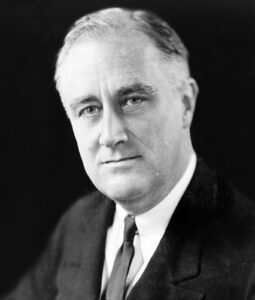
When Roosevelt took office on March 4, 1933, some thirteen million Americans were out of work and almost every bank had closed. He told the country that “the only thing we have to fear is fear itself,” closed the banks temporarily to stop the panic, and in his first hundred days worked with Congress to create the Agricultural Adjustment Administration, the Civilian Conservation Corps and the Tennessee Valley Authority, along with insurance for bank deposits and regulation of the stock market. A second wave in 1935 brought the Works Progress Administration, which employed laborers as well as artists, writers and musicians, and the Social Security Act, with unemployment compensation and old-age benefits.
Roosevelt’s second inaugural address on January 20, 1937, defined progress in terms of providing enough for those who had too little.
From the Court Fight to the Arsenal of Democracy
After a landslide over Alf Landon in 1936, Roosevelt proposed in 1937 to add justices to the Supreme Court, which had struck down New Deal legislation. Critics called it court packing, and the plan failed, though the Court began upholding New Deal laws. That defeat, and a recession midway through his second term, marked the low point of his presidency.
When war came to Europe in 1939, he sought to aid Britain, France and China despite the Neutrality Acts. After France fell in 1940 Congress enacted a draft, and in March 1941 he signed the Lend-Lease bill, making the United States the “arsenal of democracy” while it was still at peace. After Pearl Harbor he took an active hand in strategy and the choice of commanders, worked closely with Winston Churchill, and on January 1, 1942, brought the nations fighting the Axis into the Declaration of the United Nations, the seed of the postwar organization. In 1942 he also signed the executive order that forced Japanese Americans into internment camps, which the Supreme Court upheld in two challenges.
Roosevelt beat Wendell Willkie in 1940 and Thomas E. Dewey in 1944, the only president elected more than twice. By early 1944 his doctors had found serious heart and circulatory disease. On April 12, 1945, at his “Little White House” retreat at Warm Springs, he suffered a massive stroke and died about two and a half hours later, at sixty-three, weeks before victory in Europe. More than 300,000 people turned out for his funeral procession in Washington, and he was buried in the Rose Garden at Hyde Park.
Holland Lodge, Architect Lodge and a Degree Never Conferred
Roosevelt was initiated in Holland Lodge No. 8 in New York City on October 10, 1911, shortly after his first election to the state Senate, passed on November 14 and raised on November 28. He kept that membership for thirty-four years; his papers include the earliest membership card his archivists could find and the last one, sent to him in March 1945.
As governor he petitioned the Scottish Rite at the Albany Consistory on February 28, 1929, and received the thirty-second degree the same day. In 1930 he became a Shriner in Albany’s Cyrus Temple. He joined the Tall Cedars of Lebanon in Warwick, New York, and on October 30, 1931, entered the Grotto, a Masonic social order, in Poughkeepsie, alongside his friend Henry Morgenthau, later his Secretary of the Treasury. He was named Honorary Grand Master of Georgia, and in 1934 Honorary Grand Master of the Order of DeMolay, the fraternity’s organization for young men.
On November 7, 1935, as an honorary member of Architect Lodge No. 519 in Manhattan, the president helped raise his sons Franklin Jr. and James. His own draft for that evening survives, and he spoke of how the ceremonies of Freemasonry in New York “always make me wish that more Americans, in every part of our land, could become connected with our fraternity.”
In 1943 the heads of the two American Scottish Rite jurisdictions, Melvin M. Johnson of the Northern and John Henry Cowles of the Southern, traded confidential letters about conferring the honorary thirty-third degree on the sitting president. Roosevelt’s Albany home placed him under the Northern Jurisdiction, where many members opposed the New Deal; Johnson offered to waive jurisdiction if the Southern Jurisdiction asked, but Cowles declined, and the degree was never conferred before Roosevelt’s death. There is no record of Masonic rites at his funeral.
How should Roosevelt’s expansion of federal protection be remembered alongside his administration’s confinement of Japanese Americans?
Sources
- White House Historical Association — Franklin D. Roosevelt
- FDR Presidential Library & Museum — FDR Biography
- FDR Presidential Library — Found in the Archives: FDR and the Masons
- Scottish Rite Journal — Br. Franklin D. Roosevelt: A President Who Perplexed Two Supreme Councils
- Grand Lodge of Ohio — Franklin D. Roosevelt
- American Presidency Project — Franklin D. Roosevelt, Second Inaugural Address
Life & Masonic Timeline
Unknown authorUnknown author or not provided, via Wikimedia Commons · Public domain · Source