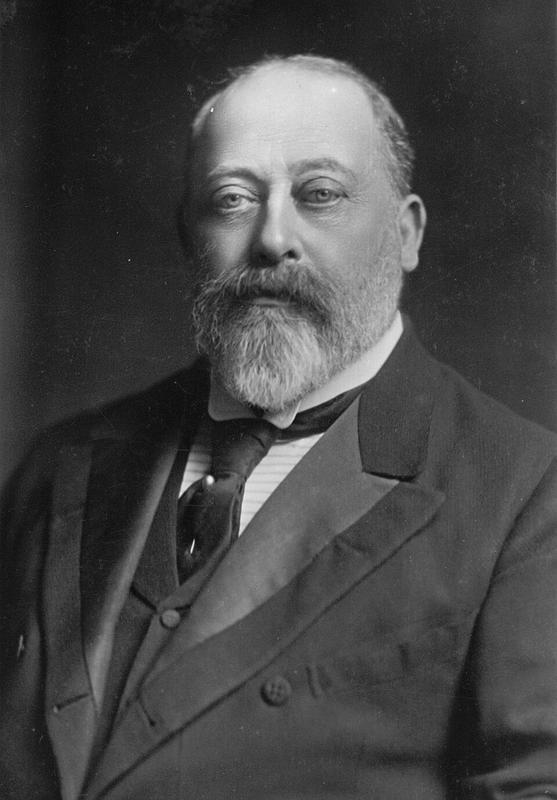
King Edward VII
Born November 9, 1841, Buckingham Palace, London · Died May 6, 1910, Buckingham Palace, London · Stockholm, Sweden (Swedish Rite)
Edward VII gave his name to the Edwardian era as king and spent decades as Grand Master of English Freemasonry while Prince of Wales.
I maintain that the craft is free from the reproach of being either disloyal or irreligious.
Albert Edward, and a Long Apprenticeship Under Victoria
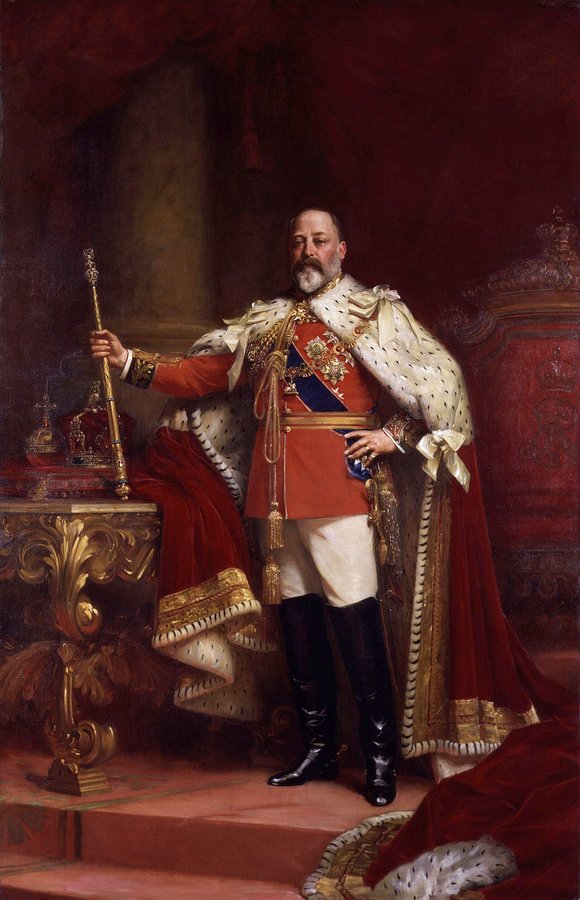
Albert Edward, the eldest son of Queen Victoria and Prince Albert, was born at Buckingham Palace on November 9, 1841, and was baptized at St. George’s Chapel, Windsor, on January 25, 1842. His parents set him a strict and carefully planned course of study, first under tutors at home and later with university training at Oxford, Cambridge and Edinburgh. In November 1858 he was made a colonel in the Army, unattached, and received the Order of the Garter.
In 1860 he crossed the Atlantic. He sailed on July 10, landed at St. John’s, Newfoundland, on July 25, and traveled through Canada, laying the foundation stone of the new Parliament buildings at Ottawa and driving home the last rivet of the Victoria Bridge at Montreal. President James Buchanan had written to the Queen offering a welcome in the United States, and the Prince returned through the States, visiting among other cities Chicago, Cincinnati, St. Louis, Washington, New York and Boston. On October 5, in company with the President, he stood uncovered at George Washington’s tomb at Mount Vernon and planted a chestnut beside it. He landed again at Plymouth on November 13.
In the summer of 1861, after his second term at Cambridge, where he lived at Madingley Hall, he served briefly with the army at the camp at the Curragh of Kildare. That autumn he met Princess Alexandra of Denmark at Speyer and Heidelberg, and they became engaged. A liaison with an actress had already caused considerable scandal, and Prince Albert had visited his son to reprimand him; Albert died two weeks later, on December 14, 1861. The Prince was summoned from Madingley to Windsor the day before the death. Victoria held her son partly responsible, withdrew almost completely from public life, and for the rest of her long reign allowed Edward to represent her at state occasions but gave him almost no chance to take part in affairs of state. He married Alexandra at St. George’s Chapel, Windsor, on March 10, 1863. They had six children, five of whom survived to adulthood. He became a leader of London society, and he also threw himself into public work: hospitals, exhibitions, schools and charities fill the record of his speeches. In December 1871 he fell seriously ill with typhoid at Sandringham; for some weeks the country waited on the daily bulletins. He recovered, and a national thanksgiving service was held at St. Paul’s Cathedral in February 1872.
King at Last, and a Constitutional Crisis Left Unfinished
He was fifty-nine when he succeeded to the throne, on January 22, 1901, as King Edward VII and Emperor of India. His coronation, set for June 26, 1902, had to be postponed when appendicitis, followed by peritonitis, required an immediate operation. The ceremony took place at Westminster Abbey on August 9, after he had recovered. He entered the work of kingship with energy and restored sparkle to a monarchy that had been rather gloomy since his father’s death forty years earlier. Related to most of the royal houses of Europe — he was known as the “Uncle of Europe” — he was able to assist in foreign-policy negotiations. A well-received state visit to Paris helped pave the way for the Anglo-French Entente Cordiale of 1904. He was the first British monarch to visit Russia. In 1902 he founded the Order of Merit, to reward those who distinguished themselves in science, art or literature.
In the last year of his life he was drawn into a constitutional crisis when the Conservative majority in the House of Lords refused to pass the Liberal budget of 1909. He died at Buckingham Palace on May 6, 1910, before the conflict was resolved, and was succeeded by his son, George V. He was buried at St. George’s Chapel, Windsor.
Grand Master at the Albert Hall, Then Protector of the Craft
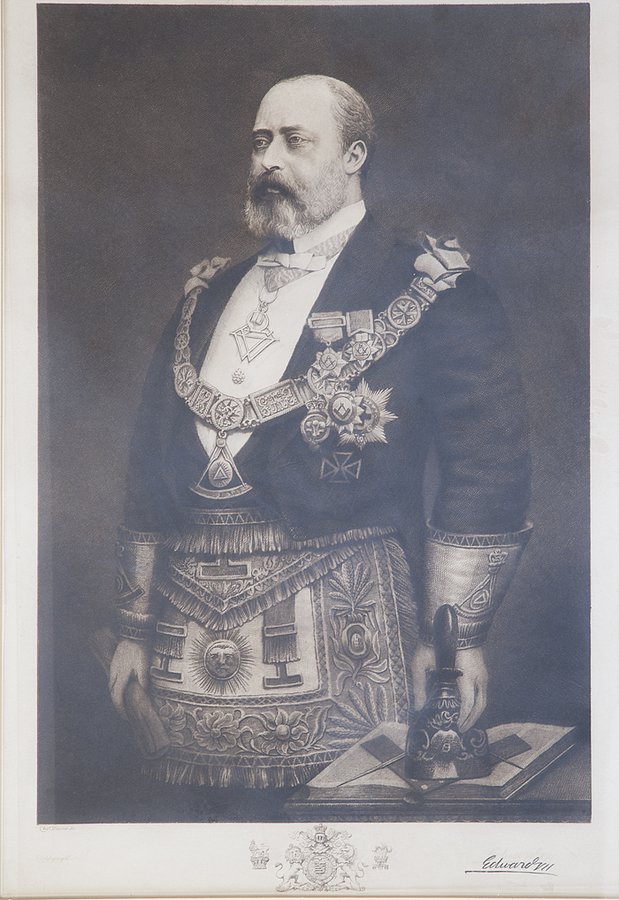
Edward was initiated by the King of Sweden, at Stockholm, in 1868. In 1870 the rank of Past Grand Master of England was conferred on him. On March 30 of that year he presided at the seventy-second anniversary festival of the Royal Masonic Institution for Boys, at Freemasons’ Hall, and told more than six hundred brethren: “I maintain that the craft is free from the reproach of being either disloyal or irreligious.” He was installed as Grand Master by the Earl of Carnarvon, then Pro-Grand Master, at the Royal Albert Hall on April 28, 1875, before nearly ten thousand Freemasons. In his address he said that “the two great watchwords of the craft are Loyalty and Charity,” and that as long as Freemasons did not, as Freemasons, mix themselves up in politics, the order would flourish. That evening, at the banquet, he recalled that he had been initiated seven years earlier by the King of Sweden.
He served as Master of Apollo University Lodge in Oxford, of Royal Alpha Lodge in London, and, from 1874, of the Prince of Wales Lodge No. 259. He did not lose opportunities to show his attachment to Freemasonry in public. He was enrolled as Patron of the Grand Lodges of Scotland and Ireland, an honorary member of Lodge of Edinburgh No. 1, a member and Patron of the Supreme Council of the Thirty-third Degree for England, and Grand Master of the Convent General of the Knights Templar. As a charismatic Grand Master and a member of several lodges, he helped raise the popularity of Freemasonry in the Victorian era.
He carried the Craft into public life. In July 1870 he laid the foundation stone of the new grammar school at Reading with Masonic honours, the local Masons in their regalia filling one side of the tent. He laid the foundation stone of Truro Cathedral with Masonic ceremony as well, and in November 1887 he returned for the consecration of what he called the first Protestant cathedral built in England since St. Paul’s. In June 1887, for Queen Victoria’s Golden Jubilee, he presided over about seven thousand Freemasons at the Royal Albert Hall, the greatest gathering of the Craft he had seen, he said, apart from his own installation, to move an address of loyalty to the Queen; the brethren gave more than £6,000 that day to the Masonic charities for children and the aged. On coming to the throne in 1901 he assumed the title Protector of the Craft, and his brother, the Duke of Connaught, succeeded him as Grand Master.
How did Edward’s years as Grand Master connect his public life as Prince of Wales with his later role as king?
Sources
- BBC — Edward VII (1841–1910)
- Westminster Abbey — Edward VII
- Grand Lodge of British Columbia and Yukon — Edward VII
- Museum of Freemasonry — The Sceptre and the Trowel
- Speeches and Addresses of H.R.H. the Prince of Wales, 1863–1888, Project Gutenberg
Life & Masonic Timeline
W. & D. Downey, via Wikimedia Commons · Public domain · Source