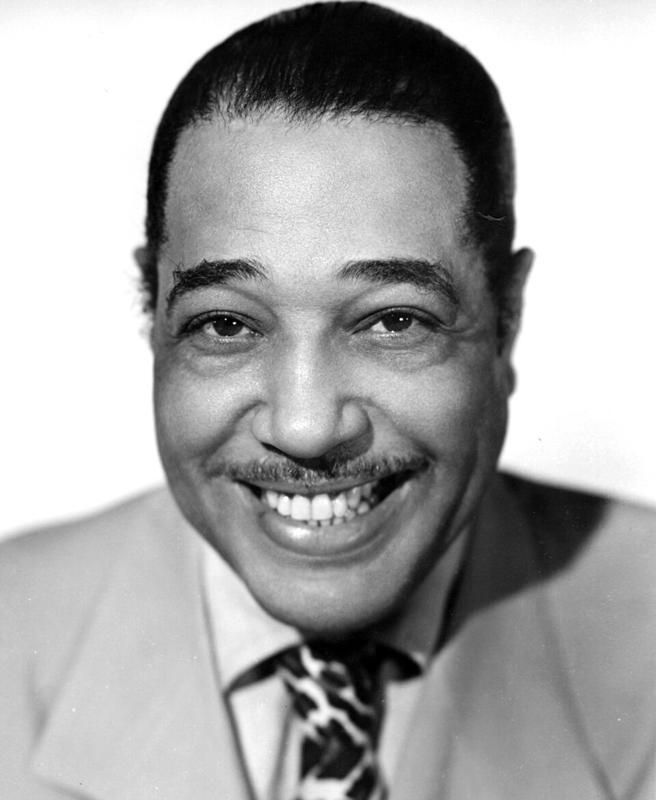
Duke Ellington
Born April 29, 1899, Washington, D.C. · Died May 24, 1974, New York City, New York · Social Lodge No. 1 (Prince Hall), Washington, District of Columbia
Duke Ellington turned the jazz orchestra into a composer’s instrument, writing for the voices of his players in songs, suites and sacred concerts.
The Young “Duke” of Washington’s West End
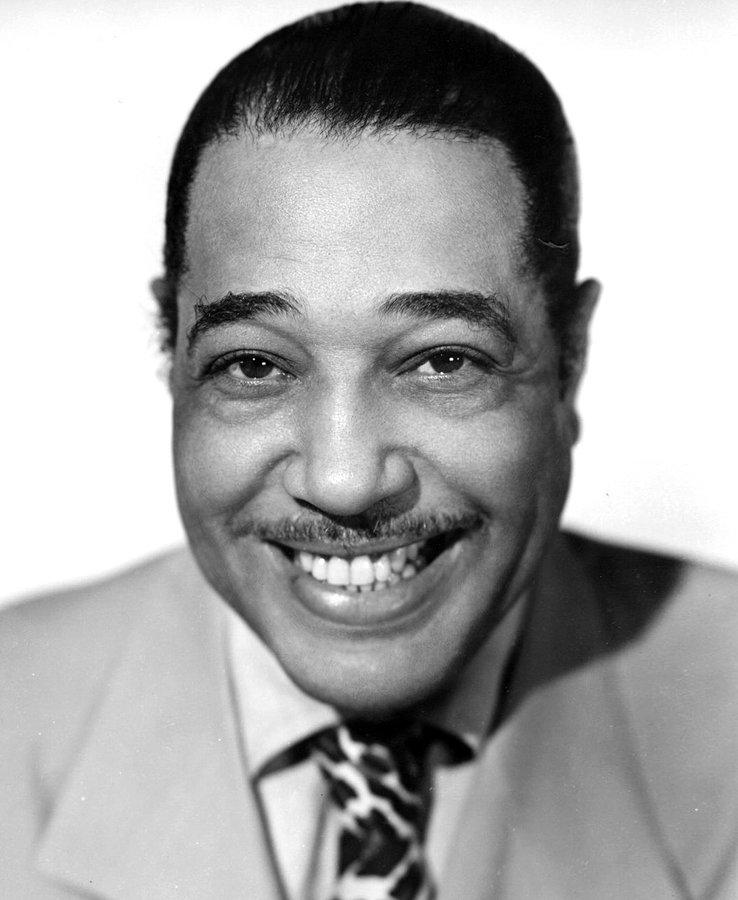
Edward Kennedy Ellington grew up in a secure middle-class family in Washington, District of Columbia. His parents, James Edward and Daisy Ellington, both played piano, and his mother in particular raised him on music, discipline and good manners. His easy bearing and dapper dress led a boyhood friend, Edgar McEntee, to give him the title that stayed with him for life. Ellington later explained that McEntee felt that to be eligible for his constant companionship, he should have a title, “so he called me Duke.”
He began piano lessons at seven, but baseball held his attention at first; Theodore Roosevelt, he remembered, “would come on his horse sometimes and stop and watch us play.” In the summer of 1914, while working as a soda jerk at the Poodle Dog Café, he worked out his first composition, “Soda Fountain Rag,” by ear, before he could read music. He studied harmony with Henry Lee Grant, a music teacher at Dunbar High School, and learned to read music from the pianist Oliver “Doc” Perry. He also showed real talent in visual art and was offered a scholarship to the Pratt Institute in Brooklyn, which he turned down to play. By seventeen he was performing professionally with his own group.
An Orchestra Built Around the Voices of Its Players
Ellington first played in New York in 1923 and moved there later that year, leading a sextet in Broadway nightclubs that grew into a ten-piece band. The Cotton Club engagements of 1927–1932 and 1937–1938 gave his orchestra a prominent Harlem base, and national radio broadcasts carried its sound across the country. The band eventually grew to fourteen musicians, and Ellington composed around the particular sounds of its players rather than treating every instrument as interchangeable.
Trumpeter Bubber Miley, with his plunger “wa-wa” mute, and trombonist Joe “Tricky Sam” Nanton, with his growling muted tone, shaped the early “jungle style” of “East St. Louis Toodle-oo” in 1926 and “Black and Tan Fantasy” in 1927. Saxophonists Johnny Hodges and Harry Carney, clarinetist Barney Bigard and trumpeter Cootie Williams became central musical voices; Carney stayed with the band for forty-seven years. In “Mood Indigo,” recorded in 1930, Ellington combined muted trumpet, unmuted trombone and low-register clarinet in an unusual instrumental texture. The band toured Europe in 1933 and 1939.
Composer and arranger Billy Strayhorn became Ellington’s close collaborator in 1939. Strayhorn wrote “Take the ‘A’ Train,” which became the orchestra’s signature number, and the two worked so closely until Strayhorn’s death in 1967 that scholars may never fully separate their contributions. The early 1940s band, with tenor saxophonist Ben Webster and bassist Jimmy Blanton, recorded “Concerto for Cootie,” “Cotton Tail” and “Ko-Ko,” each a complete design within the three minutes of a 78-rpm record. Ellington also wrote enduring popular songs, among them “Sophisticated Lady,” “Solitude,” “Prelude to a Kiss” and “Satin Doll.”
Suites, a Midnight at Newport, and a Birthday at the White House
Ellington also wrote extended works beyond the length of a dance-band record. Black, Brown and Beige, introduced in 1943, presented a musical account of Black American history. After the extended composition Harlem in 1950, he presented its score to President Harry Truman. Such Sweet Thunder drew on Shakespeare, while his adaptation of The Nutcracker reworked Tchaikovsky for the jazz orchestra. He composed film scores for The Asphalt Jungle in 1950 and Anatomy of a Murder in 1959, and in 1964 the stage show My People celebrated African American life at the height of the civil rights movement.
By the mid-1950s changing tastes had left the orchestra struggling to draw crowds. At the Newport Jazz Festival on July 7, 1956, it played a short early set with four men missing, then came back around midnight to an audience already drifting toward the exits. Ellington called “Diminuendo and Crescendo in Blue,” and the tenor saxophonist Paul Gonsalves stepped forward for twenty-seven straight choruses of the blues. The crowd came out of its seats, the band played four encores, and Columbia recorded it all. Within weeks he was on the cover of Time. Asked his age in later years, he liked to say, “I was born in 1956 at the Newport Festival.”
When big bands became too costly for most leaders after the war, Ellington kept his together through constant touring, taking it to Asia, West Africa, South America and Australia as well as across Europe and North America. His sacred concerts of 1965, 1968 and 1973 combined jazz with religious themes; the first, In the Beginning God, was presented at Grace Cathedral in San Francisco. He received the Presidential Medal of Freedom on his seventieth birthday, April 29, 1969, at a White House dinner given by President Richard Nixon, who reminded the guests that Ellington’s father had once served state dinners in that house as a butler and raised a glass to “the greatest Duke of them all.” The citation said that “in the royalty of American music, no man swings more or stands higher than the Duke.” Ellington answered by naming the four freedoms Billy Strayhorn had lived by: freedom from hate, from self-pity, from fear of doing something that might help another more than himself, and from the pride that makes a man feel better than his brother. Then the president sat at the piano and led the room in “Happy Birthday,” and a jam session with Dizzy Gillespie, Benny Goodman and Earl Hines ran into the early morning. His autobiography, Music Is My Mistress, appeared in 1973.
Ellington died in New York City on May 24, 1974, a few weeks after his seventy-fifth birthday. More than 12,000 people attended his funeral at the Cathedral of St. John the Divine, and he was buried in Woodlawn Cemetery in the Bronx. That year Washington renamed the Calvert Street Bridge in his honor, and in 2009 he became the first African American to appear alone on a circulating United States coin.
A Prince Hall Mason in His Hometown Lodge
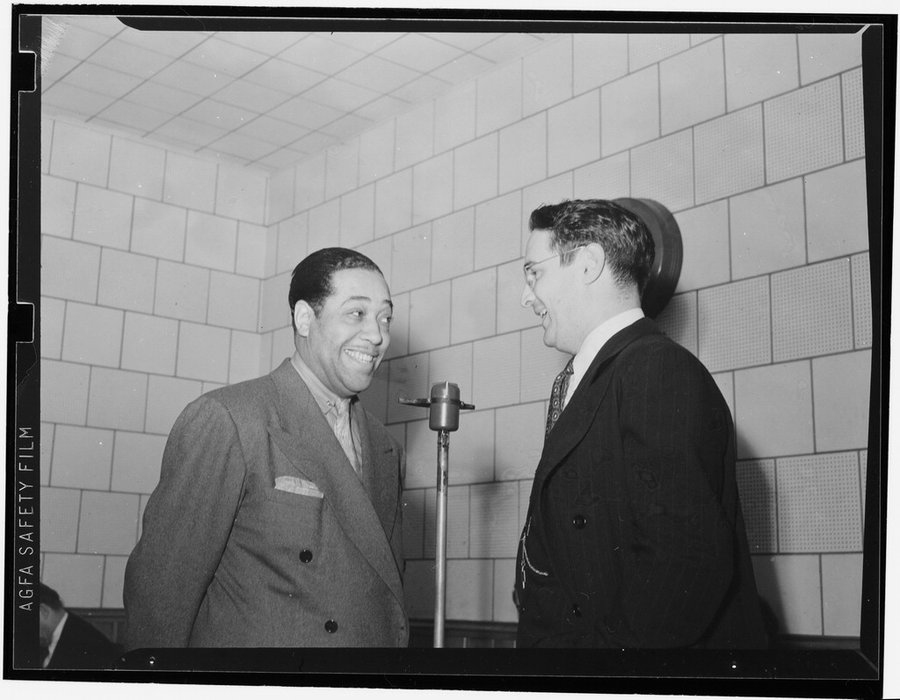
Ellington was initiated in 1932, at the age of thirty-three, in Social Lodge No. 1 in Washington, District of Columbia, a lodge working under the Most Worshipful Prince Hall Grand Lodge of the District of Columbia. His career was then reaching new heights with the orchestra’s Cotton Club broadcasts, but he joined in his hometown, the city where his musical life began.
He went on through the degrees to become a Master Mason and later received the thirty-second degree of the Ancient and Accepted Scottish Rite. He belonged to a wide circle of Prince Hall Masons in jazz that also included Count Basie and Nat King Cole.
Which Ellington recording best reveals what one orchestra can do with the distinct voices of its musicians?
Sources
- Encyclopaedia Britannica — Duke Ellington
- Scottish Rite, Northern Masonic Jurisdiction — The Extraordinary Life of Duke Ellington
- Universidad Nacional de Educación a Distancia, Virtual Museum of the History of Freemasonry — Edward Kennedy “Duke” Ellington (1899–1974)
- Grand Lodge of Ohio — Musical Masons: The Freemasons of Jazz
- The Guardian — Paul Gonsalves’s solo at the Newport jazz festival
- PaulGonsalves.com — The Trials and Tribulations of Paul Gonsalves, by Mike Hennessey
- White House Historical Association — A Duke at the White House
- The American Presidency Project — Remarks on Presenting the Presidential Medal of Freedom to Duke Ellington
Life & Masonic Timeline
Unknown authorUnknown author, via Wikimedia Commons · Public domain · Source