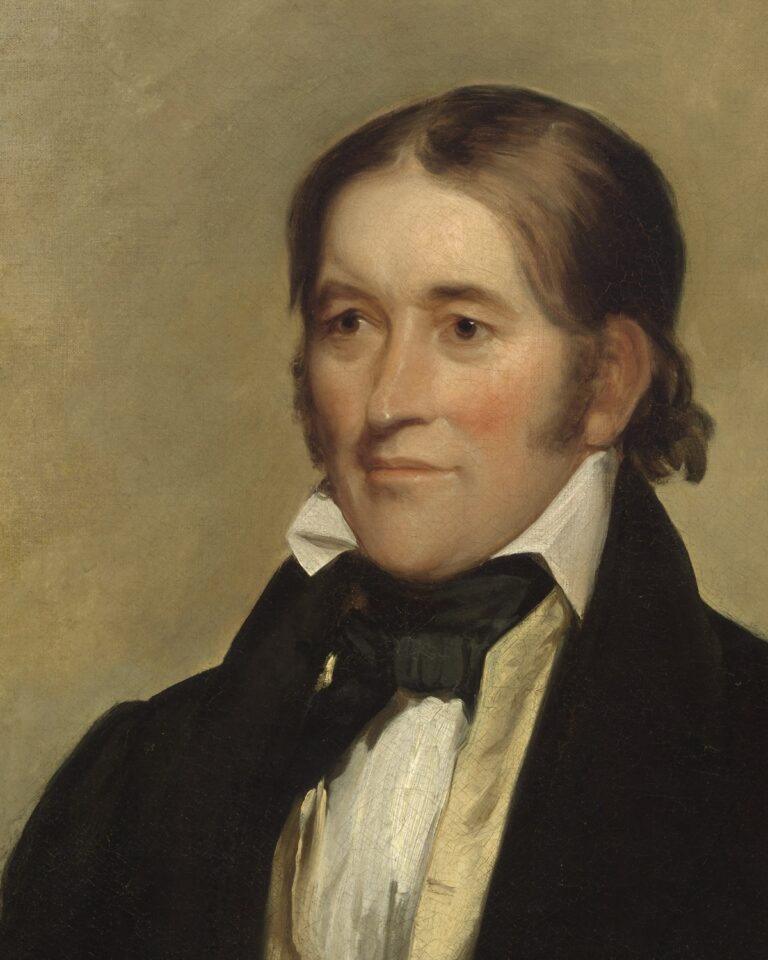
David Crockett
Born August 17, 1786, Eastern Tennessee · Died March 6, 1836, The Alamo, San Antonio, Texas
David Crockett served three terms in Congress, became a celebrated frontier storyteller and died defending the Alamo during the Texas Revolution.
A Greene County Boy Who Walked Seven Miles Through the Snow
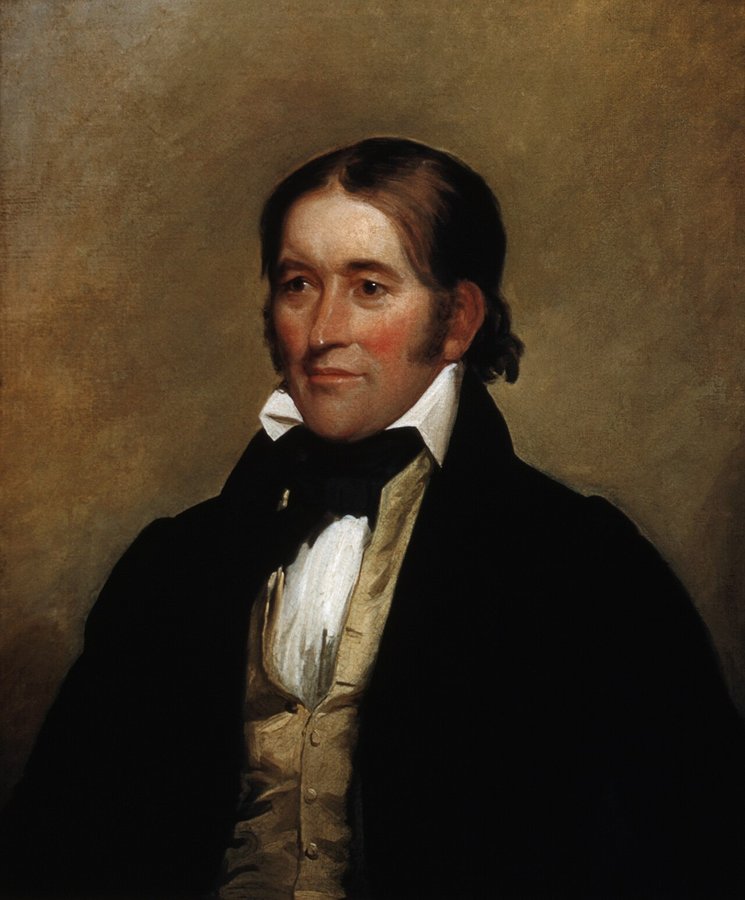
David Crockett was born on August 17, 1786, at the confluence of Limestone Creek and the Nolichucky River, in what is now Greene County, Tennessee, the son of John and Rebecca Hawkins Crockett. When he was about twelve, his father hired him out to Jacob Siler to help drive cattle to Rockbridge County, Virginia. After the drive, Siler tried to keep him by force; the boy escaped at night, walking seven miles in two hours through knee-deep snow, and made his way home late in 1798 or early in 1799. School did not last. He ran away to avoid a beating, worked for two and a half years as a wagoner and day laborer, and returned in 1802 so changed that his family did not at first know him. He then worked about a year to pay his father’s debts, which came to seventy-six dollars, and went back to school for six months.
A license to marry Margaret Elder, taken out on October 21, 1805, came to nothing. He married Mary (“Polly”) Finley on August 16, 1806, in Jefferson County. After some five years in the East Tennessee mountains they moved, with their sons John Wesley and William, to Lincoln County, and in 1813 to a homestead he named Kentuck, on Bean’s Creek in Franklin County, near the present Alabama border. That September he enlisted as a scout in the Tennessee militia after the attack on Fort Mims. On November 3, under Andrew Jackson, he took part in the massacre at the Creek town of Tallushatchee. After a first ninety-day enlistment he reenlisted in 1814 as a third sergeant, reached Florida the day after Jackson took Pensacola, and was discharged in 1815 as a fourth sergeant. He came home to a new child and, that spring, to Polly’s death. Before the summer ended he married Elizabeth Patton, a widow with two children. He later explored Alabama with an eye to settling there, nearly died of malaria, and was even reported dead before he returned.
The Congressman Who Voted Against the Indian Removal Act
The family settled at the head of Shoal Creek, in what became Lawrence County, Tennessee. Crockett served as a justice of the peace, as a town commissioner of Lawrenceburg, and, in 1818, as colonel of the Fifty-seventh Militia regiment. On New Year’s Day 1821 he resigned as commissioner to run for the Tennessee legislature; he won that August as the representative of Lawrence and Hickman counties and took up western land policy at once. After the session he moved his family to what is now Gibson County. He won again in 1823, lost his first race for Congress in 1825, and nearly died the next year when boats carrying his barrel staves wrecked on the Mississippi. Encouraged in Memphis to try Congress again, he won election to the House of Representatives in 1827.
He was reelected in 1829 and broke with President Jackson and the rest of the Tennessee delegation on land reform and on the Indian Removal Act. In his autobiography he wrote that he believed the measure “a wicked, unjust measure,” that he voted against it, and that his conscience told him it was “a good honest vote, and one that I believe will not make me ashamed on the day of judgment.” Cherokee Principal Chief John Ross wrote to thank him. The vote cost him support at home; he lost a close election in 1831 to William Fitzgerald. He defeated Fitzgerald in 1833 and returned for a final term, sitting as an Anti-Jacksonian. In 1830 he had also introduced a resolution to abolish the United States Military Academy at West Point, arguing that it used public money to benefit the wealthiest Americans.
“I Will Go to Texas”
By then a parallel fame had grown in print and on the stage. James Kirke Paulding’s play The Lion of the West, which opened in New York on April 25, 1831, drew on Crockett for its hero, Nimrod Wildfire. Books and a long run of comic almanacs, issued under his name from 1835 to 1856, circulated tall tales about a legendary “Davy” rather than the historical David Crockett. His own 1834 A Narrative of the Life of David Crockett of the State of Tennessee, written with Thomas Chilton, was meant to correct Mathew St. Clair Clarke’s unsigned Sketches and Eccentricities and to serve, in part, as a campaign book: Whig politicians were already mentioning him as an anti-Jackson possibility for 1836. On April 25, 1834, he began a three-week tour of the eastern states. The motto he made famous was “Be always sure you’re right—then go a-head!”
He lost the 1835 race to Adam Huntsman, a lawyer supported by Jackson and by Governor William Carroll, by 252 votes. Disenchanted, he set out on November 1, 1835, with William Patton, Abner Burgin and Lindsey K. Tinkle, “to explore the Texes well before I return,” with no plan, at first, to join a war for independence. At a farewell gathering in Memphis he repeated a line from the campaign: “since you have chosen to elect a man with a timber toe to succeed me, you may all go to hell and I will go to Texas.” The party reached Nacogdoches by January 5, 1836. At San Augustine, Crockett insisted that the oath of allegiance name a future republican government, so that he would not be bound to a regime that might prove despotic. On January 9 he wrote his last letter home: “I am rejoiced at my fate.” He reached San Antonio in early February. Antonio López de Santa Anna arrived on the twenty-third.
Crockett died when the Alamo fell on March 6, 1836. Accounts of his last moments differ, and it is almost impossible to determine how he died. Susanna Dickinson said he fell early, outside; Joe, who was enslaved to William Barret Travis and was the only adult male Texan to survive the battle, reported seeing him lying dead with slain Mexican soldiers around him. Other early reports said he was among men taken and killed after the fighting. What is clear is the part he played in the defense. Travis wrote that during the first bombardment Crockett was everywhere in the Alamo “animating the men to do their duty,” and he was posted at the low stockade in front of the church, among the most exposed points in the line.
A Masonic Apron, and No Surviving Lodge Minutes
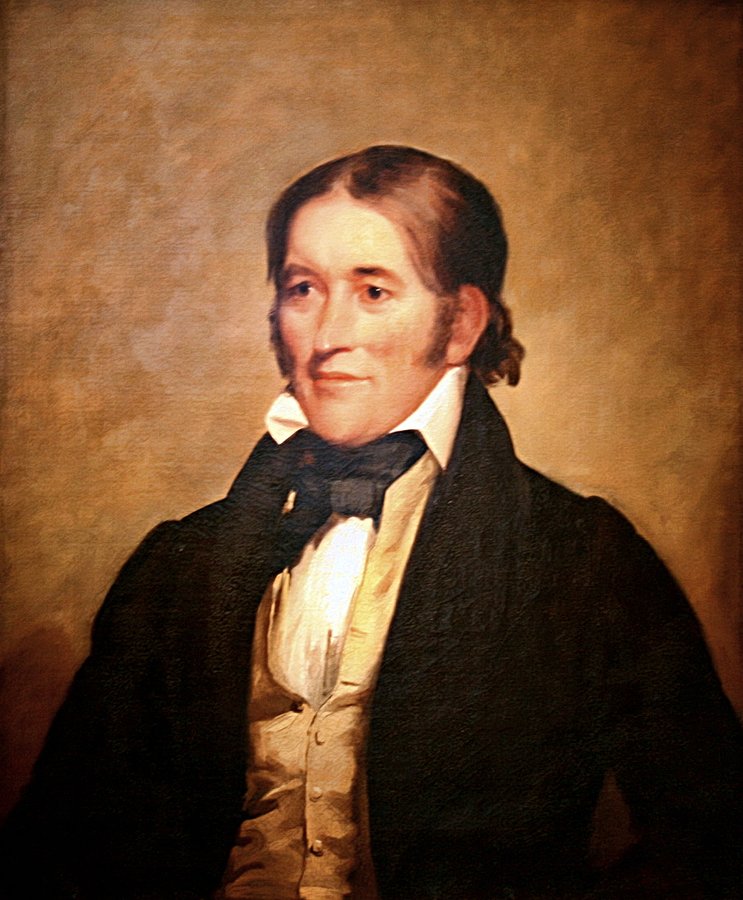
From the sources we do have, it is believed that Crockett was a Freemason. A Masonic apron associated with him, said to have been made for him in Washington by Mrs. A. C. Massie, was left with the sheriff of Weakley County, Tennessee, before Crockett went west, and was later preserved in the sheriff’s family. The lodge nearest his home in that county lost its records in a fire during the Civil War. No surviving minutes establish a particular lodge or the dates of his degrees.
What does Crockett’s opposition to Jackson reveal that the frontier legend leaves out?
Sources
- Texas State Historical Association — David Crockett
- U.S. House of Representatives, History, Art & Archives — CROCKETT, David
- Grand Lodge of Ohio — Davy Crockett
Life & Masonic Timeline
David Crockett, 1834. Chester Harding. via Wikimedia Commons, cropped · Public domain · Source