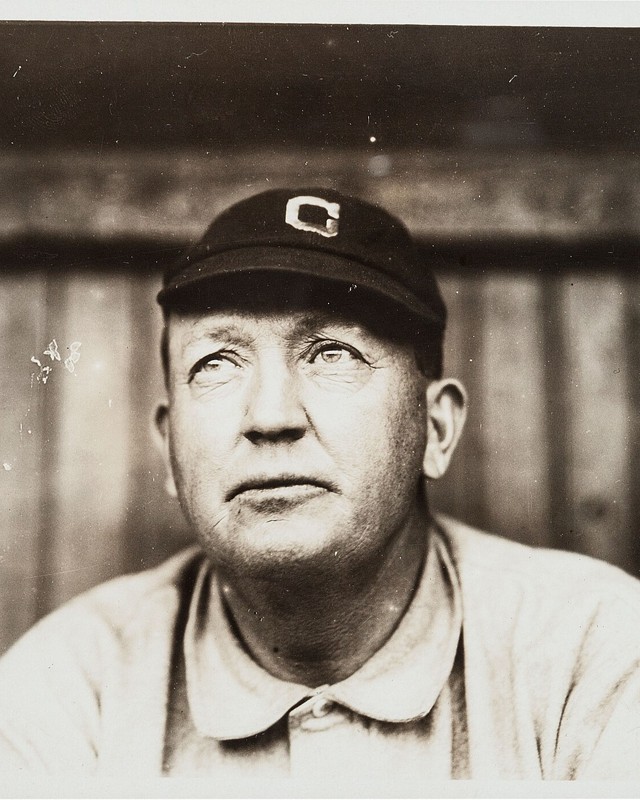
Cy Young
Born March 29, 1867, Gilmore, Ohio · Died November 4, 1955, Newcomerstown, Ohio · Mystic Tie Lodge No. 194, Dennison, Ohio
Cy Young won a record 511 major-league games across more than two decades, giving his name to baseball’s most celebrated annual pitching award.
A Farm Boy from Gilmore, and a Nickname Earned in Canton
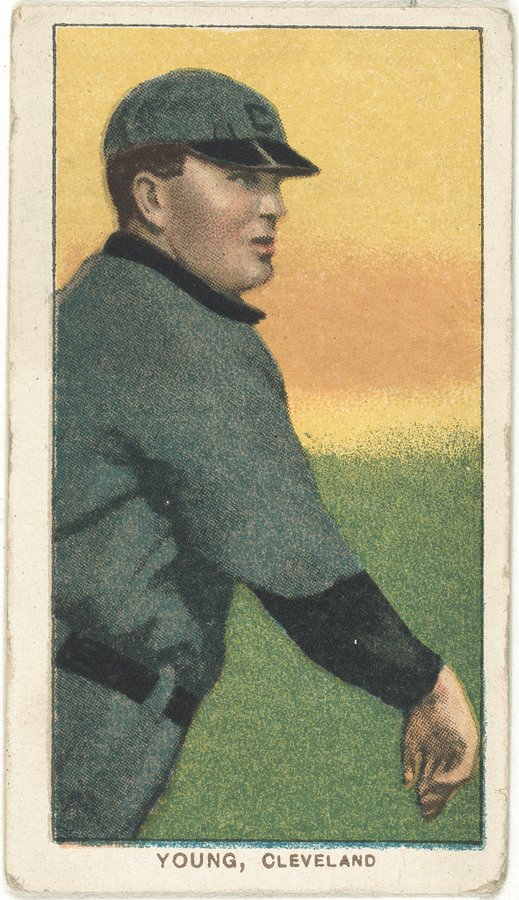
Denton True Young was born on March 29, 1867, in Gilmore, Ohio, the oldest of five children of McKinzie Young Jr. and Nancy Miller Young. He was raised on a farm about a hundred miles south of Cleveland. His schooling ended after the sixth grade so that he could help with farm work; he practiced throwing during lunch breaks and organized a team in Gilmore. In the summer of 1884, at seventeen, he played for semiprofessional clubs in nearby towns. He hoped to marry Robba Miller, who lived on the adjacent farm, and saw professional baseball as a way to make a living. For $60 a month he signed with Canton, of the Tri-State League, for the 1890 season. He was twenty-three. During Canton’s preseason he picked up the nickname “Cyclone,” soon shortened to Cy. On June 25 he threw a no-hitter for Canton, with 18 strikeouts and no walks. A few days later the National League’s Cleveland Spiders bought his contract for $300.
He debuted on August 6, 1890, against Cap Anson’s Chicago Colts. Anson is said to have called him “just another big farmer.” Young threw a three-hitter and won, 8–1. In that partial first season he finished 9–7, the only Spider with a winning record, and on the last day he won both games of a doubleheader. In 1892 he led the league with 36 wins, a 1.93 earned-run average and nine shutouts. After that season, on November 8, 1892, he married Robba Miller. Between 1892 and 1893 the pitching distance was increased to the present 60 feet 6 inches. In 1895 he won 35 games, and in the postseason Temple Cup he won three, including the clinching game, as Cleveland beat the Baltimore Orioles. His first major-league no-hitter came in September 1897, a 6–0 victory over Cincinnati. Cleveland committed four errors behind him; one play was first scored as a hit, then changed to an error after the third baseman sent a note to the press box, and Young himself continued to regard the game as a one-hitter. After the 1898 season the Spiders’ owners shifted him to their St. Louis club. He pitched two seasons there, finding a longtime catcher in Lou Criger, and in 1900 finished 19–19, one short of a tenth straight season of 20 wins.
Boston, the First Modern World Series, and a Perfect Game
In 1901 he joined Boston of the new American League, for a salary of $3,500. At thirty-four he was already being called old, and St. Louis had declined to match the offer, thinking him nearly finished. He led the league that year with 33 wins, 158 strikeouts and a 1.62 earned-run average — the pitching Triple Crown — and accounted for 33 of Boston’s 79 victories. In early 1902 he served as pitching coach for Harvard’s baseball team. In 1903 he threw the first pitch in the first modern World Series and won two games as Boston defeated the Pittsburgh Pirates. He is the only pitcher to have won a game in both the Temple Cup and the World Series.
On May 5, 1904, at the age of thirty-seven, he pitched the first perfect game of the twentieth century, and the first from the modern pitching distance, retiring every Philadelphia Athletics batter in a 3–0 win. He considered that day his greatest in baseball. The Athletics’ Rube Waddell, who had beaten him a week earlier, had promised to do so again; after the game Young called back, “How did you like that one, you hayseed?” The perfect game came in the middle of a scoreless streak that stretched to a then-record 45 innings. In 1908, at forty-one, he threw his third career no-hitter, a record for age that lasted eighty-two years, until Nolan Ryan broke it, and finished the season with a 1.26 earned-run average, the lowest of his career. “I figured the old arm had just so many throws in it, and there wasn’t any use wasting them,” he later said of pacing himself in spring training. He threw overhand, three-quarters, sidearm and even underhand as his fastball slowed, and his control only sharpened.
Mystic Tie Lodge No. 194, Between a World Series and a Perfect Game
During the 1903–04 offseason he joined Mystic Tie Lodge No. 194 in Dennison, Ohio. He was initiated on February 1, 1904, passed on February 15, and raised a Master Mason on February 29, a little more than two months before the perfect game. He joined Cyrus Chapter No. 114, Royal Arch Masons, in Uhrichsville, on November 12, 1904, received the Council degrees in Gebal Council No. 56 on December 27, and became a Knight Templar in St. Bernard Commandery No. 71 on February 1, 1905. On November 27, 1908, he received the Scottish Rite degrees in the Valley of Columbus and joined Aladdin Shrine in Columbus.
Five Hundred Wins, a Sore Arm, and a Quiet Farm in Peoli
He kept himself in shape mostly by splitting wood at his Peoli farmhouse. “It isn’t any secret,” he said, “just outdoor life, moderation, and a naturally good arm.” The farm raised corn, chickens and sheep, and he is said to have built large trunks for traveling ballplayers that were widely used in the major leagues. The Detroit Tribune marveled that perhaps no ballplayer “came out of a long series of honors showered on him with lesser opinion of himself.”
He returned to Cleveland in 1909. In 1910 he won his 499th game with a two-hitter on June 30 and his 500th on July 19, an eleven-inning win over Washington. “Quit the game, well, I guess not,” he told a Cleveland reporter. “I’d be awfully lonesome.” Released by Cleveland in August 1911, he was picked up by the Boston Rustlers of the National League, later the Braves, and finished the season there at forty-four. He tried to hang on in 1912, but on May 23, after a brief warmup on a chronically sore arm, he gave up: “It’s no use. I’m not going on. These poor fellows have lost too many games already.”
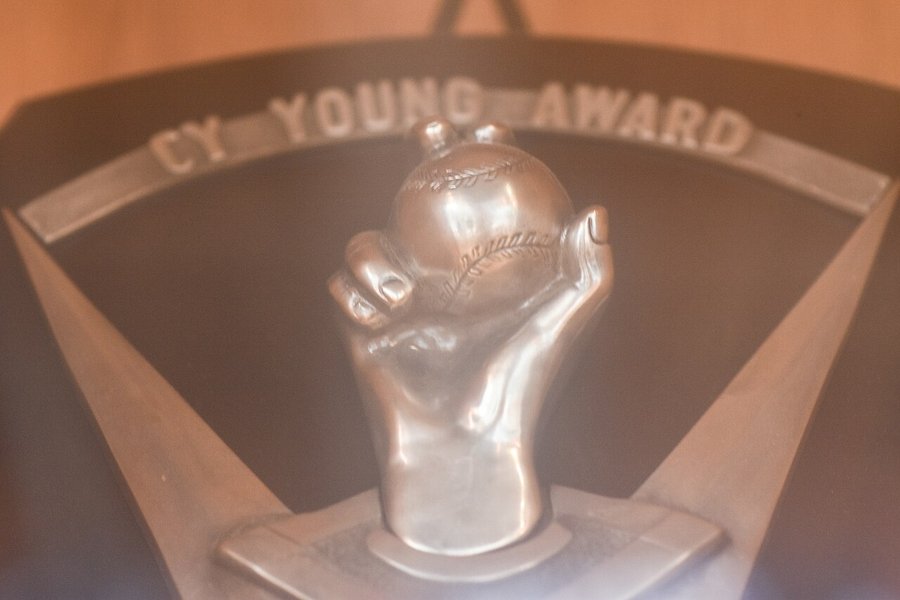
Across 906 major-league games he won 511, still the career record, with 2,803 strikeouts and an earned-run average of 2.63. He started 815 games, completed 749, and pitched more than 7,350 innings, all major-league records. He won at least 20 games in 16 seasons and at least 30 in five, and for 19 consecutive seasons ranked among his league’s ten busiest pitchers by innings. He also threw 76 shutouts. After leaving the game he managed the Cleveland Green Sox of the independent Federal League to a second-place finish in 1913, grew potatoes and tended sheep, hogs and chickens, and, with his wife, lived quietly in Peoli, Ohio. Their only child, a daughter, died a few hours after her birth in 1907. Robba died in January 1933; “Somehow, after she died I didn’t want to live there anymore,” he said, and he sold the farm. He was elected to the National Baseball Hall of Fame in 1937 and inducted when the museum opened in 1939, one of the first players to donate personal belongings to Cooperstown. Even before then, money had grown tight in the Depression: in 1935 he joined a group of baseball veterans in Augusta, Georgia, playing exhibition games; when that venture failed he came home and worked as a clerk in a store in Newcomerstown, Ohio, living with a local couple, John and Ruth Benedum. He attended old-timers’ reunions around the country, and he was still living with the Benedums when he died of a coronary occlusion on November 4, 1955, at the age of eighty-eight. He was buried in Peoli Cemetery. The following year Major League Baseball established the Cy Young Award to honor its outstanding pitchers.
What does Young’s 511-win record tell us about how the work of a pitcher has changed?
Sources
- National Baseball Hall of Fame — Cy Young
- Society for American Baseball Research — Cy Young, by Bill Nowlin
- Grand Lodge of Ohio — Cy Young
- Al Chymia Shrine — Famous Shriners (Cy Young)
Life & Masonic Timeline
Paul Thompson, via Wikimedia Commons · Public domain · Source