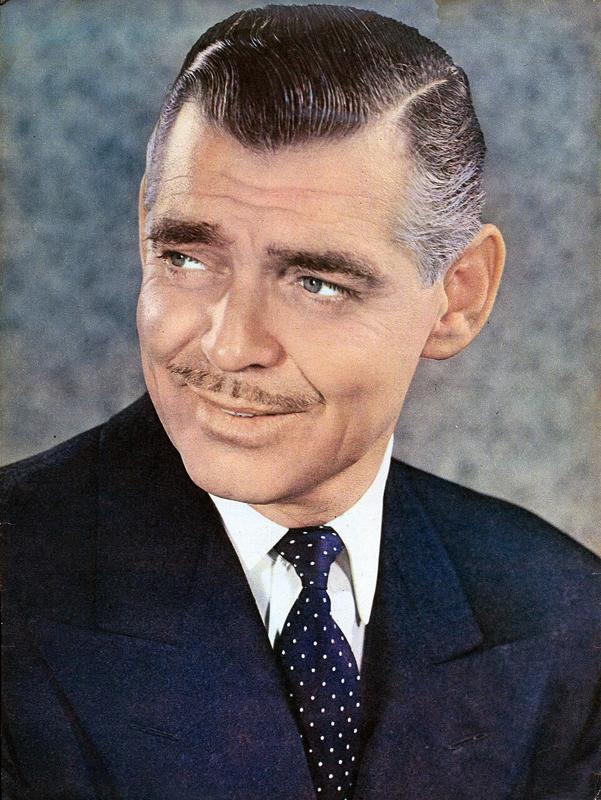
Clark Gable
Born February 1, 1901, Cadiz, Ohio · Died November 16, 1960, Los Angeles, California · Beverly Hills Lodge No. 528, California
Clark Gable, Hollywood’s King, won an Academy Award for It Happened One Night and starred as Rhett Butler in Gone with the Wind.
An Oil-Field Worker’s Son and a Long Road to the Screen
William Clark Gable was born on February 1, 1901, in Cadiz, Ohio, the only son of an itinerant oil-field worker. His mother died when he was not yet ten months old. He grew up in Ohio, reportedly left high school at sixteen, and held a string of jobs before he began acting in his early twenties.
In Oregon he became the protégé of the veteran actress Josephine Dillon, who coached him in poise and elocution and paid for his orthodontic work. Though he was seventeen years her junior, they married in 1924, about the time he began to land small roles in silent films.
His first big break was the lead in the Broadway play Machinal (1928). In 1930 a Los Angeles stage production of The Last Mile brought him to producers’ attention. He failed a first screen test at Metro-Goldwyn-Mayer, in part because executives thought his ears too big for a leading man, but his supporting performance in the low-budget western The Painted Desert (1931) convinced the studio. Forceful performances in A Free Soul and Night Nurse (both 1931), equal parts “man’s man” and “ladies’ man,” made him one of Hollywood’s top stars within a year. Red Dust and Strange Interlude (both 1932), Dancing Lady and Hold Your Man (1933), and Manhattan Melodrama and Men in White (1934) followed. For all the swagger, his screen presence was largely unthreatening. His smile and playful winks made him a charming rogue who did not take himself too seriously, and he kept a self-deprecating view of his own talent all his life, though he proved most capable in demanding roles.
As punishment for refusing a role, MGM lent him to Columbia Pictures, then derided as “poverty row,” for Frank Capra’s It Happened One Night (1934), opposite Claudette Colbert. The film swept the Academy Awards in all five major categories, and Gable won Best Actor. He did not think himself right for Fletcher Christian in Mutiny on the Bounty (1935), yet the film was hugely popular and earned him a second Oscar nomination. Also in 1935 he played Jack London’s hero in Call of the Wild for Twentieth Century Fox; during filming he had an affair with Loretta Young, who gave birth to a daughter later that year, though he was not publicly revealed as the father until well after his death. He reluctantly took the role of the political boss Blackie Norton in San Francisco (1936), one of the most praised and popular films of his career and the first of his pictures with Spencer Tracy, a pairing later repeated in Test Pilot and Boom Town. After the costume drama Parnell (1937) flopped, he at first declined the role of Rhett Butler in David O. Selznick’s film of Margaret Mitchell’s novel Gone with the Wind. Studio pressure and public demand brought him back, and the 1939 picture became one of the most popular films ever made. It won the Oscar for best picture, and Gable received his third nomination, for the role with which he is most associated.
The Star Who Chose to Fly
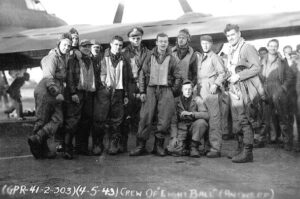
During the filming of Gone with the Wind he married the actress Carole Lombard; they had met on the set of No Man of Her Own (1932) but did not begin dating for several years. In 1942 Lombard was killed in a plane crash while returning home from a war-bond rally. Making movies suddenly seemed frivolous to him. Though past draft age, he enlisted as a private in the Army Air Forces at Los Angeles on August 12, 1942. He graduated from Officers’ Candidate School at Miami Beach as a second lieutenant on October 28, trained as an aerial gunner, and, on personal orders from General Hap Arnold, went to England in February 1943 to make a film about aerial gunners.
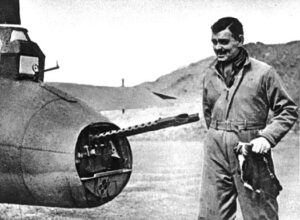
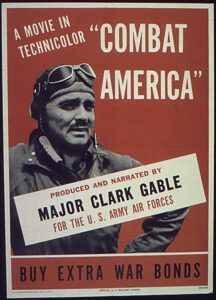
Assigned to the 351st Bomb Group at Polebrook, he flew operational missions over Europe in B-17s, though he was neither ordered nor expected to, to get the combat footage he believed the picture required. He served as a gunner, and the risk made him a greater hero than ever in the eyes of his fans. The footage became Combat America. He returned to the United States in October 1943 and was relieved from active duty as a major on June 12, 1944, at his own request, since he was over-age for combat. Because his film schedule made it impossible to fulfill his duties as a Reserve officer, he resigned his commission on September 26, 1947.
The Last Pictures, and the Fellowship of Beverly Hills Lodge
Gable returned to films after the war, but the joyous insouciance of his earlier performances was largely gone. Among the better pictures were The Hucksters (1947) and Mogambo (1953), and late films such as Band of Angels (1957), Run Silent, Run Deep (1958) with Burt Lancaster, and the romantic farces Teacher’s Pet (1958) with Doris Day and It Started in Naples (1960) with Sophia Loren. His final film, John Huston’s The Misfits (released in 1961), opposite Marilyn Monroe and Montgomery Clift, features one of his finest performances. He insisted on doing his own stunt work in its grueling scenes of roping wild horses, and he died of a heart attack within days of the film’s completion, on November 16, 1960, in Los Angeles, at fifty-nine. Several newspapers ran the same banner headline: “The King is Dead.” Several months later his fifth wife, Kay Williams, gave birth to John Clark Gable, his only son.
Gable was raised a Master Mason in Beverly Hills Lodge No. 528, in California, a lodge whose members included Douglas Fairbanks, one of the founders of the Academy of Motion Picture Arts and Sciences. Gable was known to slip away from celebrity life to enjoy the private fellowship of the lodge.
How did Gable’s decision to volunteer for combat change the course of an already successful film career?
Sources
- Encyclopaedia Britannica — Clark Gable
- Encyclopaedia Britannica — Clark Gable: Gone with the Wind, tragedy, and later films
- National Museum of the United States Air Force — Maj. Clark Gable
- California Freemason — Lights, Camera, Lodge
Life & Masonic Timeline
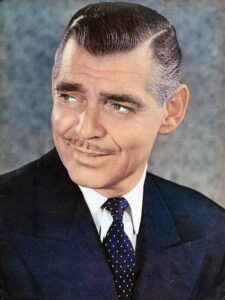
New York Daily News Color Studio (likely Harry Warnecke), via Wikimedia Commons · Public domain · Source