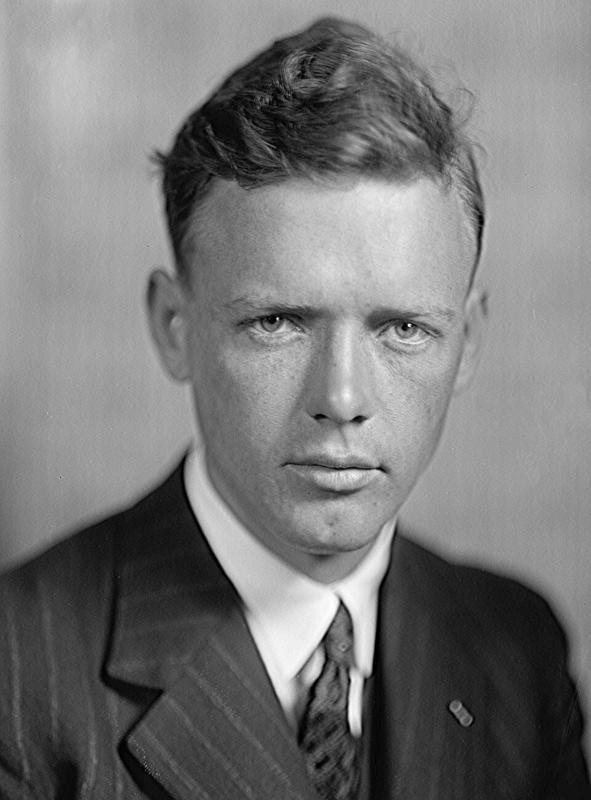
Charles Lindbergh
Born February 4, 1902, Detroit, Michigan · Died August 26, 1974, Kipahulu, Maui, Hawaii · Keystone Lodge No. 243, St. Louis, Missouri
Charles Lindbergh completed the first solo nonstop flight from New York to Paris in 1927, making the Spirit of St. Louis an aviation landmark.
Aviation will be one of the great forces of the future to bring nations together.
A Little Falls Farm, and a Young Man Who Left Wisconsin to Fly
Charles Augustus Lindbergh was born in Detroit, Michigan, on February 4, 1902. When he was less than two months old his parents took him to their farm on the west bank of the Mississippi River, two miles south of Little Falls, Minnesota. His father, Charles A. Lindbergh, a Little Falls lawyer, was elected to Congress from Minnesota’s Sixth District in 1906 and served for ten years. After that election the family spent winters in Washington and summers in Minnesota. His schooling was irregular; he later graduated from Little Falls High School. In 1912, near Washington, he saw his first airplane. He entered the College of Engineering at the University of Wisconsin in Madison, grew absorbed in aviation, and left after a year and a half to study flying with the Nebraska Aircraft Corporation in 1922.
He barnstormed in the Midwest until 1924, when, at twenty-two, he enrolled as a flying cadet in the Army Air Service and later received a reserve commission, becoming an officer in the Missouri National Guard. The following year he was hired as chief pilot for the Robertson Aircraft Corporation, flying the airmail between St. Louis and Chicago.
The Spirit of St. Louis, from New York to Paris
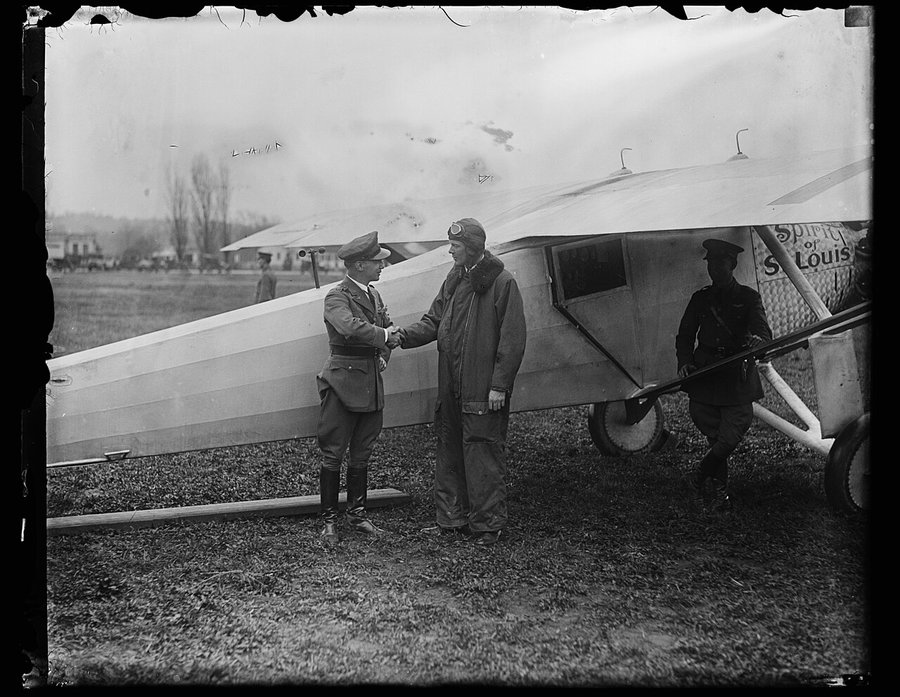
Early in 1927, with financial backing from St. Louis businessmen, he set out to win the twenty-five-thousand-dollar prize that the hotelier Raymond Orteig had offered in 1919 for the first nonstop flight between New York and Paris. In February he ordered an aircraft from Ryan Airlines in San Diego. Donald A. Hall designed it from a Ryan M-2 monoplane, with a large fuel tank ahead of the cockpit at the center of gravity. Lindbergh could see forward only through a periscope or by turning the plane to look out a side window. A Wright Whirlwind J-5C engine supplied the power. The silver aircraft, registered N-X-211 and named the Spirit of St. Louis, was finished late in April. On May 10–12 he flew it from San Diego to New York, stopping once at St. Louis, in 21 hours and 40 minutes, a new transcontinental record.
On the morning of May 20, 1927, after waiting several days for weather, the twenty-five-year-old pilot took off alone from Long Island. Thirty-three hours and thirty minutes later, and 3,610 miles on, having stayed awake the whole way through extreme cold and isolation, he landed at Le Bourget Field near Paris, where a crowd of more than a hundred thousand waited; headlights on the road to the field helped him find the strip. It was the first solo nonstop flight from New York to Paris. He and the plane returned aboard the U.S.S. Memphis on June 11. President Calvin Coolidge, calling him “our messenger of peace and goodwill,” welcomed him in Washington, and New York held a ticker-tape parade. He received the Distinguished Flying Cross, the French Legion of Honor, and, on March 21, 1928, on the White House lawn, the Medal of Honor. On April 30 he flew the plane from St. Louis to Washington and gave it to the Smithsonian Institution, where it remains.
Goodwill Tours, Anne Morrow, and a Kidnapping
The flight touched off the “Lindbergh boom” in aviation: aircraft stocks rose, and interest in flying jumped. On July 20, 1927, he set out on a ninety-five-day tour of the United States, stopping in 82 cities in all 48 states, and speaking at each stop about aviation’s commercial future. About thirty million people came out to see him and the plane. At the government’s request he then toured Latin America to help relations with Mexico, visiting 15 countries and flying 9,500 miles. On that tour he met Anne Morrow, a twenty-one-year-old college senior whose father, a diplomat, was one of his financial advisers. “What could I say to this boy?” she wrote in her diary. They married in 1929. That year she made her first solo flight and became the first woman in the United States to earn a glider-pilot’s license; she earned her private pilot’s license in 1931, learned Morse code, and qualified as a radio operator. Soon after the wedding the couple carried a camera on a transcontinental flight and made the first aerial maps of Arizona’s Canyon de Chelly and New Mexico’s Chaco Canyon and Pecos area, becoming, in effect, aerial archaeologists. She flew with him as navigator, copilot and radio operator, including a 1931 Great Circle survey through northern Canada, Alaska and Asia, and became the first woman to receive the National Geographic Society’s Hubbard Gold Medal, its highest award for exploration. She also published books about their travels, and fiction.
Fame also brought a terrible cost. In March 1932 the couple’s twenty-month-old son, Charles Jr., was kidnapped from his nursery. In May a truck driver found the child’s body. The arrest, trial and, in 1936, execution of Bruno Richard Hauptmann for the crime held the country’s attention for years.
Keystone Lodge No. 243, the Year Before the Crossing
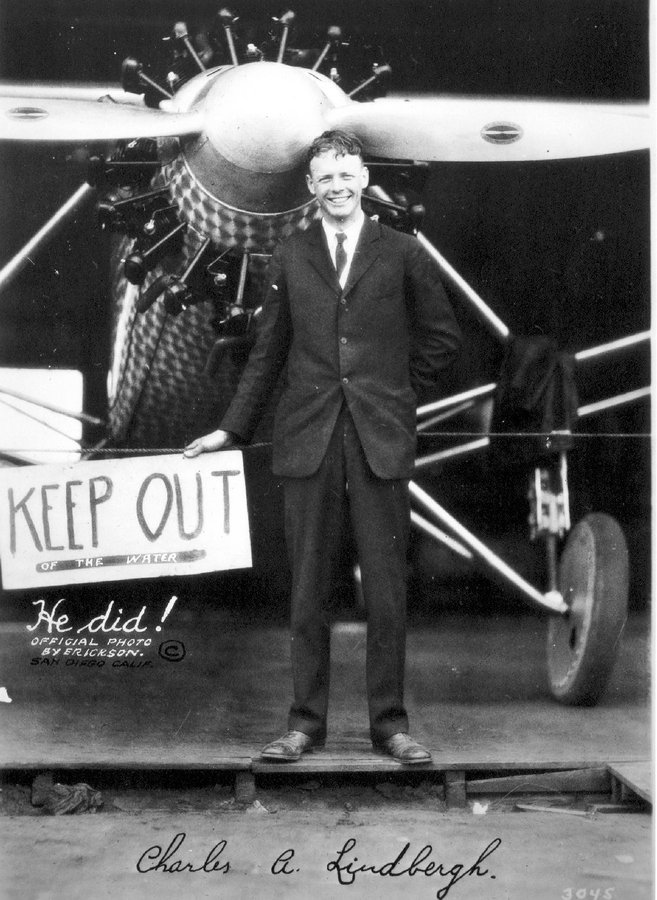
Lindbergh completed his Masonic degrees in 1926 at Keystone Lodge No. 243 in St. Louis, Missouri, while he was flying the airmail for Robertson, and was raised a Master Mason there that year, months before the Atlantic flight. From the sources we do have, it is believed that he wore a square and compasses pin during the crossing and that the Spirit of St. Louis carried a Masonic emblem.
A Speech in Des Moines, and What Followed
From 1939 to 1941 Lindbergh was the most famous public voice of the isolationist movement that opposed American entry into the Second World War. He delivered more than a dozen speeches for the America First Committee. In a 1939 article in Reader’s Digest he set those views in racial terms, writing that people of “European blood” must prevent “dilution by foreign races” and that war would “reduce the strength and destroy the treasures of the White race.” On October 18, 1938, Hermann Göring, a high-ranking Nazi leader, had presented him with the Service Cross of the German Eagle, a decoration that included a signed proclamation from Adolf Hitler, for services to world aviation. Lindbergh never returned the medal. He was not a Nazi: he condemned the horrors of Nazism in the strongest terms and firmly supported the Nuremberg war-crimes trials. But he was antisemitic and had an interest in eugenics.
On the evening of September 11, 1941, Lindbergh addressed an America First rally at the Des Moines Coliseum. The speech, which he titled “Who Are the War Agitators?,” named three groups he said were pressing the United States into the war: the British, “the Jews,” and the Roosevelt administration. He said that “no person with a sense of the dignity of mankind can condone” the Nazis’ treatment of Jews in Europe, then turned to Jews in the United States and repeated conspiracy claims, including that their “greatest danger” was “their large ownership and influence in our motion pictures, our press, our radio, and our Government.” The press reaction was overwhelmingly hostile, and after the speech he was no longer invited to America First rallies. When Japan attacked Pearl Harbor on December 7, he issued a statement: “Our country has been attacked by force of arms, and by force of arms we must retaliate.” The Roosevelt administration denied him any official wartime role. He died on Maui, Hawaii, in August 1974, at the age of seventy-two, and was buried at the Kipahulu Church Cemetery.
How should Lindbergh’s Atlantic flight be remembered alongside his later antisemitic speech and isolationist politics?
Sources
- Smithsonian National Air and Space Museum — Charles Lindbergh
- Smithsonian National Air and Space Museum — Ryan NYP Spirit of St. Louis
- United States Holocaust Memorial Museum — Charles Lindbergh and the “War Agitators” Speech
- Congressional Medal of Honor Society — Charles Augustus Lindbergh Jr.
- Grand Lodge of Maryland — Charles Lindbergh
- Charles A. Lindbergh, “We” (1927), Project Gutenberg
Life & Masonic Timeline
Harris & Ewing, via Wikimedia Commons · Public domain · Source