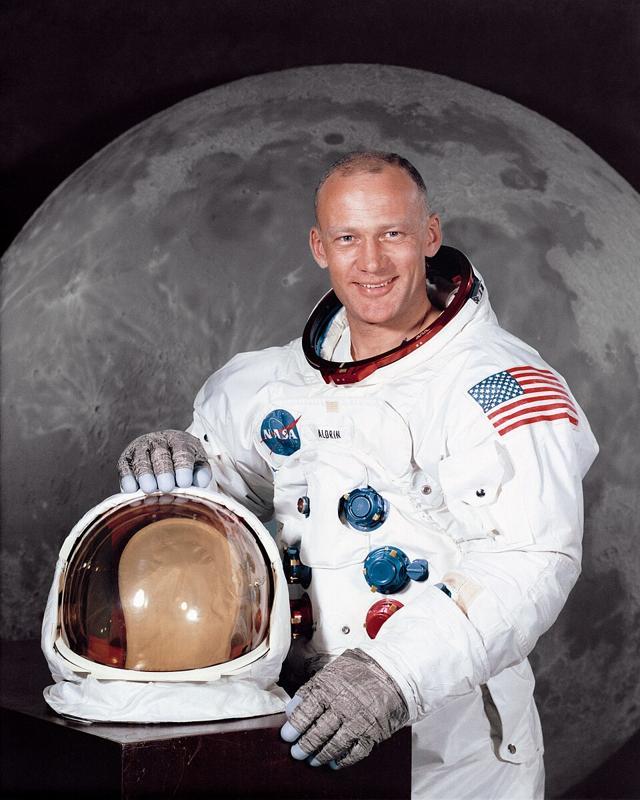
Buzz Aldrin
Born January 20, 1930, Glen Ridge, NJ · Lawrence N. Greenleaf Lodge No. 169, Denver (raised); also Oak Park No. 864, Montclair No. 144, Clear Lake No. 1417
Buzz Aldrin piloted the Apollo 11 lunar module in July 1969 and followed Neil Armstrong onto the Moon as the second man to walk on its surface.
A Montclair Boy, a Korean War Pilot, and a Doctorate in Rendezvous
Edwin Eugene “Buzz” Aldrin Jr. was born on January 20, 1930, in Montclair, New Jersey, and graduated from Montclair High School. In 1951 he received a bachelor of science degree from the United States Military Academy at West Point, graduating third in his class. As an Air Force fighter pilot in the Korean War he flew 66 combat missions in F-86s and shot down two MiG-15s. He then served as an aerial gunnery instructor at Nellis Air Force Base in Nevada and as aide to the dean of faculty at the Air Force Academy, and flew F-100s as a flight commander at Bitburg, Germany. He went on to earn a doctorate of science in astronautics at the Massachusetts Institute of Technology, with a thesis on guidance for manned orbital rendezvous, and was assigned to the Gemini Target Office of the Air Force Space Systems Division in Los Angeles. The National Aeronautics and Space Administration (NASA) named him in its third group of astronauts in October 1963. Before the first landing on the Moon, he flew as pilot of Gemini XII, the tenth and final crewed flight of the Gemini program, which bridged the Mercury and Apollo programs.
Gemini XII’s Three Spacewalks and a Docking with Agena
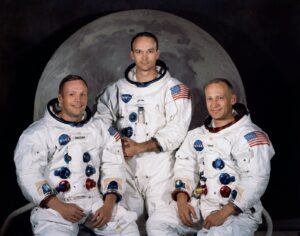
Gemini XII launched on November 11, 1966, from Complex 19 at Cape Canaveral, with James A. Lovell Jr. as command pilot and Aldrin as pilot. An Agena target vehicle had been placed in orbit about an hour and a half earlier, and the crew’s objectives included rendezvous and docking with that vehicle, three periods of work outside the spacecraft, a tethered station-keeping exercise, docked maneuvers using the Agena propulsion system, an automatic reentry, and fourteen scientific, medical, and technological experiments. Backup crewmen were L. Gordon Cooper Jr. and Eugene A. Cernan. The flight lasted three days, 22 hours, 34 minutes, and 31 seconds.
On November 12, Aldrin performed a standup spacewalk lasting two hours and 29 minutes. On November 13, he left the spacecraft on a spacewalk of two hours and six minutes, after which Gemini XII undocked from the Agena for a tether experiment. A third standup spacewalk, lasting 55 minutes, followed on November 14. Altogether he spent about five and a half hours outside the spacecraft, a new record for extravehicular activity. The spacecraft splashed down in the western Atlantic on November 15, bringing the Gemini program to a successful close. Those three periods of work outside the cabin were among the exercises NASA used to prepare crews for the Apollo lunar missions that followed.
Eagle, Columbia, and the Sea of Tranquility
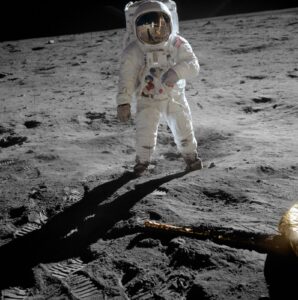
Apollo 11 launched from Cape Kennedy on July 16, 1969, at 9:32 a.m. Eastern Daylight Time, from Launch Pad 39A. Neil Armstrong commanded the mission; Michael Collins was command module pilot of Columbia, and Aldrin was lunar module pilot of Eagle. After a translunar injection burn, Columbia separated from the stage that carried Eagle, docked with the lunar module, and continued toward the Moon. On July 18, Armstrong and Aldrin entered Eagle through the docking tunnel to check the vehicle. On July 19, after Apollo 11 had passed behind the Moon, a retrograde firing placed the combined spacecraft into lunar orbit, later adjusted to about 62 by 70.5 miles.
On July 20, Eagle undocked from Columbia. A descent-orbit insertion burn, performed while the lunar module was behind the Moon, was followed by powered descent. Armstrong partly piloted the final approach by hand in order to avoid a crater. Eagle landed in the Sea of Tranquility, about four miles downrange from the predicted point and almost a minute and a half earlier than scheduled. A commemorative plaque signed by President Richard M. Nixon and the three astronauts was attached to the descent stage. The first walk on the surface was advanced from a planned rest period. Armstrong stepped onto the Moon at about 109 hours and 42 minutes after launch; Aldrin followed about 20 minutes later. President Nixon spoke with them by telephone. The pair ranged up to 300 feet from Eagle. Aldrin deployed the Early Apollo Scientific Experiments Package, and both men collected surface samples. After Aldrin had spent one hour and 33 minutes on the surface, he re-entered the lunar module, followed 41 minutes later by Armstrong. The entire excursion lasted more than two and a half hours. Armstrong and Aldrin spent 21 hours and 36 minutes on the Moon.
The ascent stage lifted off and docked with Columbia, and the lunar module was later jettisoned. After a midcourse correction on the return flight, Apollo 11 re-entered Earth’s atmosphere on July 24. The command module splashed down in the Pacific Ocean at 12:50:35 p.m. Eastern Daylight Time, after a flight of 195 hours, 18 minutes, and 35 seconds, about 13 miles from the recovery ship USS Hornet. Because of weather, the landing point had been shifted about 250 miles. An estimated 650 million people watched Armstrong’s first step on the surface.
Return to Earth, and the Years After Apollo
Aldrin received the Presidential Medal of Freedom in 1969, as well as the Robert J. Collier Trophy, the Robert H. Goddard Memorial Trophy and, in 1967, the Harmon International Trophy. He logged 289 hours and 53 minutes in space, 7 hours and 52 minutes of them outside his spacecraft. He resigned from NASA in July 1971. His last Air Force post was as commander of the Test Pilot School at Edwards Air Force Base in California, and in March 1972 he retired from active duty after twenty-one years of service. He wrote an autobiography, Return to Earth, and later a book about the Apollo program, Men from Earth, and he lectured around the world on America’s future in space.
Clear Lake Lodge, a Flag for the House of the Temple, and Tranquility Lodge No. 2000
From the sources we do have, it is believed that Aldrin was initiated at Oak Park Lodge No. 864 in Alabama and raised at Lawrence N. Greenleaf Lodge No. 169 in Colorado, and that he later became a member of the York Rite and of Arabia Shrine Temple of Houston. On July 20, 1969, he was a member of Clear Lake Lodge No. 1417, Ancient Free and Accepted Masons, in Seabrook, Texas. The Grand Master of Texas, J. Guy Smith, issued a Special Deputation appointing Aldrin a Special Deputy of the Grand Master, with authority to claim Masonic territorial jurisdiction for the Grand Lodge of Texas on the Moon and to make due return of his acts. Aldrin certified that he carried the deputation with him on July 20, 1969.
Astronauts were allowed to carry personal items, and Aldrin also took a Scottish Rite flag, emblazoned in color with the double-headed eagle, the Blue Lodge emblem and the insignia of the Sovereign Grand Commander of the Southern Jurisdiction. On September 16, 1969, he was welcomed to the House of the Temple in Washington, D.C., by Sovereign Grand Commander Luther A. Smith and Grand Secretary General Kleinknecht, and presented the flag to the Supreme Council. Three days later he wrote to Smith that it had been “a great moment in my life to be so cordially welcomed,” and that his greatest pleasure had been to present “the Scottish Rite Flag which I carried on the Apollo 11 Flight to the Moon.”
To commemorate the landing, the Grand Lodge of Texas later chartered Tranquility Lodge No. 2000, named for the Sea of Tranquility. The lodge is based in Texas under that Grand Lodge until it may meet on the Moon. Its stated purposes include promoting the principles of Freemasonry and assisting organizations that work for the health, welfare, education, and patriotism of children. Meetings are held quarterly in various Texas cities, with an annual meeting in Waco each July. The Grand Lodge of Texas counts itself the first grand lodge to have a member step onto the Moon.
What does Aldrin’s Special Deputation reveal about the public symbolism of the Moon landing?
Sources
- NASA, Apollo 11 Mission Overview
- NASA, Gemini XII
- NASA, Apollo 11
- NASA Goddard Space Flight Center, Apollo 11 mission information
- Tranquility Lodge No. 2000, History
- Grand Lodge of British Columbia and Yukon, Freemasons in Space
- Scottish Rite, Northern Masonic Jurisdiction — Masonic astronauts
- NASA Johnson Space Center — Buzz Aldrin biographical data
- Grand Lodge of British Columbia and Yukon — Aldrin’s letter to the Sovereign Grand Commander, September 19, 1969

Life & Masonic Timeline
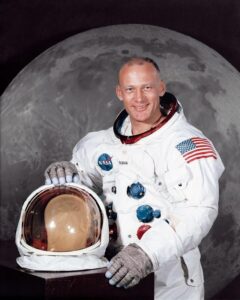
NASA, via Wikimedia Commons · Public domain · Source