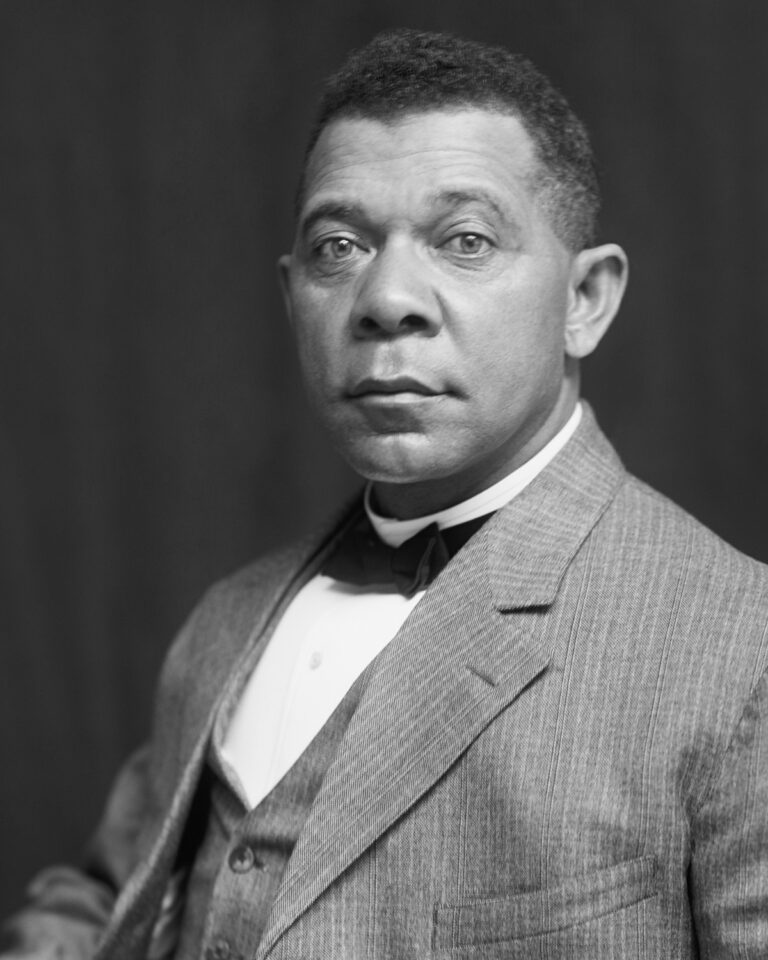
Booker T. Washington
Born April 5, 1856, Hale's Ford, Virginia · Died November 14, 1915, Tuskegee, Alabama · Prince Hall Grand Lodge of Massachusetts (believed membership)
Booker T. Washington led Tuskegee Institute for more than thirty years and became an influential voice for Black education in America.
From Hale’s Ford to Tuskegee
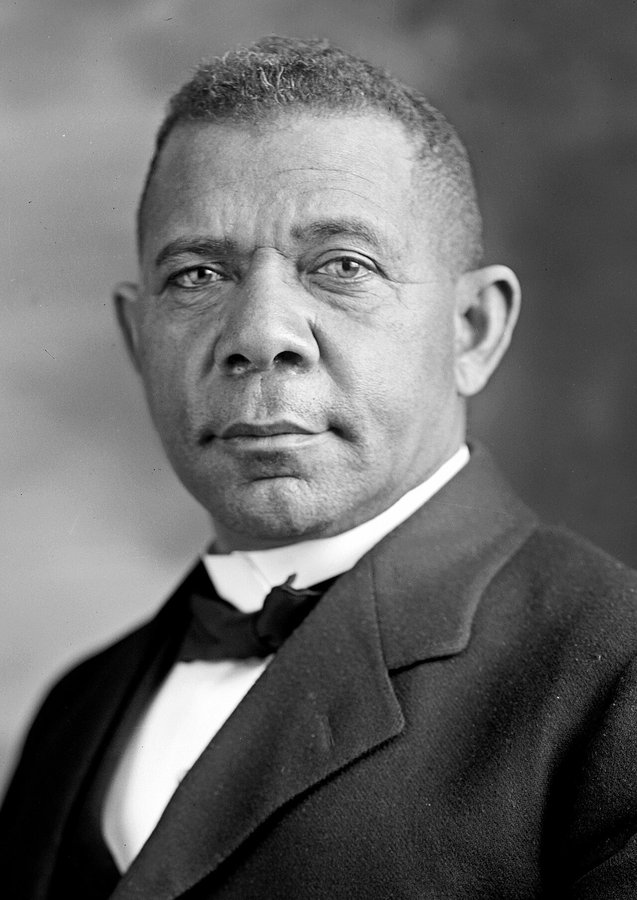
Booker Taliaferro Washington was born into slavery on a small tobacco farm owned by James Burroughs at Hale’s Ford, Virginia. Few records were kept of enslaved births, and April 5, 1856, is the date usually given. He lived with his mother, Jane, the plantation cook, and his brother and sister in a one-room log cabin with a dirt floor that also served as the plantation kitchen. One of his duties was to carry a Burroughs daughter’s books to school, and he lingered at the schoolhouse door longing for the education he was not allowed. He never knew his father’s name, and it was widely speculated that his father was a white plantation owner. In 1860 his mother married Washington Ferguson, an enslaved man from a nearby plantation who later escaped to West Virginia. The family saw him only once a year, at Christmas, but Booker considered him his stepfather.
A Coal Miner Who Walked to Hampton
After emancipation in 1865, his mother took her children to Malden, West Virginia, to join Ferguson, who was working in the salt works there. At nine Booker was packing salt; between ten and twelve he worked in a coal mine, putting in his hours mornings and evenings so that he could attend school in Tinkersville, a small town outside Malden. He gave himself the surname Washington when he first enrolled. In 1871 he became a houseboy for the wife of General Lewis Ruffner, the mine owner.
At sixteen he set out for Hampton Normal and Agricultural Institute in Virginia, traveling most of the way on foot and arriving with only fifty cents. His entrance examination was to clean a room, which a teacher inspected with a white handkerchief; he was admitted and paid his room and board as a janitor. Principal Samuel Chapman Armstrong’s combination of practical training and academic study shaped his educational thinking, and Washington later called him “the noblest, rarest human being it has ever been my privilege to meet.”
Washington graduated with honors in 1875 and returned home to teach at a Black school in Tinkersville until 1878. He studied for eight months at Wayland Seminary and returned to Hampton in 1879 to teach Native American students and lead the night school. When Alabama approved a school for Black teachers in Macon County at the urging of Lewis Adams, a former slave, and George W. Campbell, a former slave owner, officials asked Armstrong to recommend a white principal. He recommended Washington instead.
The Principal Who Built a Campus with Student-Made Brick
Tuskegee opened on July 4, 1881, in a building borrowed from Butler Chapel African Methodist Episcopal Zion Church. The state’s $2,000 a year covered salaries but provided no land or buildings. With money borrowed from Hampton’s treasurer, Washington bought an abandoned hundred-acre plantation. Students built a kiln, made bricks, erected classrooms, a dining hall, a dormitory and a chapel, and sold surplus bricks to raise money. The first class of thirty graduated in 1885, and by 1888 the institute covered 540 acres and enrolled more than four hundred students.
Instruction combined academic subjects with farming, printing, carpentry, shoemaking and other trades, and Washington insisted that classroom teaching relate to students’ experience. In 1896 he hired George Washington Carver to lead the agricultural work; Carver introduced crop rotation to cotton farmers working depleted soils, found numerous uses for the peanut and the sweet potato, and developed an agricultural extension program in Alabama managed by a Tuskegee graduate, Thomas Monroe Campbell. His Movable School, a classroom on wheels, carried improved farming methods to rural Black farmers. Washington raised money from Andrew Carnegie, John D. Rockefeller, Julius Rosenwald, Anna T. Jeanes and others, and in 1900 founded the National Negro Business League to advise Black businessmen. The writers Claude McKay, Ralph Ellison and Albert Murray later studied at Tuskegee.
His home life was marked by loss. He married Fanny Smith in 1882; she died in 1884, leaving a daughter. Olivia Davidson, Tuskegee’s first woman principal, became his second wife in 1885 and bore two sons before her death in 1889. In 1892 he married Margaret James Murray, a teacher and later a principal, and they raised her orphaned niece, Laura.
The Atlanta Speech and the Quarrel with Du Bois
Washington’s 1895 address at the Cotton States and International Exposition in Atlanta established him as a national spokesman. The speech came to be known as the Atlanta Compromise. He told his audience that Black and white Southerners could be as separate as the fingers in social matters yet one as the hand in mutual progress. Many white Americans welcomed the speech because it did not demand political equality. As disfranchisement and racial violence grew, other Black leaders came to see it as a ready acceptance of second-class citizenship. Others supported him for his advocacy of industrial education, which Frederick Douglass had embraced before him.
W. E. B. Du Bois became his chief critic. In The Souls of Black Folk in 1903 he challenged Washington’s emphasis on industrial education and his near silence on voting rights, and he called Washington’s political and financial network of editors, educators, politicians and philanthropists the “Tuskegee Machine.” When Alabama’s 1901 constitution disfranchised most Black voters, Washington, who could vote, protested little, and as he kept giving speeches in the spirit of Atlanta he came to be called the “Great Accommodator.” Washington was more active than his public caution suggested. He secretly funded efforts against lynching, asked Secretary of War William Howard Taft to intervene when Southern states disbanded Black militia units in 1905, and lobbied Theodore Roosevelt to reverse the dismissal of Black soldiers after the Brownsville affair. He advised Presidents William McKinley, Roosevelt and Taft on race relations and appointments, and he dined with Roosevelt at the White House in 1901, the year Up from Slavery appeared.
By Tuskegee’s twenty-fifth anniversary the campus covered two thousand acres, with eighty-three buildings and more than fifteen hundred students. Washington’s later books included The Negro in the South, written with Du Bois in 1907, Character Building, My Larger Education and The Man Farthest Down. When his health failed in 1915 he returned from a New York hospital to Tuskegee, where he died on November 14 at fifty-nine, most likely of overwork and heart disease. His funeral drew nearly eight thousand people, and students made the brick for his tomb on campus. His home, The Oaks, is now part of Tuskegee Institute National Historic Site, and his Virginia birthplace became a national monument on April 5, 1956.
Washington and Prince Hall Freemasonry
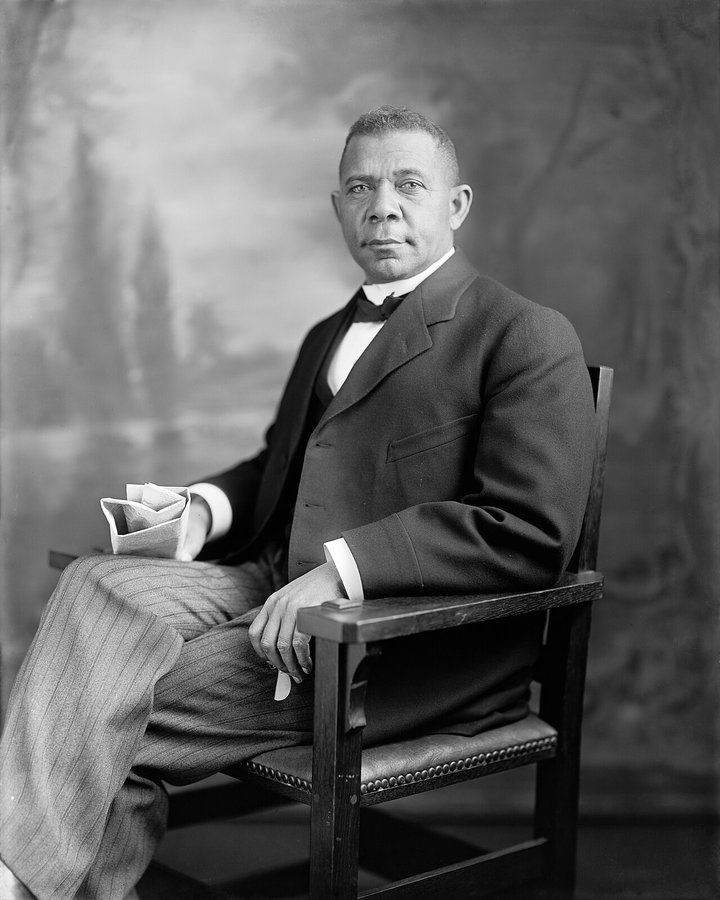
From the sources we do have, it is believed that Washington was made a Mason “at sight” by the Grand Master of the Prince Hall Grand Lodge of Massachusetts, a Grand Master’s traditional power to make a man a Mason outside the usual lodge process, and that, living in Alabama, he never affiliated with a lodge in Massachusetts.
The question is not settled. The historians who edited his papers counted the Prince Hall Masons among the fraternal orders to which he did not belong, though in the years 1906 to 1908 he worked privately to influence them. The Masons invited him to be the orator at their centennial celebration and then, after heated debate, withdrew the invitation.
What do Tuskegee’s student-built classrooms reveal about Washington’s vision of education?
Sources
- Tuskegee University — Booker T. Washington
- Encyclopedia of Alabama — Booker T. Washington
- Grand Lodge of British Columbia and Yukon — Booker T. Washington
Life & Masonic Timeline
Booker T. Washington, c. 1895. Frances Benjamin Johnston. via Wikimedia Commons, cropped · Public domain · Source