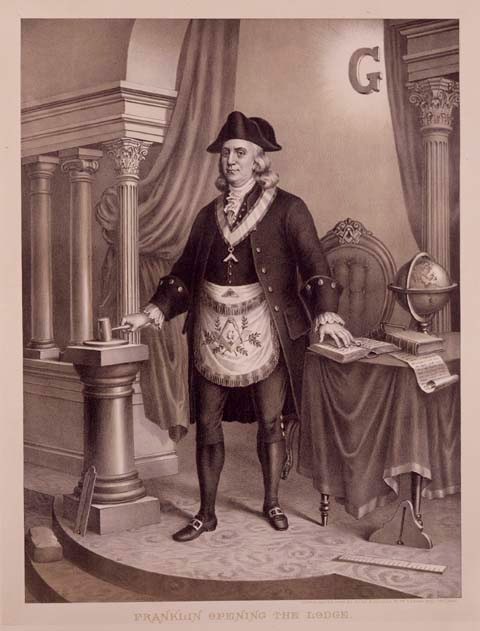
Benjamin Franklin
Born January 17, 1706 · Died April 17, 1790 · St. John's Lodge, Philadelphia
Printer, scientist, and founding father, Franklin joined St. John’s Lodge in Philadelphia in 1731, printed the first Masonic book in America, and served as Grand Master of Pennsylvania.
They are in general a very harmless sort of People; and have no principles or Practices that are inconsistent with Religion or good Manners.
The printer who could not leave a problem alone
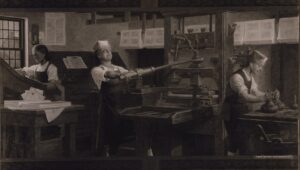
Benjamin Franklin was born in Boston on January 17, 1706. From 1718 to 1723 he was apprenticed as a printer to his brother James, and in 1723 he moved to Philadelphia with little more than his trade. He worked in London as a journeyman printer, came home, bought the Pennsylvania Gazette in 1729, and published Poor Richard’s Almanack from 1732 to 1758. By 1748 he had done well enough to retire from printing and give the rest of his life to science and public service.
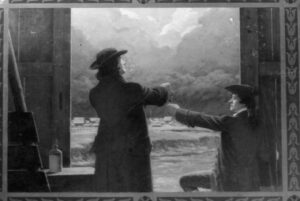
He seemed unable to see a problem without trying to fix it. He invented the Franklin stove, the lightning rod and bifocals, and in 1751 he published Experiments and Observations on Electricity. In 1727 he gathered the Junto, a club of friends who met to improve themselves and their city. Out of that habit of mind came the Library Company of Philadelphia, fire companies, better lighting and paving, the Pennsylvania Hospital and the American Philosophical Society. His 1749 proposals on education became the basis of the Academy that grew into the University of Pennsylvania.
His public career was just as wide. He was clerk of the Pennsylvania Assembly and postmaster of Philadelphia. In 1754 he proposed a plan for colonial unity at the Albany Congress, and he represented the colonies in London for most of the years between 1757 and 1775. He served on the committee that drafted the Declaration of Independence. As commissioner and then minister to France, he secured the treaties of 1778 that brought France into the war, and in 1783 he signed the Treaty of Paris that recognized American independence. At 81 he represented Pennsylvania at the Constitutional Convention. He died in Philadelphia on April 17, 1790.
A founder with a divided record
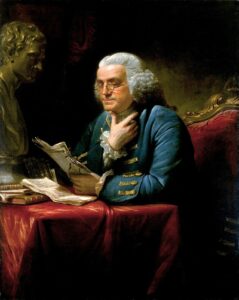
Franklin showed that ordinary people, organized and curious, can build the institutions a community needs, such as a library, a hospital, a school or a fire company, without waiting for anyone’s permission. That idea of civic self-improvement is still one of the best things America has given the world.
He was also one of the first to imagine the colonies acting as one. His 1754 plan for colonial unity at Albany came more than twenty years before independence. As a diplomat in Paris, his reputation as a scientist and man of letters won the new nation friends it badly needed. The treaties he signed in 1778 and 1783 helped bring the United States into being. Few people have served their country in so many ways: as printer, scientist, organizer, legislator and diplomat.
His record on slavery needs to be told plainly. The University of Pennsylvania’s archives note that from as early as 1735 to as late as the 1770s he owned at least seven enslaved people. His Gazette printed advertisements for slave auctions and runaways, while also printing essays deeply critical of slavery. His views changed slowly. In 1757 he supported a school for African Americans in Philadelphia, and in 1787 he became president of the Pennsylvania Society for Promoting the Abolition of Slavery. One of his last public acts was to sign the Society’s February 1790 petition asking Congress to end slavery and the slave trade. Congress set it aside, and he died two months later. His life shows both how deep the wrong ran and how a man can change his mind late, and act on it.
Among the first Masons of Pennsylvania
Franklin was made a Mason in St. John’s Lodge in Philadelphia in 1730 or 1731. The Grand Lodge of Pennsylvania records that he was entered, passed and raised early in 1731, but the lodge’s early minutes were long ago lost, so no exact dates survive for his second and third degrees. The Grand Lodge of Ohio notes that before he joined, he had poked fun at the fraternity in his newspaper, and that his tone changed to warm praise once he was a member. He rose quickly. Within about a year he was on the committee drafting St. John’s Lodge by-laws, and on June 24, 1732, he was appointed Junior Warden of the Grand Lodge of Pennsylvania. In 1734 he was Grand Master, and later he served as Secretary.
Also in 1734 he printed The Constitutions of the Free-Masons, a reprint of Anderson’s 1723 work, which became the first Masonic book printed in America. In France he joined the Paris lodge Les Neuf Sœurs in 1777, and in 1778 he took part in Voltaire’s initiation there. He was also elected to other French lodges in the 1780s. For a man so busy with the world, he made time for the lodge for most of his adult life.
It would be easy to overclaim, so we won’t. Franklin’s genius was his own. But a man who formed a club for mutual improvement at 21, and who spent his life turning good intentions into working institutions, clearly found something familiar in a fraternity built to make good men better. Brethren today can take up the same work in small ways: one improvement, one neighbor and one useful act at a time.
Franklin started a library, a fire company and a hospital by gathering a few friends around a problem. What is one need in your town that a handful of brothers could take on together?
Sources
- Library of Congress, Benjamin Franklin (1706 to 1790) timeline
- University of Pennsylvania Archives, Benjamin Franklin
- National Archives, Benjamin Franklin’s Anti-Slavery Petitions to Congress
- Grand Lodge of Pennsylvania, Freemason (Dec. 1955), William J. Paterson, "Benjamin Franklin, The Freemason"
- Grand Lodge of Ohio, Benjamin Franklin: Freemason & Founding Father
Life & Masonic Timeline
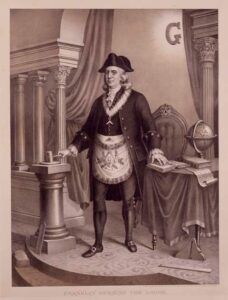
Franklin Opening the Lodge, 1896. Kurz & Allison, Chicago. Public domain. · Public domain