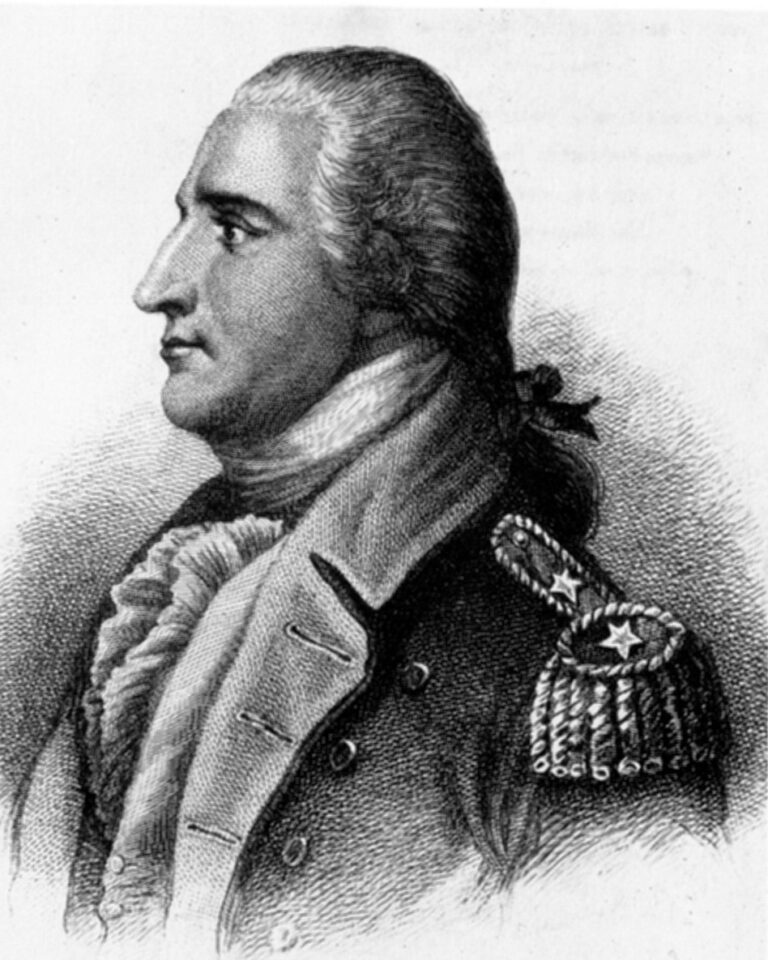
Benedict Arnold
Born January 14, 1741, Norwich, Connecticut · Died June 14, 1801, London, England · Hiram Lodge No. 1, New Haven, Connecticut
Benedict Arnold fought for American independence at Saratoga before plotting to surrender West Point to the British in 1780.
A Norwich-Born Merchant, Ticonderoga, Quebec, and Valcour Island
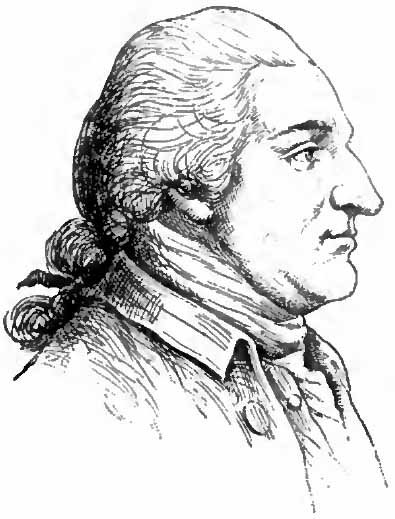
Benedict Arnold was born in Norwich, Connecticut, on January 14, 1741, the great-grandson of a Rhode Island governor of the same name. The family was prominent, but he lost most of his siblings to yellow fever, losses that may have driven his father to drink, and in his teens the family fell on hard times. As a young man during the French and Indian War he enlisted in the New York militia twice, and twice returned home under pressure from his family to complete an apothecary apprenticeship with his uncles. After his parents died, when he was 21, he moved with his sister to New Haven and opened a store. He became one of the more successful coastal merchants, with ships sailing between the Caribbean and Canada. In the 1760s the Stamp Act and the Sugar Act brought him into conflict with British regulation of colonial trade. He joined the Sons of Liberty and carried on his business in defiance of those acts, in effect becoming a smuggler. In 1767 he married Margaret Mansfield; they had three sons. She died in June 1775.
From the sources we do have, it is believed that Arnold became a Freemason on his merchant voyages to Canada and the West Indies; the dates of his degrees are not known. On April 10, 1765, he affiliated with Hiram Lodge No. 1 in New Haven, whose minutes read: “Brother Benedict Arnold is by Right Worshipful [Nathan Whiting] proposed to be made a member of the Right Worshipful Lodge and is accordingly made a member in this Lodge.” Margaret Mansfield was the daughter of a fellow Freemason, Samuel Mansfield.
From Shared Command at Ticonderoga to the Attack at Saratoga
In 1775, as captain of a Connecticut militia company, Arnold rode to Cambridge, Massachusetts, after the fighting at Lexington and proposed an expedition against Fort Ticonderoga. He received permission to lead a force there and, on the way, encountered Ethan Allen and the Green Mountain Boys on the same errand. After argument, the two agreed to share command and captured the fort, then Crown Point and Fort George, by the end of June. Arnold later believed he had been forced from command of those posts. In September, under orders from General George Washington, he took part in the American invasion of Canada. The attempt to add a “Fourteenth Colony” failed in a desperate attack on Quebec; Arnold was wounded in the leg and was promoted to brigadier general.
In the summer of 1776 he was placed in charge of an American fleet on Lake Champlain, with orders from General Horatio Gates to defend the area and to attack only if attacked. Learning that a British force under Guy Carleton had gathered at the northern end of the lake, Arnold stationed his ships near Valcour Island in October. After several days of fighting he saved many of his men by grounding and burning the vessels. Gates regarded the maneuver as a disobedience of orders. In August 1777, General Philip Schuyler sent Arnold west from Albany to relieve Fort Schuyler, then under pressure from Barry St. Leger. Arnold turned St. Leger’s Indian allies by inducing a loyalist to spread rumors of a large approaching force; St. Leger retreated before Arnold arrived on August 21.
Back with the northern army, now under Gates, Arnold argued after the fighting at Freeman’s Farm over whether to attack Burgoyne’s shaken force and was relieved of command. On October 7, when Burgoyne struck again, Arnold rode onto the field against Gates’s orders and led an attack that captured a British stronghold. The position gained that day helped force Burgoyne’s surrender. Arnold was wounded in the same leg injured at Quebec. Washington and Congress thanked him and promoted him to major general; he was sent to Philadelphia to recover, no longer able to command in the field. Today a monument to Arnold’s leg stands at Saratoga National Historical Park. During his recovery he turned to a Masonic duty. Dr. Joseph Warren, a fellow Mason who had become his friend in Massachusetts, had been widowed in 1773, and his death at Bunker Hill left four children orphaned. In April 1778 Arnold contributed $500 toward their education and persuaded Congress to pay a pension for their support from the date of their father’s death until the youngest came of age.
Philadelphia, West Point, and a Name That Became a Synonym
In June 1778, Washington gave Arnold command of Philadelphia after the British withdrawal. The following year he married Peggy Shippen, a member of a prominent Loyalist family in the city. He was the focus of hostility from other officers and from Pennsylvania’s Supreme Executive Council. He had brought complaints against Moses Hazen that led to Hazen’s court-martial, and Hazen answered with charges of his own; Joseph Reed, a former aide to Washington who sat on the council, attacked Arnold’s conduct as oppressive to the people of Philadelphia, and Washington referred the matter to Congress. In January 1780 a court-martial cleared him of serious charges but, in Washington’s words, found his conduct “imprudent and improper.” The trial damaged his reputation. John Brown, who had served with him in the Quebec campaign, published a pamphlet claiming, “Money is this man’s God, and to get enough of it he would sacrifice his country.”
Arnold resigned his Philadelphia post and, with the endorsement of Philip Schuyler, obtained command of West Point, a fortified position on the Hudson River. While still in Continental service he entered into secret negotiations with the British, passed information that would help them take the post, and weakened its defenses and thinned its supplies. Some of the letters survive: lines written by Peggy Arnold are interspersed with Arnold’s coded text, first written in invisible ink. His British contact was Major John André, the officer in charge of British intelligence in North America. In late September 1780, André was stopped by three patriots, John Paulding, Isaac Van Wart and David Williams, and searched; the documents he carried implicated Arnold. Two of his captors later became Freemasons: Paulding joined Cortlandt Lodge No. 34 in New York in the 1790s, and Williams joined Lotus Lodge No. 31 in 1827, serving as its first Junior Warden. The Americans offered to exchange André for Arnold; the British refused, and André was hanged as a spy. He made so sympathetic a figure that Colonel Alexander Hamilton, Washington’s aide-de-camp, wrote, “He died universally esteemed and universally regretted.” Arnold escaped aboard the ship Vulture. Washington wrote, “Treason of the blackest dye was yesterday discovered!” Britain made him a brigadier general and gave him a pension, money for his lost property and command of deserters and Tories, making him the only man to serve as a general on both sides of the war. The British never fully trusted him, but they placed him in command of 1,600 troops on a mission to burn Richmond, Virginia. On May 16, 1781, Solomon’s Lodge No. 1 resolved: “Ordered that the Name of Benedict Arnold be considered as obliterated from the Minutes of this Lodge, a Traitor.” His signature in the lodge’s list of visitors for June 12, 1771, was struck through in a way that leaves the name beneath still legible, and beside the resolution someone drew a small hand with a finger pointing at the word “Traitor.”
Arnold served in the British army for the rest of the war and afterward engaged in business in Canada and England. He died in London on June 14, 1801, at the age of 60, and was buried at St. Mary’s Church, Battersea. His name became, in the United States, a synonym for betrayal, even as the fighting at Quebec, Valcour Island, and Saratoga remained part of the same career.
How should Arnold’s courage at Saratoga be remembered alongside his betrayal at West Point?
Sources
- National Park Service — Benedict Arnold
- George Washington’s Mount Vernon — Benedict Arnold
- The Masonic Leader — Snapshot of a General, Patriot and Traitor
Life & Masonic Timeline
Benedict Arnold, 1879. Henry Bryan Hall after John Trumbull. via Wikimedia Commons, cropped · Public domain · Source