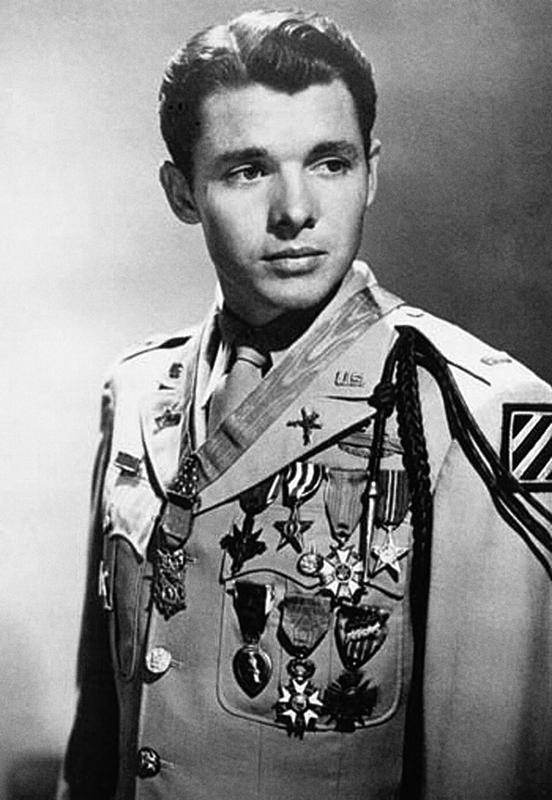
Audie Murphy
Born June 20, 1925, Kingston, Texas · Died May 28, 1971, Near Roanoke, Virginia (plane crash, Brush Mountain) · North Hollywood Lodge No. 542, California
Audie Murphy earned the Medal of Honor in World War II, starred in To Hell and Back and spoke openly about the lasting effects of combat stress.
A Hunt County Childhood, and an Army Enlistment
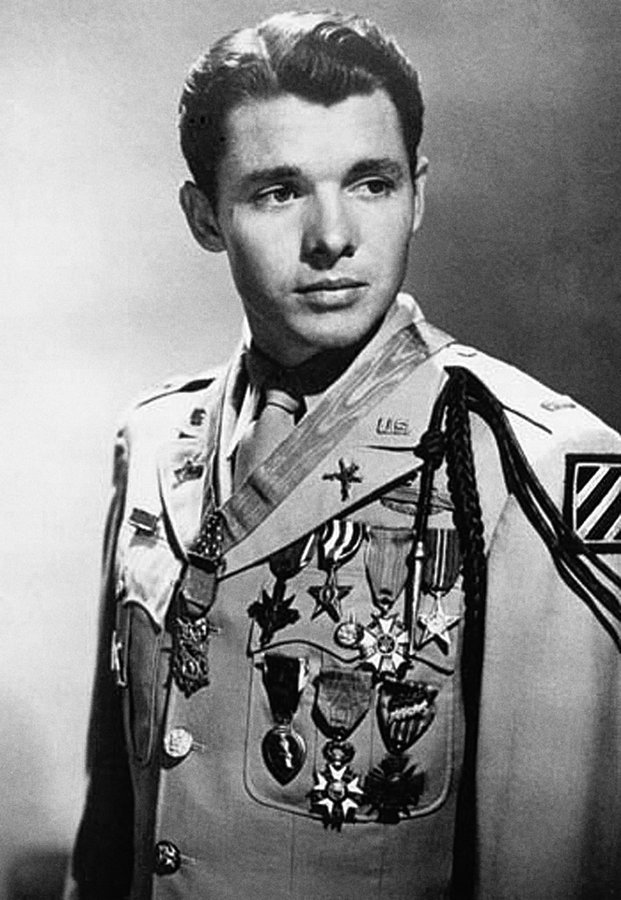
Audie Leon Murphy was born on June 20 near Kingston, in Hunt County, Texas. He was the seventh of twelve children of Emmett and Josie Murphy. His father, a sharecropper, eventually left; his mother raised the children largely on her own. Murphy entered first grade at age nine, left school during the fifth grade, and took whatever work he could find — picking cotton, pulling corn — to help feed the household. Hunting supplied food and trained his marksmanship: ammunition was costly, and a missed shot could mean an empty table.
His mother, the person he later said he loved most, died in 1941, just days before her fiftieth birthday. After the attack on Pearl Harbor he sought military service, but he stood only 5 feet 5 inches tall and weighed about 110 pounds, and the Marines and the Army paratroopers turned him away. With help from his sister Corrine, he enlisted in the Army on June 30, 1942, at Greenville, Texas. After training at Camp Wolters, Texas, and Fort Meade, Maryland, he arrived in North Africa the following year as a private in Company B, 15th Infantry Regiment, Third Infantry Division.
He fought in eight campaigns in Sicily, Italy, France and Germany, took part in amphibious assaults in Sicily and southern France, and was wounded three times. Promotions followed, including a battlefield promotion to second lieutenant; he later commanded Company B. Asked about courage, he pointed not to glory but to the men beside him. “Loyalty to your comrades, when you come right down to it, has more to do with bravery in battle than even patriotism does,” he said.
On a Burning Tank Destroyer at Holtzwihr
On January 26, 1945, near Holtzwihr, France, Second Lieutenant Murphy’s company was attacked by six German tanks and waves of infantry. He ordered his men back to prepared positions in a woods and remained forward at his command post, directing artillery fire by telephone. An American tank destroyer behind him received a direct hit and began to burn; its crew withdrew. With the enemy tanks abreast of his position, Murphy climbed onto the burning vehicle, which was in danger of blowing up at any moment, and used its .50-caliber machine gun against the advancing infantry. He was alone and exposed to fire from three sides.
He continued firing for about an hour. German soldiers came as close as ten yards. He received a leg wound and ignored it, and when his ammunition ran out he made his way back to his company, refused medical attention, and organized a counterattack that forced the Germans to withdraw. He was credited with killing or wounding about fifty of the enemy and with saving his company from possible encirclement. The Medal of Honor was presented to him on June 2, 1945, at an airfield near Werfen, Austria, by Lieutenant General Alexander M. Patch. In all he received thirty-three awards, citations and decorations. By the war’s end he had received every American Army combat award for valor available during his service, as well as decorations from France and Belgium — a distinction that sat uncomfortably with him. “I never liked being called the ‘most decorated’ soldier,” he said. “There were so many guys who should have gotten medals and never did — guys who were killed.” He was discharged at Fort Sam Houston, in San Antonio, on August 17, 1945.
To Hell and Back, and a Voice for Veterans
After the war he built an acting career, with a first starring role in Bad Boy in 1949. His autobiography, To Hell and Back, written with David McClure, appeared that year and became a best seller. Murphy played himself in the 1955 film adaptation, which became one of Universal’s most successful pictures of the decade and held the studio’s highest-grossing record until Jaws in 1975. His other films included The Red Badge of Courage (1951) and The Unforgiven (1960). He appeared in more than forty feature films. In 1955 American theater owners named him one of the year’s most popular Western stars, and in 1957 British audiences chose him as their favorite Western actor. He starred opposite James Stewart in Night Passage (1957).
His writing extended beyond the memoir. He published poetry and co-wrote seventeen country-and-western songs, including “Shutters and Boards” and “When the Wind Blows in Chicago,” recorded by singers including Dean Martin, Porter Wagoner and Eddy Arnold; both spent weeks in the Top 10 on the Hit Parade. He also bred racehorses. In 1949 he married the actress Wanda Hendrix; they divorced two years later. In 1951 he married Pamela Archer, a stewardess for Braniff Airlines, and they had two sons. In 1950 he joined the 36th Division of the Texas National Guard as a captain, hoping to serve in the Korean War; the division was not called to active duty. He later attained the rank of major, went to inactive status in 1957, and transferred to the Army Reserve in 1966, remaining there until his death.
Away from the screen, he spoke candidly about the combat stress then commonly called battle fatigue, in an effort to draw attention to the problems faced by veterans returning from Korea and Vietnam. “People are very quick to ridicule others for showing fear,” he said. “But we rarely know the secret springboards behind human action. The man who shows great fear today may be tomorrow’s hero.”
A Theater Owner’s Nudge, and North Hollywood Lodge No. 542
Encouraged by a friend, the Texas theater owner Skipper Cherry, Murphy petitioned a California lodge in 1955. He received his degrees in North Hollywood Lodge No. 542: initiation on February 14, passing on April 4, and raising on June 27. He became a dual member of Heritage Lodge No. 764 on May 14, 1956. In November 1957, at the Scottish Rite Temple in Dallas, he completed the degrees through the Thirty-second Degree and, the next day, became a Shriner in Dallas’s Hella Temple. He was decorated a Knight Commander of the Court of Honor on December 11, 1965. In the spring of 1971 he affiliated with the Long Beach Scottish Rite and with Al Malaikah Temple in Los Angeles.
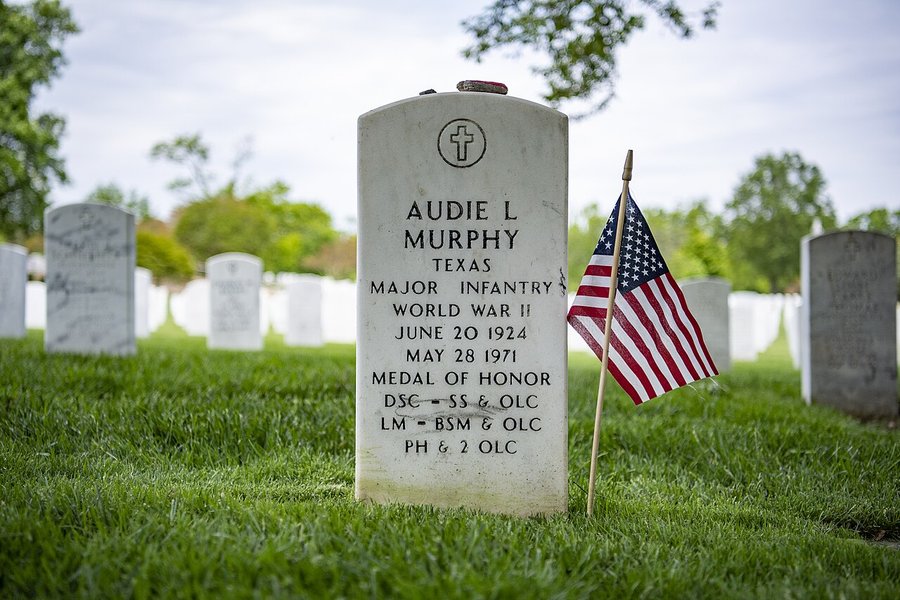
He often took part in Shrine parades in Texas and California. One of his last public speeches was at a Mariner’s Night dinner sponsored by Los Angeles Harbor Lodge No. 332, on April 15, 1971. He was killed in a plane crash in Virginia on May 28, 1971, and his body was not found until three days later. Two funeral services were held on June 4, one at Hollywood Hills, California, and one at the First Baptist Church in Farmersville, Texas. He was buried with full military honors at Arlington National Cemetery on June 7, near the Tomb of the Unknown Soldier. Months after his death, on November 19, 1971, the Long Beach Scottish Rite Bodies graduated their 111th class, 124 men from forty-five California cities and towns, as the “Audie Murphy Memorial Class,” and screened To Hell and Back for them. The Scottish Rite later elected him posthumously to the Thirty-third Degree, and in November 2000 members of the Valley of Long Beach presented a Thirty-third Degree cap to his widow, Pamela.
Texas kept remembering him. A new veterans hospital in San Antonio was dedicated in 1973 as the Audie L. Murphy Memorial Veterans Hospital. On June 20, 1996, the Texas Legislature declared his birthday Audie Murphy Day, and that year he entered the Western Performers Hall of Fame in Oklahoma City. On October 29, 2013, in Farmersville, Governor Rick Perry posthumously awarded him the Texas Legislative Medal of Honor, the state’s highest military honor; his last surviving sibling, Nadine Murphy-Lockey, accepted it.
How did Murphy’s willingness to discuss combat stress change what other veterans could say about coming home?
Sources
- National Medal of Honor Museum — Audie Murphy: From Boyhood to Battlefield—and the Big Screen
- Congressional Medal of Honor Society — Audie Leon Murphy
- Handbook of Texas — Murphy, Audie Leon
- Grand Lodge of British Columbia and Yukon — Audie Leon Murphy
- Audie L. Murphy Memorial Website — Audie and Masonry
Life & Masonic Timeline
U.S. Army (http://www.detrick.army.mil/samc/index.cfm), via Wikimedia Commons · Public domain · Source