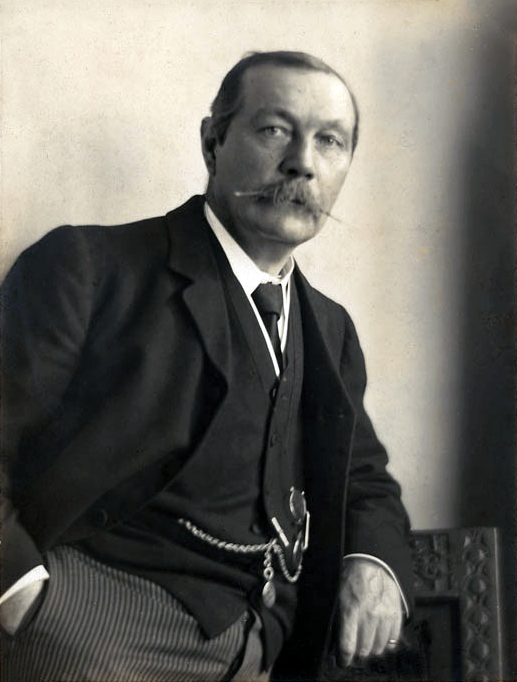
Sir Arthur Conan Doyle
Born May 22, 1859, Edinburgh, Scotland · Died July 7, 1930, Crowborough, East Sussex, England · Phoenix Lodge No. 257, Southsea
Arthur Conan Doyle created Sherlock Holmes, wrote historical fiction and campaigned on public causes after beginning his career as a physician.
The highest morality may prove also to be the highest wisdom when the half-told story comes to be finished.
An Edinburgh Student Who Watched Joseph Bell Diagnose a Stranger
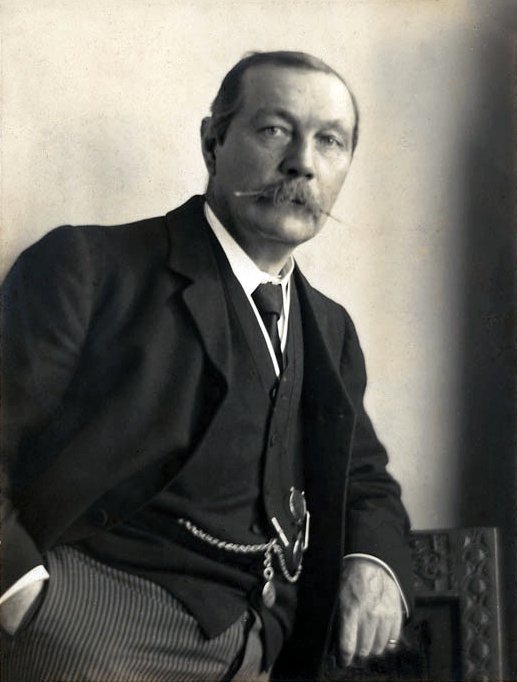
Arthur Conan Doyle was born on May 22, 1859, at Picardy Place in Edinburgh, the son of Charles and Mary Doyle and the grandson, on his father’s side, of the caricaturist John Doyle, known as “H. B.” The family often struggled; Charles’s work as an artist was shortened by illness, and from the age of nine Arthur was sent away to school. He studied medicine at the University of Edinburgh, taking his degree in 1881. Among his teachers was Joseph Bell, a surgeon at the Edinburgh Infirmary whose gift was diagnosis, not only of disease but of occupation and character. As Bell’s outpatient clerk, Conan Doyle watched him learn more from a few glances than the students had from their questions. In one case Bell told a civilian patient that he had served in a Highland regiment, had not long been discharged, had been a non-commissioned officer and had been stationed at Barbados—deductions he then explained from the man’s bearing, his accent and the West Indian character of his complaint. Conan Doyle later wrote that he used and amplified those methods when he created Sherlock Holmes.
In 1880, still a third-year student, he spent seven months as surgeon on the Arctic whaler Hope, under Captain John Gray, and after graduation took medical charge of the steamer Mayumba, which left Liverpool for the West African coast on October 22, 1881. He then settled at Southsea, on the English south coast, where patients were scarce and the waiting hours in the consulting room left time to write. Early short stories earned him, on average, only a few pounds each, and no more than ten or fifteen pounds a year.
Holmes in the Strand, the Reichenbach Falls, and Skis at Davos
A Study in Scarlet appeared in Beeton’s Christmas Annual in 1887. When The Strand Magazine was launched, Conan Doyle proposed a single character running through a series of short stories, so that a reader who cared about that character would return to the magazine. He wrote the Holmes stories in those long hours of waiting; Greenhough Smith, the editor, liked them from the first. Their success allowed Conan Doyle to give up medical practice. Wanting to concentrate on historical novels such as The White Company and on other work, he decided, on a holiday in Switzerland with his wife, that the Reichenbach Falls would make “a worthy tomb for poor Sherlock.” “The Final Problem,” in 1893, sent Holmes over the falls. The public protest amazed him: some readers wore black armbands, and others wrote angry letters.
The Hound of the Baskervilles brought Holmes back into print in 1901, with events set before his apparent death. “The Empty House,” published in The Strand in 1903, revealed that he had survived. The complete Holmes series ran to fifty-six short stories as well as the novels. Other fiction included The Lost World; his nonfiction included The Great Boer War and, later, a history of the First World War. His first wife, Louise, mother of their children Mary and Kingsley, was diagnosed with tuberculosis in 1893 and died in 1906. He married Jean Leckie on September 18, 1907, and they had three children.
Louise’s illness took the family to Davos, in the Swiss Alps. There, in the winter of 1894, having read Fridtjof Nansen’s account of crossing Greenland, he sent to Norway for skis. With Tobias Branger, a sporting tradesman in the village, and Branger’s brother, he spent weeks tumbling in front of amused onlookers before the three climbed the Jacobshorn, opposite the Davos Hotel. They then crossed a high pass to Arosa, in the next valley, which in winter could otherwise be reached only by a long, roundabout railway journey. On one steep descent his skis shot from under him and vanished down the slope, and he had no choice but to slide over the edge after them. At the hotel, Branger entered his profession in the register as “Sportes-mann,” which he took as a compliment. He believed those excursions first showed the Swiss what skis could do.
Langman’s Hospital, a Knighthood, and Two Campaigns for the Wrongly Convicted
Rejected for military service in the South African War, he volunteered in 1900 as a doctor with John Langman’s field hospital and served at Bloemfontein. He later wrote a short pamphlet, The Cause and Conduct of the War in South Africa, a concise defense of the British position; he believed that work, rather than the longer history, led to his knighthood in 1902 and to his appointment as deputy lieutenant of Surrey. He received the accolade at Buckingham Palace that year. He also stood unsuccessfully for Parliament twice, once at Edinburgh and once in the Border Burghs, in seats that experts considered unwinnable.
In late 1906 he read, in a paper called The Umpire, a statement by George Edalji, a young law student and the son of the vicar of Great Wyrley, who had been convicted in 1903 of a series of horse-maimings and sentenced to seven years. The evidence, Conan Doyle thought, was incredibly weak. He went to Staffordshire, walked the ground, studied the trial and began a series of articles in the Daily Telegraph on January 12, 1907, bargaining that they should be free of copyright so that other papers could reprint them. The campaign, he later wrote, ended “in partially rectifying a very serious miscarriage of justice.” He then took up, reluctantly at first, the case of Oscar Slater, convicted in Scotland of the 1908 murder of Miss Gilchrist, an elderly woman in Glasgow. Having looked at the facts, he was convinced that Slater “had in all probability no more to do with the murder… than I had.” When Conan Doyle published his memoirs in 1924, Slater was still in prison.
In later years he became a leading public advocate of spiritualism, and his support for photographs presented as evidence of fairies drew as much criticism as attention. He had earlier warned, in essays and stories, against German militarism and had written about a Channel tunnel, submarines and airships. Much of his final public work and expenditure went toward arguing that communication with the dead was possible. He died of a heart attack at Crowborough on July 7, 1930.
Phoenix Lodge No. 257, Southsea
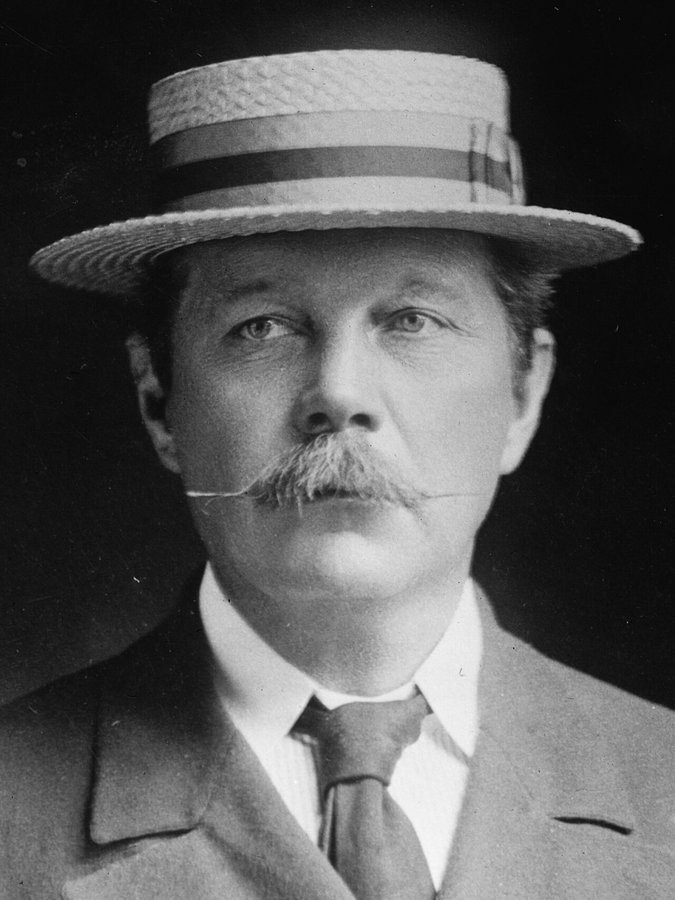
Conan Doyle was initiated in Phoenix Lodge No. 257, at Southsea, on January 26, 1887, passed on February 23 and raised on March 23—the same year Holmes first appeared in print. He demitted in 1889, rejoined in 1902 and demitted again in 1911. Masonic references occur in his fiction, though they are not central to the plots.
How do Conan Doyle’s campaigns against wrongful convictions change the way you read Sherlock Holmes?
Sources
- Arthur Conan Doyle, Memories and Adventures (1924), Project Gutenberg
- British Broadcasting Corporation — Sir Arthur Conan Doyle
- British Broadcasting Corporation — Arthur Conan Doyle biography
- Grand Lodge of British Columbia and Yukon — Sir Arthur Conan Doyle
Life & Masonic Timeline
Walter Benington, via Wikimedia Commons · Public domain · Source