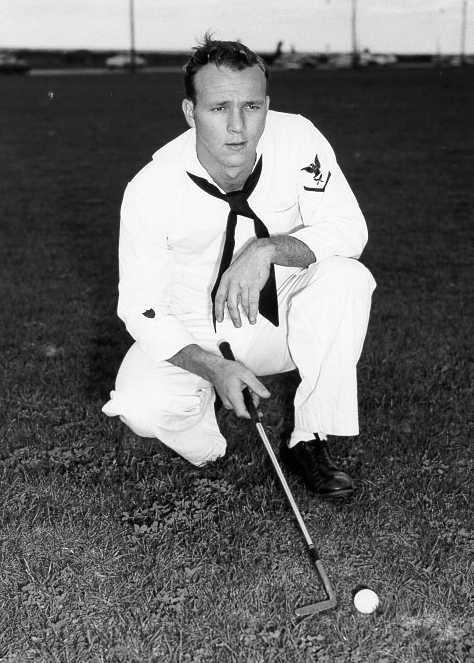
Arnold Palmer
Born September 10, 1929, Latrobe, Pennsylvania · Died September 25, 2016, Pittsburgh, Pennsylvania · Loyalhanna Lodge No. 275, Latrobe, Pennsylvania
Arnold Palmer won major golf championships and helped bring the game to a mass television audience, followed by his devoted Arnie’s Army.
A Greenskeeper’s Son from Latrobe
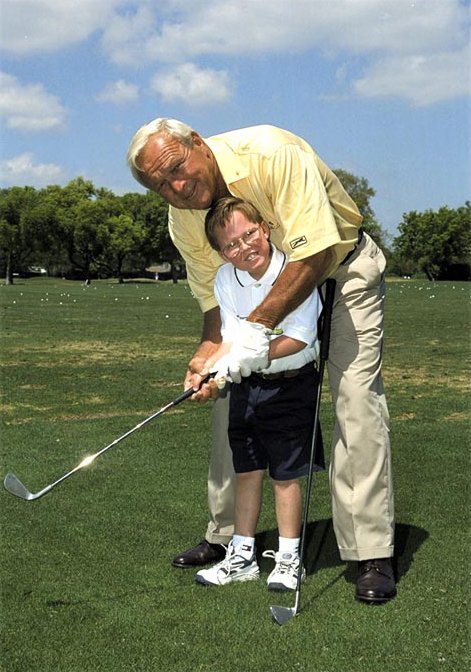
Arnold Daniel Palmer was born on September 10, 1929, in Latrobe, Pennsylvania, a steel-mill town in the west of the state, to Doris and Milfred Jerome “Deacon” Palmer. His father worked at Latrobe Country Club from 1921 until his death in 1976, as the greenskeeper of a course that only members were allowed to play. Deacon taught his son to hit a golf ball when the boy was four. Arnold later went with his mother to the club after dark, and at eleven he became a caddie. He won the Pennsylvania high-school championship twice and, at seventeen, the first of five West Penn Amateur titles. A golf scholarship took him to Wake Forest College, where he became one of the leading collegiate players.
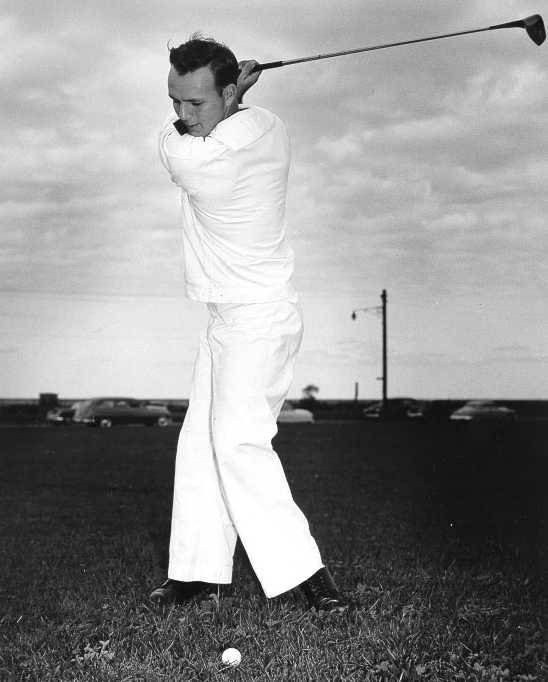
In 1950 his close friend Bud Worsham was killed in a car accident. Palmer left Wake Forest without a degree and enlisted in the United States Coast Guard, serving from 1951 to 1954. At basic training in Cape May, New Jersey, he built a simple nine-hole pitch-and-putt course. Toward the end of his service he was assigned to the Ninth District Headquarters in Cleveland, near Pine Ridge Country Club, where he could practice. In 1953 he returned to competition, won the Ohio Amateur twice, and in 1954 won the United States Amateur Championship in Detroit. That victory decided him to turn professional. Not long afterward he met Winifred Walzer at a tournament in eastern Pennsylvania; they married in 1954, had two daughters, Peggy and Amy, and remained together until her death from cancer in 1999. Of his choice of work he later said, “What other people find in poetry, I find in the flight of a good drive.”
Seven Majors, and the Opening of the British Open to American Stars
Palmer won 62 PGA Tour titles between 1955 and 1973, and 92 professional championships in all. His major victories were the Masters Tournament in 1958, 1960, 1962 and 1964; the United States Open in 1960; and the Open Championship, often called the British Open, in 1961 and 1962. From 1960 to 1963 he won 29 titles. An Associated Press poll named him Athlete of the Decade for the 1960s, and in 1960 Sports Illustrated named him Sportsman of the Year. He remains fifth on the PGA Tour’s list of winners and was one of the World Golf Hall of Fame’s original thirteen inductees. He was among the game’s first television stars, and his career in golf stretched over more than six decades.
The win that made the legend came at Cherry Hills, outside Denver, in the 1960 United States Open. Palmer, who had won the Masters that April, began the final round seven shots behind the leader. In the locker room he asked his friend Bob Drum, a Pittsburgh sportswriter, what a 65 might do for him. “For you, nothing,” Drum said. “You are too far back.” Palmer drove the green of the 346-yard first hole, birdied the first four holes and six of the first seven, and finished with that 65 for a total of 280. Ben Hogan, chasing a record fifth Open, found the water at the seventeenth, and a twenty-year-old amateur named Jack Nicklaus finished second, two strokes back.
At a time when many American professionals paid little attention to playing abroad, he entered the Open Championship in 1960, finished second, and came back to win it the next two years. Those appearances almost single-handedly drew American attention back to the oldest of the majors. He competed in fifty consecutive Masters Tournaments before retiring from competitive golf in 2006. After Palmer’s death, Jack Nicklaus said that he “took the game from one level to a higher level, virtually by himself.”
Arnie’s Army, and a Business Built on the Fairway
His galleries became known as “Arnie’s Army.” The name first belonged to soldiers stationed at Augusta National during the 1959 Masters, then became the name of his following. President George W. Bush, presenting him the Presidential Medal of Freedom on June 23, 2004, recalled the announcer Vin Scully’s remark that “In a sport that was high society, Arnold Palmer made it ‘High Noon,’” and said that every large gallery at a golf tournament since had started with Arnie’s Army. Palmer was known for signing autographs and taking time for a handshake, and his television presence helped carry golf beyond the private clubs where he had first learned the game.
Arnold Palmer Enterprises grew into a global business with a hand in country clubs, automobile and aviation firms, the founding of the Golf Channel, and an iced-tea drink that still bears his name. He designed more than 300 golf courses in 37 states, 25 countries and five continents. In 2009 he received the Congressional Gold Medal, one of the few athletes to hold both that medal and the Medal of Freedom.
He was also a serious pilot. He took his first flying lessons in 1956 at the Latrobe airfield, less than a mile from where he was born, and over fifty-five years in the cockpit logged nearly 20,000 hours and owned ten aircraft. In May 1976, flying a Learjet 36 with the pilots James Bir and Lewis Purkey, he left Denver heading east and returned two days, nine hours, 25 minutes and 42 seconds later, a round-the-world record for a business jet that the American Revolution Bicentennial Administration recognized as a bicentennial event. In 1999 the county airport where he had learned to fly was renamed Arnold Palmer Regional Airport.
Loyalhanna Lodge No. 275, and the Hospitals That Bear His Name
Palmer was raised a Master Mason in 1959 at Loyalhanna Lodge No. 275 in Latrobe, and remained a member for many years. In 1997 he received the thirty-third degree in the Scottish Rite’s Northern Masonic Jurisdiction. In 2010 that jurisdiction awarded him the Gourgas Medal. In the same year as his thirty-third degree he was diagnosed with prostate cancer, underwent surgery, and afterwards spoke publicly for cancer research and early detection, supporting programs at the University of Pittsburgh Medical Center and at Latrobe Area Hospital, whose board he served on for many years.
For twenty years he was honorary national chairman of the March of Dimes Birth Defects Foundation. He also helped raise funds for the Arnold Palmer Hospital for Children and Women in Orlando, Florida, and, with his first wife, supported youth and health work through the Arnold and Winnie Palmer Foundation. In 2005 he married Kathleen Gawthrop. He died on September 25, 2016, at the University of Pittsburgh Medical Center, at the age of eighty-seven.
What made Palmer’s relationship with his spectators different from that of other champions?
Sources
- Grand Lodge of Ohio — The King: Arnold Palmer
- Scottish Rite, Northern Masonic Jurisdiction — The Life and Career of Brother Arnold Palmer
- President George W. Bush, remarks at the Presidential Medal of Freedom ceremony, June 23, 2004
- Cherry Hills Country Club — Club History
- National Archives, The Text Message — Arnold Palmer: Record-setting Round-the-world Flyer
- Arnold Palmer Regional Airport — Arnold Palmer and LBE
Life & Masonic Timeline
U.S. Coast Guard, via Wikimedia Commons · Public domain · Source