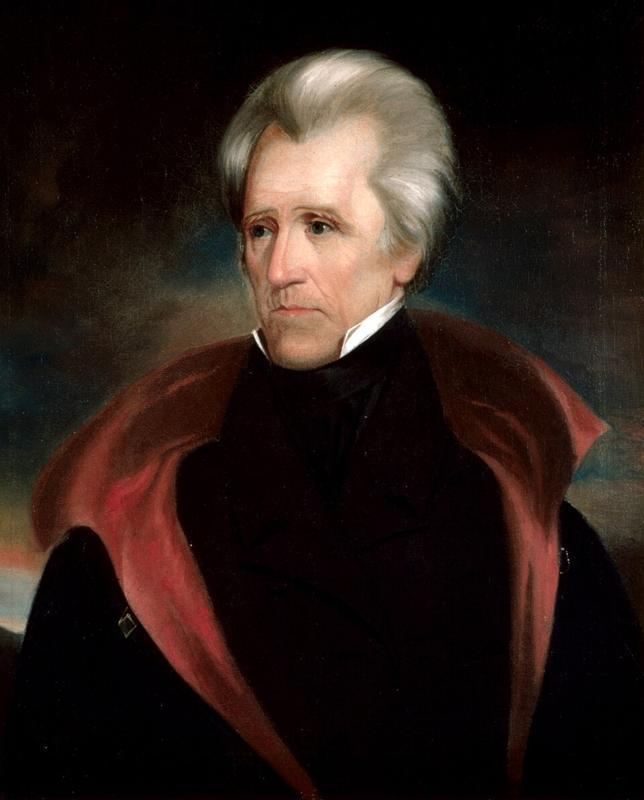
Andrew Jackson
Born March 15, 1767, Waxhaws region, Carolinas · Died June 8, 1845, The Hermitage, Nashville, Tennessee · Harmony Lodge No. 1 (formerly St. Tammany Lodge No. 1), Nashville, TN
Andrew Jackson won the Battle of New Orleans and reshaped presidential politics, while his Indian Removal policy inflicted lasting harm on Native peoples.
Eternal vigilance by the people is the price of liberty, and that you must pay the price if you wish to secure the blessing.
An Orphan of the Waxhaws, a Nashville Lawyer, and Old Hickory
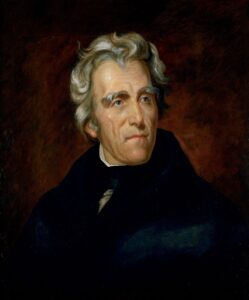
Andrew Jackson was born on March 15, 1767, in the Waxhaw settlement along the border of North and South Carolina, a few months after his father died. He considered himself a South Carolinian. His mother, Elizabeth, raised Andrew and his brothers Hugh and Robert among Scots-Irish farmers. The Revolutionary War ended his childhood. Hugh died after fighting at Stono Ferry. Andrew and Robert, still boys, fought with American irregulars, were captured in 1781, and contracted smallpox; Robert died after their release. Their mother died later that year of cholera in Charleston while nursing sick relatives. Jackson was fourteen and alone. He carried a scar on his head from a British officer’s sword. He drifted, taught school briefly, and read law in Salisbury, North Carolina. Licensed in 1787, he crossed the mountains in October 1788 to serve as prosecutor for the Mero District, with its seat at Nashville.
He built a legal practice, entered trading ventures, and began to acquire land and enslaved people. In 1791 he began living with Rachel Donelson Robards, who was separated from her husband; they married formally in 1794 after her divorce. Charges arising from that episode followed him into presidential politics. Within a decade he had been Tennessee’s first member of the House of Representatives, a United States senator, and a judge of the state’s Superior Court. In 1802 he became major general of the Tennessee militia. He was a hard man to cross: in May 1806 he killed Charles Dickinson in a duel, and in September 1813 he took a bullet in the arm in a Nashville brawl with Thomas Hart Benton and Jesse Benton.
In the War of 1812, when the War Department ordered his Tennessee volunteers dismissed at Natchez, far from home, Jackson refused to abandon them and marched them back himself. The hardships of that march earned him the name “Old Hickory.” He defeated Creek forces at Talladega in November 1813 and at Horseshoe Bend in March 1814, and imposed treaties that transferred millions of acres. On January 8, 1815, a few weeks after American and British diplomats had signed the Treaty of Ghent, he routed a British army at New Orleans and became a national hero. In 1818 he led an army after Seminole fighters into Spanish Florida; in 1819 Spain ceded the territory, and Jackson served briefly as its territorial governor, then as a senator from Tennessee from 1823 to 1825.
Two Elections, the Bank, Nullification, and Indian Removal
In the four-candidate race of 1824, Jackson led the popular and electoral vote but lost in the House of Representatives, where Speaker Henry Clay’s influence helped elect John Quincy Adams. Jackson defeated Adams in 1828, in a campaign that attacked Jackson’s marriage and that he later believed contributed to Rachel’s death at The Hermitage before he left for Washington. He took office in March 1829. They had no children of their own; Rachel’s nephews were treated as sons, and Sarah Yorke Jackson and Emily Donelson served as White House hostesses. Jackson easily defeated Clay in 1832 and left office in 1837.
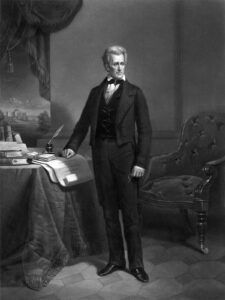
He vetoed the recharter of the Second Bank of the United States, which he treated as a government-supported monopoly, and he used “rotation in office” to replace many officials, a practice that also rewarded political supporters. When South Carolina declared the tariff null and void, Jackson acted to uphold federal authority. At a dinner in 1830 he toasted, looking at John C. Calhoun, “Our federal Union: It must be preserved.” He signed the Indian Removal Act of 1830 and pressed Native nations—among them the Cherokee, Chickasaw, Choctaw, and Creek—into treaties that transferred land and compelled removal west of the Mississippi. The relocation resulted in the deaths of tens of thousands. The forced Cherokee exodus became known as the Trail of Tears. Jackson owned enslaved people at The Hermitage for most of his adult life, brought enslaved workers to the White House, and continued to purchase people while he was president.
He fought the Bank War to the end. His 1832 veto message set the virtuous plain people against the bank’s privileged stockholders, and the next year he moved the government’s deposits from the bank to state-chartered banks, setting off a brief financial panic. The Senate censured him in 1834. Undeterred, he turned against government-granted privilege of every kind, especially corporate charters, and in his Farewell Address of 1837 warned of an insidious “money power.” He vetoed more bills than all his predecessors combined. His first Cabinet broke apart when he championed Peggy Eaton, the controversial wife of his secretary of war, a quarrel that also ruptured his relations with Vice President John C. Calhoun. In 1836 he secured the succession for his loyal lieutenant and second vice president, Martin Van Buren.
Harmony Lodge No. 1 and Grand Master of Tennessee
Jackson’s Masonic home was in Nashville. Masons there had organized St. Tammany Lodge in 1789 under a dispensation from the Grand Lodge of North Carolina, the first lodge in what became Tennessee; in November 1800 it took the name Harmony Lodge No. 1. Jackson’s name appears on its rolls as a member in 1805. From the sources we do have, it is believed that he received his Craft degrees there; the dates of his initiation, passing and raising are not known. In 1822 the Grand Lodge of Tennessee elected him Grand Master. A eulogy later recalled that “in the years 1822 and 1823, he presided,” and that in 1824 “he was punctual on his attendance as Grand Master until his successor was elected.” In May 1825, during the Marquis de Lafayette’s tour of the United States, Jackson introduced Lafayette to the Grand Lodge of Tennessee. Only one other American president has served as Grand Master of a state grand lodge: Harry S. Truman, in Missouri.
Jackson took office as president less than three months after Rachel’s death, as the Anti-Masonic movement gathered strength after the disappearance of William Morgan from Batavia, New York, in 1826. For the 1832 election the Anti-Masonic Party nominated William Wirt. The Past Grand Master of Tennessee won a second term that November. He returned to The Hermitage in 1837 and died there on June 8, 1845, at seventy-eight. He was buried two days later in the garden beside Rachel.
How should Jackson’s Masonic leadership be remembered alongside his ownership of enslaved people and policy of Native removal?
Sources
- White House Historical Association — Andrew Jackson
- Miller Center — Andrew Jackson, Life in Brief
- Miller Center — Andrew Jackson, Life Before the Presidency
- Miller Center — Andrew Jackson, Domestic Affairs
- Tennessee Masonic Museum — Andrew Jackson
Life & Masonic Timeline
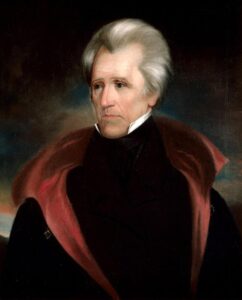
Ralph Eleaser Whiteside Earl, via Wikimedia Commons · Public domain · Source