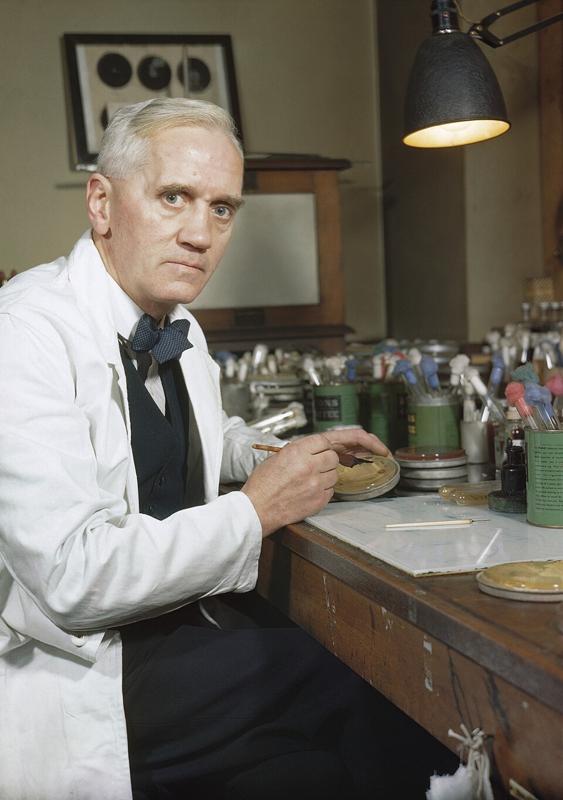
Sir Alexander Fleming
Born August 6, 1881, Darvel, Ayrshire, Scotland · Died March 11, 1955, London, England · Sancta Maria Lodge No. 2682, London
Alexander Fleming discovered penicillin’s antibacterial properties in 1928, beginning work that transformed the treatment of bacterial infections.
My only merit is that I did not neglect the observation and that I pursued the subject as a bacteriologist.
A Farm Boy from Ayrshire Who Found His Way to St Mary’s
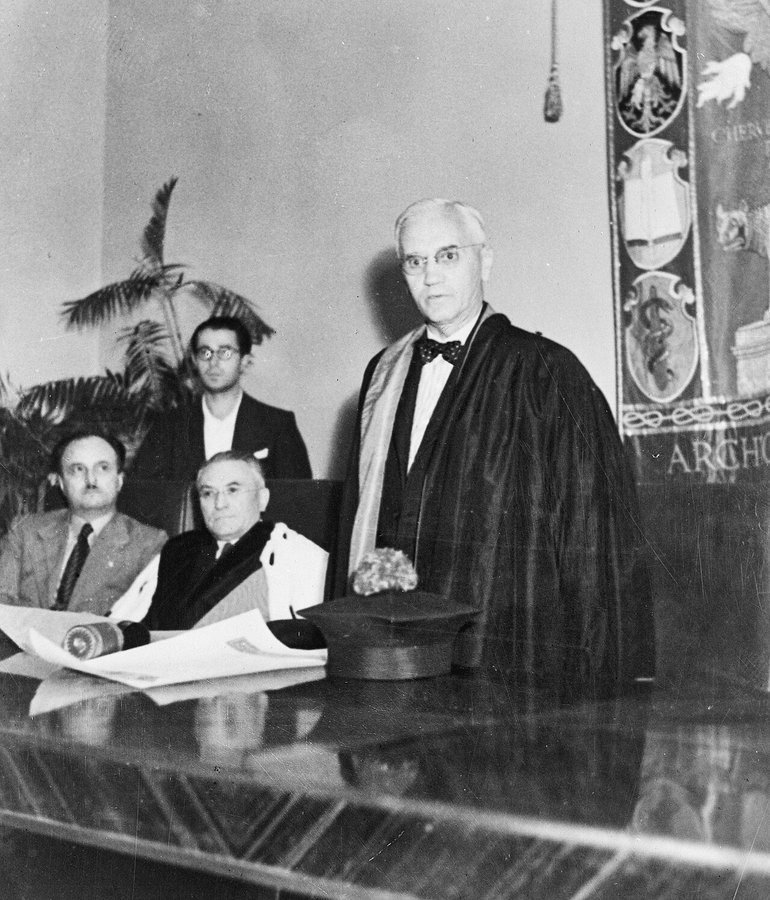
Alexander Fleming was the seventh of eight surviving children in a farming family at Lochfield, near Darvel in Ayrshire. His father died when he was seven, leaving his mother to run the farm with her eldest stepson. After Loudoun Moor School, Darvel School and Kilmarnock Academy, he followed a stepbrother who was already a practicing physician to London at the age of thirteen.
He took classes at the Regent Street Polytechnic and spent four years as a clerk in a shipping office. From 1900 to 1914 he was also a keen private in the London Scottish Regiment of the Territorial Army. In 1901 he won a scholarship to St Mary’s Hospital Medical School in Paddington, and St Mary’s remained his professional home for the rest of his life. He qualified with distinction in 1906, joined the Inoculation Department under Sir Almroth Wright, a pioneer of vaccine therapy, and in 1908 took his medical degrees with a gold medal. He lectured at St Mary’s until the First World War.
A Bacteriologist Who Learned from Wounds and Tears
Wright believed in strengthening the body’s own defenses rather than attacking germs with chemicals, yet he passed Fleming samples of Salvarsan, Paul Ehrlich’s new drug for syphilis, and Fleming built a successful practice administering it. During the war he served as a captain in the Army Medical Corps, was mentioned in dispatches and worked in Wright’s wound-research laboratory at Boulogne in France. There he showed that the chemical antiseptics of the day, such as carbolic acid, did not sterilize jagged wounds, and that in dilutions too weak to harm bacteria they still damaged the white blood cells that were the body’s first line of defense.
Back at St Mary’s in 1918, he looked for antibacterial substances that would not harm living tissue. In 1921 he found one in nasal mucus that caused bacteria to dissolve, and he and a colleague went on to detect it in tears, saliva, blood serum, milk and egg white. He named it lysozyme. A fraction of a drop of tears could clear a milky suspension of bacteria in seconds, but lysozyme worked best against microbes that do not infect people. The laboratory methods he devised to measure it, however, were exactly the tools he would need seven years later.
The Mould He Did Not Neglect
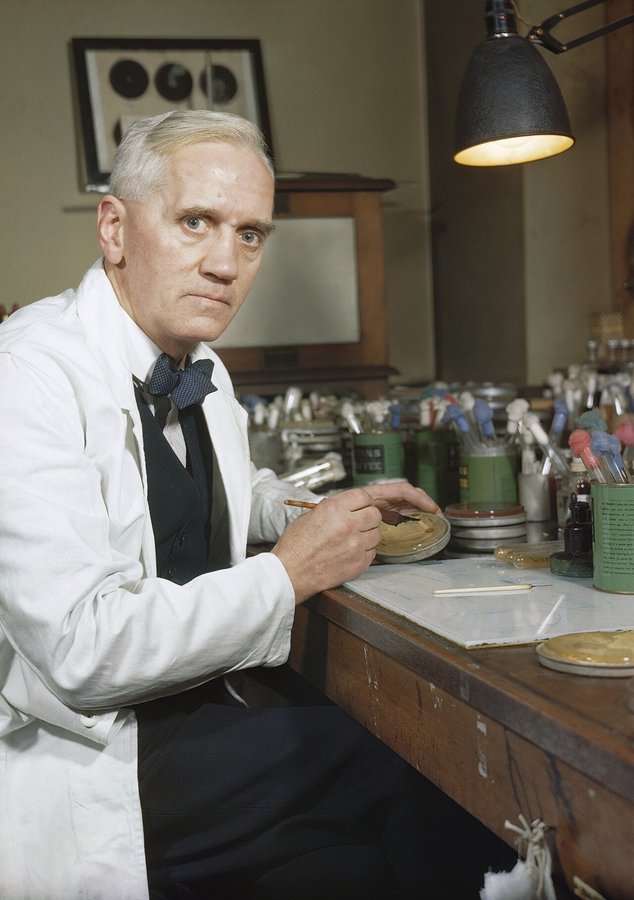
In 1928, while investigating staphylococcus, Fleming left a culture plate on his bench rather than in the incubator before going away for two weeks. A spore of Penicillium mould had found its way onto the plate, and when he returned he saw that the bacterial colonies around the mould had become translucent and were breaking down. He isolated the mould, showed that only certain strains produced the effect, and found that the fluid it grew in stopped staphylococci even when diluted 800 times. Following the custom by which digitalin was named for the Digitalis plant, he called the substance penicillin.
He tested it against many common germs and found that some of the most frequent causes of human infection were strongly inhibited, while it seemed harmless to animals and to human blood cells. Yet he could not concentrate or stabilize it, and he used it mainly as a laboratory tool for separating one kind of bacteria from another. His 1929 paper in the British Journal of Experimental Pathology attracted little notice. In 1940 Howard Florey and Ernst Chain at Oxford showed that purified penicillin could treat a wide range of bacterial infections, and wartime production followed.
His own accounts of the discovery do not agree. His laboratory notebooks are sketchy. The spore may have drifted in through a window or, more likely, up a stairwell from a laboratory below where moulds were being cultured, and it grew only because the dish had been left out of the incubator. The photograph he took of the first culture suggests he saw bacteria being destroyed, as in his lysozyme work, but at other times he described a clear zone where their growth had been prevented. Having run many experiments since, he probably forgot which observation came first. One puzzle remains: he tested the fluid’s toxicity on a mouse and a rabbit but never infected animals first and then treated them. Believing that cures came from within the body, he saw penicillin more as a topical antiseptic than as a cure.
Fleming never claimed more than his share. In his Nobel lecture he said that he might have presented the discovery as the result of deep study, but “that would have been untrue and I preferred to tell the truth that penicillin started as a chance observation.” In the same lecture he warned that people who took too little penicillin could make microbes resistant to it, and summed up the lesson plainly: “If you use penicillin, use enough.”
Honors That Followed a Quiet Professor Around the World
Fleming became a professor at St Mary’s in 1928, a Fellow of the Royal Society in 1943 and a knight in 1944. He shared the 1945 Nobel Prize in Physiology or Medicine with Chain and Florey. Honors poured in, including the United States Medal for Merit, the Grand Cross of Alphonse X the Wise from Spain and nearly thirty honorary doctorates; he was named an honorary chief of the Kiowa tribe and served as rector of Edinburgh University from 1951 to 1954.
He married Sarah Marion McElroy of Killala, Ireland, in 1915; their son became a general practitioner. After her death in 1949 he married Dr. Amalia Koutsouri-Voureka, a Greek colleague at St Mary’s, in 1953. Fleming died in London on March 11, 1955, and was buried in St Paul’s Cathedral.
Master of Two London Lodges and a Grand Officer
Fleming was initiated in 1909, at the age of twenty-seven, in Sancta Maria Lodge No. 2682 in London, while still a young researcher under Wright. Two years later he became a joining member of London Scottish Rifles Lodge No. 2310, a lodge bearing the name of the regiment in which he was then serving. He was Senior Warden of Sancta Maria Lodge in 1922 and its Master in 1924, the years between his lysozyme and penicillin discoveries.
In 1925 he joined Misericordia Lodge No. 3288 in London and served as its Master in 1935. He received London Grand Rank in 1934, was appointed Senior Grand Deacon of the United Grand Lodge of England in 1942, as penicillin was entering wartime production, and was promoted to Past Senior Grand Warden in 1948.
Why does Fleming’s discovery make more sense when read alongside the work of Chain and Florey?
Sources
- Nobel Prize in Physiology or Medicine 1945
- Nobel Prize — Sir Alexander Fleming: Biographical
- Alexander Fleming, “Penicillin,” Nobel Lecture, December 11, 1945
- Science History Institute — Alexander Fleming
- United Grand Lodge of England — Sir Alexander Fleming
Life & Masonic Timeline
Official photographer, via Wikimedia Commons · Public domain · Source