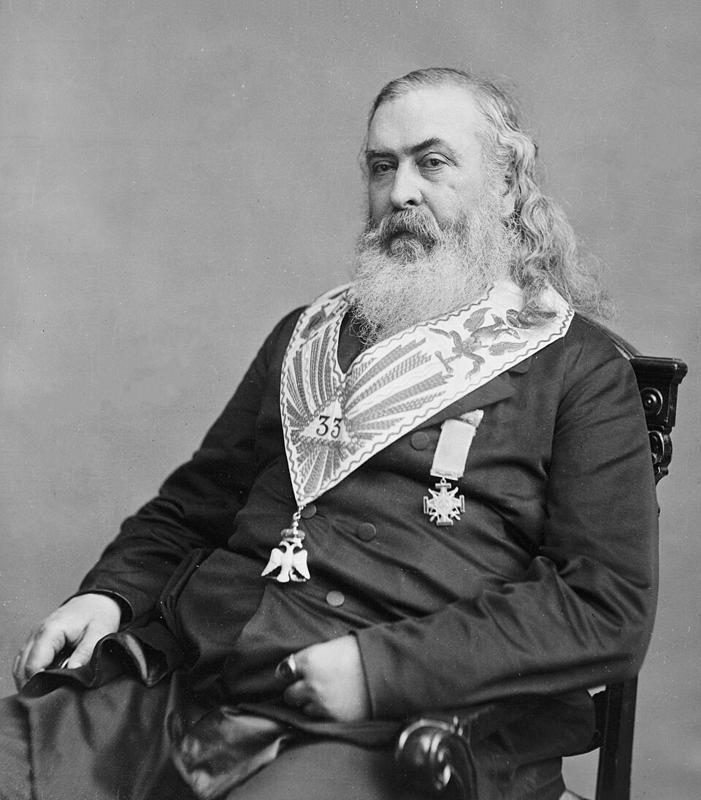
Albert Pike
Born December 29, 1809, Boston, Massachusetts · Died April 2, 1891, Washington, D.C. · Western Star Lodge No. 2, Little Rock, Arkansas
Albert Pike was a lawyer, poet and soldier who rewrote the Scottish Rite degrees and wrote Morals and Dogma, a lasting work of Masonic philosophy.
The true Mason labors for the benefit of those who are to come after him, and for the advancement and improvement of his race.
A Boston Schoolteacher Who Walked into Arkansas
Albert Pike was born in Boston on December 29, 1809, one of six children of Benjamin Pike, a cobbler, and Sarah Andrews. He attended public schools in Byfield, Newburyport and Framingham, Massachusetts, and came away grounded in classical and contemporary literature and in Hebrew, Latin and Greek. He passed Harvard’s entrance examination when he was sixteen, but could not pay the tuition and taught school instead, in Newburyport, Gloucester and Fairhaven. In 1859 Harvard awarded him an honorary Master of Arts degree “for his deep scholarship.” He wrote poetry all his life. At twenty-three he published “Hymns to the Gods,” and later poems appeared in Blackwood’s Edinburgh Magazine and in local newspapers. His first collection, Prose Sketches and Poems Written in the Western Country, appeared in 1834, and he gathered much of his verse again in Hymns to the Gods and Other Poems (1872).
In 1831 he left Massachusetts for Santa Fe, then in Mexico, and from an expedition on the plains walked to Fort Smith, where he taught for a short time. In 1833 he published anonymous newspaper letters, signed “Casca,” after one of the Roman conspirators who assassinated Julius Caesar, in support of Robert Crittenden’s candidacy for territorial delegate to Congress. The letters made his reputation across the territory and caught the eye of Charles Bertrand, owner of the Whig Arkansas Advocate, who brought him to Little Rock as its editor. He also clerked in the legislature. On October 10, 1834, he married Mary Ann Hamilton; they had six children. Her considerable means helped him buy an interest in the Advocate that year, and the next year he became its sole proprietor. He studied law while editing, was admitted to the Arkansas bar about 1836 or 1837, sold the newspaper and devoted himself to practice. In 1849 he was admitted to appear before the United States Supreme Court.
His clients included the Creek (Muscogee) and the Choctaw, whom he represented in a claim against the United States for lands taken under the Treaty of Fort Jackson; he learned several Native dialects in that work. From 1836 to 1844 he was the first reporter of the Arkansas Supreme Court, and in 1842 he issued the Arkansas Form Book for practitioners. In 1840 he was appointed receiver for the failed Arkansas State Bank, and the fees from that work secured his fortune. In 1846 he helped raise the Little Rock Guards and served as their captain under Colonel Archibald Yell in the war with Mexico. After the Battle of Buena Vista he wrote harshly of Lieutenant Colonel John Selden Roane; when Roane demanded an apology, Pike refused, and the two fought a duel on a sandbar in the Arkansas River near Fort Smith. Neither man was hit. After the war he practiced law again and wrote essay after essay promoting a railroad from New Orleans to the Pacific. In 1853 he moved to New Orleans, translated French legal volumes into English while preparing for the Louisiana bar, and won a charter from the Louisiana legislature for one of his railroad projects, before returning to Little Rock in 1857.
A Proslavery Walkout, a Confederate Command, and Pea Ridge
Pike had long been a Whig, but the party’s refusal to address slavery, and his own anti-Catholicism, led him to the Know-Nothing Party. At its 1856 national convention he walked out with other Southern delegates when the party would not adopt a strong proslavery platform. He believed in states’ rights, considered secession constitutional, and set out his position in an 1861 pamphlet, State or Province, Bond or Free? That year the Arkansas secession convention named him commissioner to Indian Territory, and in August the Confederate War Department appointed him a brigadier general there. He negotiated treaties and helped raise Native regiments, insisting they be used only to defend their own territory.
In the spring of 1862, General Earl Van Dorn ordered those troops into northwestern Arkansas, a move Pike protested as a violation of the treaties. He obeyed, but many of the Native troops refused to leave Indian Territory, and only part of his brigade marched east. At the Battle of Pea Ridge, on March 7–8, his brigade played a limited role; Federal artillery scattered the command, and many of the troops left the field. Charges circulated that Federal dead had been scalped and mutilated, and that Native troops were responsible. Pike was vigorously denounced in the North. Later that summer, after a conflict with General Thomas C. Hindman over authority in Indian Territory, Confederate authorities reprimanded him. He resigned on July 12, 1862, saying the Confederate government was violating the treaties. He retired to Greasy Cove, in Montgomery County. In 1864 he was appointed a judge of the Arkansas Supreme Court, though little is known of his work there, and on November 7 of that year he was named Grand Orator of the Grand Lodge of Arkansas.
After the war he went to New York, then briefly to Canada. President Andrew Johnson granted him amnesty on August 30, 1865. He returned to the law in Arkansas, then in 1867 moved to Memphis, where he practiced in partnership with General Charles W. Adams and edited the Memphis Appeal. While living there he may have become involved in organizing the Ku Klux Klan; from the sources we do have, that is not certain. He moved to Washington in 1870, practiced law there in partnership with the former United States senator Robert W. Johnson until 1880, and argued cases before the Supreme Court. The war had left him poor. He often borrowed from the Supreme Council of the Scottish Rite for living expenses until, in 1879, the council voted him an annuity of $1,200 a year for the rest of his life.
Sovereign Grand Commander, and a Book That Was Not the Ritual
Pike received the Entered Apprentice and Fellowcraft degrees in July 1850 in Western Star Lodge No. 2, in Little Rock, and was raised a Master Mason on November 4. That year he also took part in founding St. Johns’ College, a Masonic school in Little Rock. In 1852 he demitted to become a charter member of Magnolia Lodge No. 60 and served as its Master in 1854. He later belonged to Marion Lodge No. 68 in New Orleans, Kilwinning Lodge No. 341 in Memphis and Pentalpha Lodge No. 23 in Washington, and from 1853 onward he chaired numerous committees and boards and served as Grand Representative of four jurisdictions. He also received the York Rite degrees, helped form the Grand Chapter of Arkansas in 1851, and in 1853–54 served as its Grand High Priest.
In March 1853, in Charleston, Albert Gallatin Mackey conferred on him the Scottish Rite degrees. Mackey invited him onto the Southern Jurisdiction’s Supreme Council in 1858, and in 1859 Pike was elected Sovereign Grand Commander, an office he held until his death. Encouraged by Mackey, he began a revision of the ritual in 1855, which the Supreme Council endorsed in 1861. His Morals and Dogma, published in 1871, was a separate work of comparative philosophy and commentary, intended as a supplement to the ritual, not the ritual itself. It was given to members after the fourteenth degree until 1974, when shorter guides replaced it, and it did not govern the first three degrees of Craft Masonry. He published many other works on the order, among them Meaning of Masonry, Book of the Words and The Point Within the Circle. In later life he grew interested in Indian thought and its relation to Masonry, learned Sanskrit, translated works written in it, and published Indo-Aryan Deities and Worship as Contained in the Rig-Veda. In the chapter “Grand Pontiff” of Morals and Dogma he wrote: “The true Mason labors for the benefit of those who are to come after him, and for the advancement and improvement of his race.”
Pike died at the Scottish Rite Temple in Washington on April 2, 1891, and was first buried in Oak Hill Cemetery. On December 29, 1944, the anniversary of his birth, his body was moved to a crypt in the Temple. Fellow Masons erected a statue of him in Washington in 1901, and in Arkansas the Albert Pike Highway, the Albert Pike Hotel and the Albert Pike Memorial Temple in Little Rock bear his name; his Little Rock home still stands. Calls to remove the Washington statue began in the summer of 2017, after a white supremacist rally at Confederate monuments in Charlottesville, Virginia. It was pulled down on June 19, 2020, during nationwide protests after the murder of George Floyd. On August 4, 2025, the National Park Service announced that it was being restored, and it was reinstalled on October 25, 2025.
How should Pike’s Scottish Rite scholarship be remembered alongside his defense of slavery and secession?
Sources
- Encyclopedia of Arkansas — Albert Pike
- National Park Service, Pea Ridge National Military Park — General Pike
- Grand Lodge of British Columbia and Yukon — Albert Pike
- Grand Lodge of British Columbia and Yukon — Albert Pike biography (ritual and Morals and Dogma)
- Albert Pike, Morals and Dogma (1871), Grand Pontiff chapter, sacred-texts transcription
Life & Masonic Timeline
Mathew Benjamin Brady / Levin Corbin Handy, via Wikimedia Commons · Public domain · Source